Table of contents
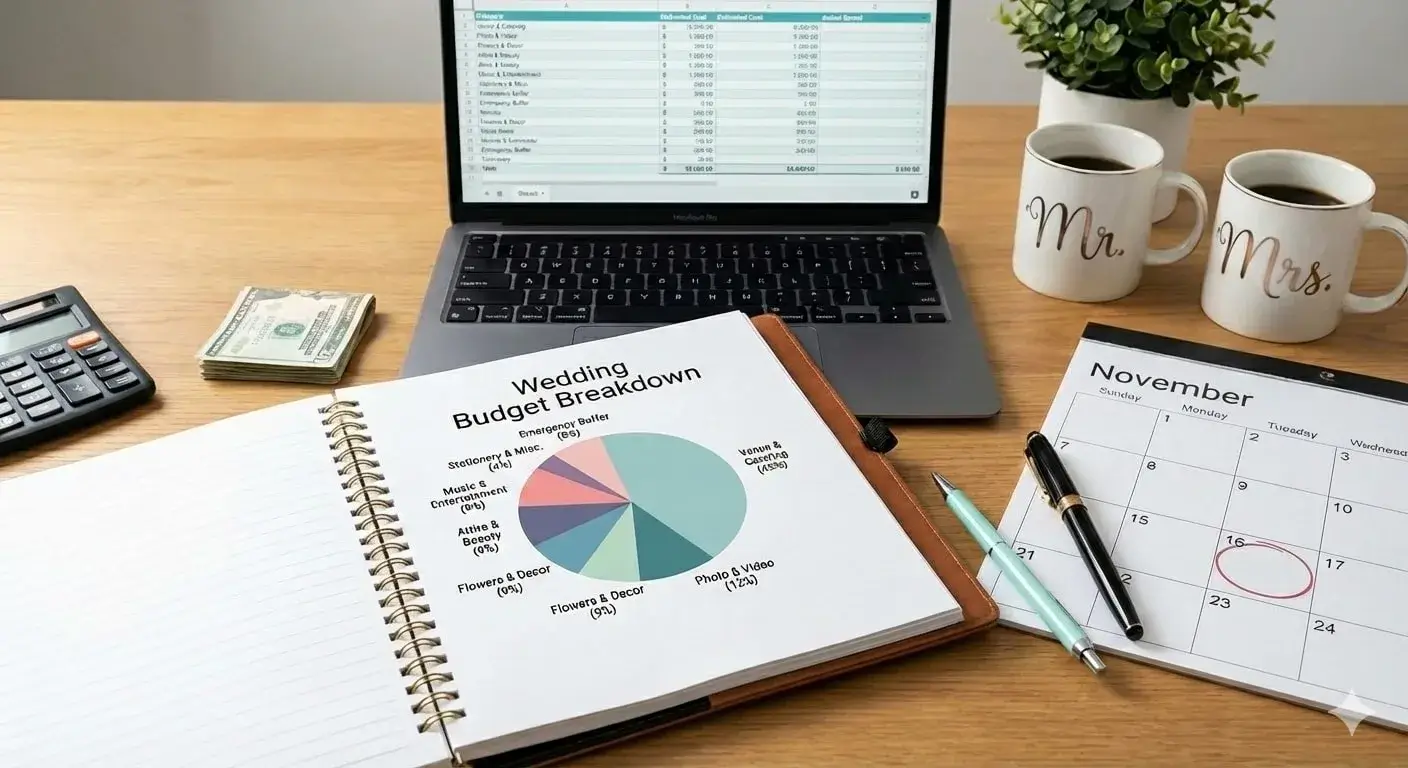
A workable split is 29% venue and rentals, 24% catering and bar, 10% photography and video, 9% flowers and decor, 6% each for music and for attire and beauty, 5% rings, and 10 to 15% held back as contingency. Those are starting points, not rules — two categories should sit high because you chose them to.
Percentages solve a specific problem. Early in planning you know your total but have no way to judge whether $3,500 for a photographer is reasonable. The answer does not depend on the photographer; it depends on what share of your budget that is.
The figures below come from The Knot Real Weddings Study 2026, which reports the actual allocation across US weddings held in 2025. Unlike per-category dollar averages, percentages are defined to add up, which is exactly what makes them usable for planning.
1. The benchmark allocation
| Category | Share | On a $30,000 budget |
|---|---|---|
| Venue and rentals | 29% | $8,700 |
| Catering, cake and drinks | 24% | $7,200 |
| Photography and video | 10% | $3,000 |
| Flowers and decor | 9% | $2,700 |
| Music | 6% | $1,800 |
| Attire and beauty | 6% | $1,800 |
| Rings | 5% | $1,500 |
| Planner | 5% | $1,500 |
| Guest entertainment | 2% | $600 |
| Transportation | 2% | $600 |
| Stationery and officiant | 2% | $600 |
That allocation reflects what US couples actually did, and it accounts for the full budget without a contingency line. Add 10 to 15% on top for contingency and tips, which is the single most common omission — see section four.
Percentages are a tool for dividing money, not a verdict on your taste. If music matters more to you than flowers, the table is wrong, not you.
2. Why half the money goes to one block
Venue plus catering and bar is 53% of the total. That concentration is structural, not a failure of discipline: it is the only large block that scales directly with guest count. Photography, attire, rings and stationery are fixed.
The practical consequence is a sequencing rule. Do not set percentages first and guest count second. Fix the guest count, work out what the scaling block costs, and see what is genuinely left to allocate; on a twelve-month plan, budget frame, guest numbers, venue and date are all settled in the first eight weeks.
What that looks like in numbers
At $80 per head all-in for catering, 120 guests consume $9,600 before the venue fee. On a $30,000 budget that leaves very little room above the benchmark. At 60 guests the same catering is $4,800, and $4,800 has moved into the discretionary part of the budget.
This is why couples who cut a category rarely solve a shortfall, while couples who cut twenty guests usually do.
Why the percentages break at smaller budgets
The benchmark allocation comes from a mid-range total. At smaller budgets it stops working, for an arithmetic reason: the fixed block — photography, attire and beauty, rings, music, officiant, stationery — does not shrink in proportion to the total. A competent full-day photographer still costs $2,500 to $3,500 whether your budget is $45,000 or $15,000.
| Total budget | Lean fixed block | Its share | Left for venue, catering and bar |
|---|---|---|---|
| $15,000 | about $8,000 | about 53% | about $7,000 |
| $30,000 | about $9,000 | about 30% | about $21,000 |
| $50,000 | about $12,000 | about 24% | about $38,000 |
That table is arithmetic rather than survey data: it holds the fixed block deliberately lean and shows what remains. The conclusion is the single most important sentence here for anyone under $20,000. At $15,000, roughly $7,000 is left for food and drink; at a realistic all-in $110 to $140 per head including service charge and tax, that is about 50 to 63 guests. Guest count is no longer a free choice at that point. It is an output of the budget.
Couples who hold on to the percentage benchmarks at a small total end up cutting in exactly the places with the least give. The better sequence is the reverse: price the fixed block as lean as you are willing to accept, then divide what remains by your marginal cost per guest. The percentage split becomes a result rather than an instruction.

3. Translating percentages into quotes
A percentage becomes useful when you hold it against real market prices. Working from a $30,000 budget and 90 guests:
- Photography and video at 10% = $3,000. The US average photographer is $3,000 and a videographer another $2,300. So the benchmark covers a photographer and nothing else. If you want both, something has to move.
- Music at 6% = $1,800. The average DJ is $1,800; the median band is $1,900 but the average is $4,500. A DJ fits exactly. A band mostly does not.
- Flowers at 9% = $2,700. The US average floral spend is $2,800 and the median $1,900. Comfortable at the median, tight at the mean.
This exercise is the real value of the method. It does not tell you that you have too little money; it tells you which decision you have to make, and it tells you now rather than three months out.
One caution on the comparison itself: national averages and your metro can differ by a factor of two. Before you conclude that a quote is high, check it against local pricing rather than against a national figure, because the benchmark that matters is the one your vendors are competing in.
Related articles
4. The four allocation mistakes
- Forgetting the service charge. Venues and caterers add 18 to 25% of the food and beverage total. On $9,000 of food and drink that is $1,600 to $2,250 — larger than most stationery, transport and officiant lines combined.
- Forgetting tips. A realistic tipping budget runs 5 to 10% of the total, or $1,500 to $3,000 on a $30,000 wedding. It is almost never in the plan and always in the outcome.
- Treating contingency as savings. It is not a line you can cut; it is the line that stops you having to cut everything else.
- Missing the bar. Alcohol is its own line, not an appendix to catering. US couples spend $2,800 on average, and $15 to $45 per person is the working range.
Together these four explain why budgets rarely fail because of one big decision. They fail because of six medium ones that were never written down.
The fifth mistake: the final invoice is larger than the contract
Four of these mistakes happen while you build the budget. The fifth happens at the end. Between the signed proposal and the closing statement there are routinely several hundred to a few thousand dollars that nobody forgot — they were simply never in the proposal.
The recurring items are predictable. Vendor meals, billed by the caterer at a reduced rate, run $30 to $60 each and there are usually four to eight people eating. Overtime: nearly every photography, music and venue contract ends at a stated hour and bills each additional hour separately, often at a premium rate. Cake cutting and corkage fees, charged per slice or per bottle when the item did not come from the house. Delivery, setup and strike for rentals and florals, which appears on the invoice rather than in the per-item pricing. Late-night and security fees imposed by the venue once the event runs past a set hour.
These are why a 10 to 15% contingency is a calculated line rather than a comfort blanket. It covers precisely the category of cost that sits, systematically, outside the quotes you compared.

5. Building your split in four steps
- Fix the total and the guest count together, not one after the other.
- Subtract contingency first. Ten to fifteen percent leaves the pot before anything is allocated.
- Name two priorities that get to sit above their benchmark share — and two that have to sit below.
- Recalculate after your first three real quotes. The percentages are a hypothesis; the quotes are data.
Expect the split to drift
By the halfway point of planning, your percentages will no longer match. That is normal rather than a planning failure: early figures are estimates and later ones are contracts. Venue and catering typically grow as service charges, overtime and rental minimums surface; decor and stationery typically shrink, because they are decided last, when the money is already committed.
Track that drift deliberately instead of letting it happen. If venue and catering end up at 60% instead of 53%, that is fine — as long as you know which category paid for it.
Apply the percentages to your own total once, test the three largest lines against real quotes, and adjust from there.
Then run the inverse check once. Total the fixed block in dollars, subtract it from your budget, and divide what is left by your all-in cost per guest. If the number that comes out is below your guest list, the split is not the problem — one of the two inputs is.
Planning your dream wedding?
Create your own wedding website in minutes – with RSVP function, photo gallery, and more.