Table of contents
This is what you will be holding while you say the most important sentences of the day, which is the argument against treating it as decoration. A6 sits steady in one hand where a loose sheet does not, eight to sixteen pages is usually enough, and foil stamping or calligraphy wants two to four weeks before you need it.
In this comprehensive guide, we dive deep into the world of wedding vow books. We discuss choosing the right materials, provide tips for content design, and explain why these small books are much more than just stationery – they are the first heirlooms of your new family. Discover how to immortalize your love on paper while perfectly blending style and tradition.
1. Aesthetics at the altar: why the medium defines the message
Visuals matter. When the photographer captures that one magical moment where you look deep into each other's eyes and read your promises, it makes a huge difference what you hold in your hands. A high-quality vow book made of handmade paper or with a fine linen cover radiates a calmness and value that a glass screen can never achieve.
Furthermore, a book offers security. In the excitement of the moment, hands can shake – a sturdy book feels much better in your hand than a single sheet of paper that might flutter in the wind. The conscious decision for an analog medium also signals: this moment is special. It is slowed down and deserves our full attention. A vow book forces you to pause, turn the page, and give each word the weight it deserves. It is the visual and tactile equivalent of your deep connection.
Words fade, but the written word remains as a testimony to your love forever.
2. Materials and tactility: from leather to handmade paper
When choosing your wedding vow books, you should not compromise. The most common and noble variants are:
- Linen Covers: Timeless, classic, and available in almost every wedding color. Linen feels natural and can be wonderfully customized with gold or silver embossing.
- Leather and Velvet: For couples who like it luxurious and rustic. Leather develops a beautiful patina over the years, while velvet adds a soft, romantic touch.
- Handmade Deckle-Edge Paper: The choice for aesthetes. The irregular edges and the texture of the paper make each book unique.
Ensure that the paper inside is thick enough so that the ink does not bleed through (at least 120g/m²). If you plan to write your vows with a fountain pen or nib, the absorbency of the paper is crucial. A good vow book should also be small enough to be held discreetly in one hand (usually A6 format or slightly narrower) but large enough to be easily readable.
3. Design tips: making your books unique
A vow book is only complete when it bears your personal touch – literally. Many couples have the cover printed with their initials, the wedding date, or simply with 'His Words' and 'Her Words' (or 'My Vows'). Hot foil stamping in gold, rose gold, or copper looks particularly elegant and fits almost any wedding concept.
A pro tip for the interior design: Draft your vows on a scrap piece of paper first and only transfer them in neat handwriting into the book when you are absolutely satisfied. Use lightfast ink for the transfer so that the writing does not fade even after decades. If you are unsure about your handwriting, you can also hire a calligrapher to work magic in the book. Some couples also paste a small photo from their engagement day on the first inside page to complete the story of the book.
Before you transfer the first line in your best handwriting, settle the length. It decides both the number of pages and the moment itself. Reading aloud at a ceremony runs at something like 100 to 120 words a minute, noticeably slower than ordinary speech. A minute and a half is therefore 150 to 180 words, two minutes 200 to 240, three minutes 300 to 360. Two vows one after the other double that: at two minutes each the ceremony stands still for four minutes, and it carries those four minutes effortlessly. At five minutes each it is ten, and the back rows notice.
How many pages that comes to is not something you estimate, it is something you measure. Write ten lines of your draft in your normal handwriting on a sheet the size of the book and count the words that fit on a page. If around 45 words go on an A6 page, then 200 words fill a good four pages. A book of eight pages is enough at that point, and one of sixteen leaves air for a paragraph that goes wrong.
With the pen, a single word on the packaging decides it: archival. Many gel and fiber-tip pens are not, and they fade in daylight within a few years. On the paper side the counterpart is acid-free and age-resistant, recognizable by the ∞ symbol and by ISO 9706. Allow for drying time as well: fountain pen ink on smooth paper needs longer than it takes you to close the cover, and a sheet of blotting paper between the pages costs nothing and saves the spread. And do not write the fair copy on the eve of the wedding, but at least three days ahead. By the evening before, your hand is already shaking.
4. The marriage vow as a family heirloom in your archive
The wedding is the starting signal for your shared family archive. While the cake has been eaten and the flowers have withered, the rings and your vow books remain. They are documents of your history. Imagine pulling these books from your archive on your tenth, twenty-fifth, or even fiftieth wedding anniversary and reading the words from back then again. It is a time capsule of emotions.
Many couples integrate these physical treasures into their digital archive by scanning the pages. This way, the words are safely protected from loss, while the original is kept securely in a memory box or safe. Passing these books on to future generations – perhaps even showing them to your children on their wedding day – gives your marriage a historical dimension. It is more than paper; it is an anchor for stormy times and a constant reminder of why you said 'I do'.
5. Checklist for buying your vow books
To ensure nothing goes wrong when buying, here is our compact checklist for perfect wedding vow books:
- Match the Concept: Does the color and material match the rest of your wedding stationery?
- Check the Format: Does the book feel good in your hand? (Recommendation: A6 format)
- Number of Pages: Are the pages sufficient for your vows? (Usually 8-16 pages are enough)
- Paper Quality: Is the paper ink-proof and acid-free (for long shelf life)?
- Customization: Is enough time planned for possible embossing or calligraphy (often 2-4 weeks lead time)?
Remember to order the books in time so that you don't have to reach for your smartphone at the last second. A vow set usually consists of two identically designed books that fit together harmoniously. You can also take the opportunity to configure your wedding site according to your wishes.
To turn that purchase decision into a book that is genuinely finished on time, work backwards from the wedding day. The pace is not set by the writing but by the finishing: embossing and calligraphy take two to four weeks with most suppliers, and that single item governs the whole chain.
- Ten weeks before: decide on format, binding and finishing, and order both books together so that they really do match each other.
- Six weeks: write the draft, separately from one another and without reading what the other has written.
- Four weeks: read it aloud and take the time. You cut to the target length in minutes, not to a page count.
- Three weeks: compare the length only, never the content. If one vow is twice as long as the other, that feels lopsided in the moment itself.
- Two weeks: the fair copy, in stages, never more than one page at a sitting.
- One week: have it read back to you by somebody who can keep a secret, or by nobody at all.
- The day before: give both books to your witnesses. Whoever carries their own book will be looking for it at exactly the moment it is needed.
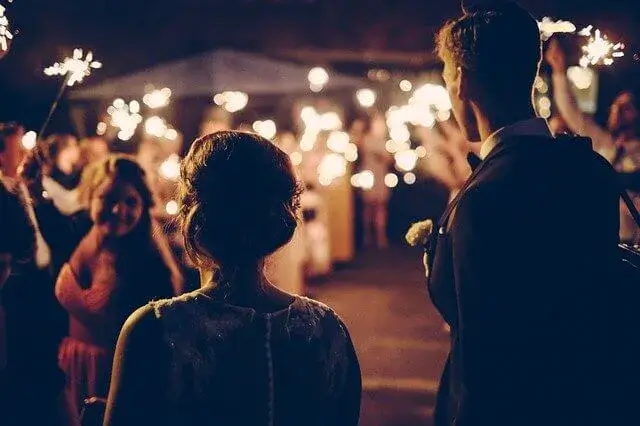
The last point appears on no shopping list and still costs the most books: agree in advance who collects the two of them once the vows are spoken. What follows immediately afterwards is the exit, with sparks, confetti and hugs, and from that moment nobody is thinking about two small books left at the altar. Scan them in the days that follow. 300 dpi is enough for the text, 600 dpi shows the stroke of the nib; save the pages as PNG or TIFF rather than JPEG, and keep the file somewhere other than where the book itself lives.
Your wedding vow books are the silent witnesses of your love on the most important day of your life. They preserve your deepest feelings in a form that does justice to the meaning of your words. We firmly believe that the most important documents in life deserve a special place – whether in the archive or in your hands at the altar. Invest in these small treasures, and you will have a tangible reminder of this magical moment for a lifetime. Words on high-quality paper have a power that never fades. We wish you an unforgettable ceremony!
Planning your dream wedding?
Create your own wedding website in minutes – with RSVP function, photo gallery, and more.