Table of contents
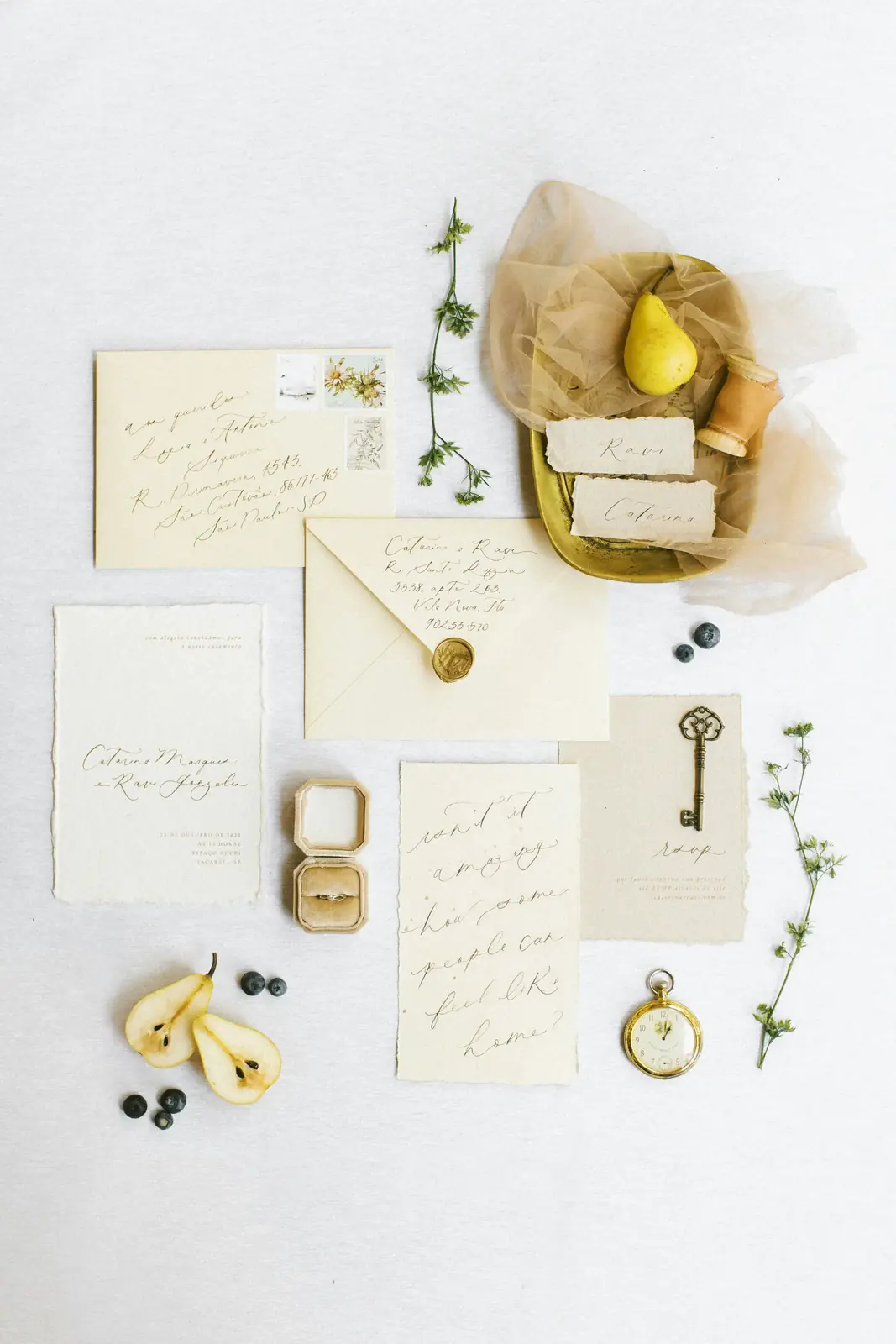
A wedding invitation needs eight things: who is hosting, who is marrying, what guests are invited to, the date, the time, the place, how and by when to reply, and one note about dress or schedule. Everything else belongs on a details card. Tone is free; the order is not.
Wording is where most couples spend far longer than they planned. It is rarely the writing itself. It is that three questions have to be answered at once: who appears as host, how formal it should sound, and how to mention gifts without sounding as though you are asking for them.
Traditional invitation language still carries real conventions — "the honour of your presence" for a religious ceremony, "the pleasure of your company" for everywhere else — and knowing them means you can follow or break them deliberately rather than by accident.
This article breaks the card into its parts, gives three complete versions you can copy, and then handles the phrasings that reliably eat the most time.
1. The eight elements
Almost every invitation, in any style, contains the same components. Leave one out and every guest asks the same question.
- The host line: who is inviting. The couple, the parents, or both together.
- The couple's names: in full. Even close friends need surnames for the reply card.
- The request: what guests are invited to. If someone is invited to the reception only, the card must make that clear.
- The date: with the day of the week and the month written out. "Saturday, 12 September 2026" is unambiguous; "12/09/26" is not, and reads differently on either side of the Atlantic.
- The time: the time guests should arrive, not the time things begin. In practice those differ by about fifteen minutes.
- The place: venue name and full address. Two venues means both, in the order of the day.
- The reply: how and by when, with a full date.
- One note: dress code, children, schedule or accommodation — whichever is the open question for your guests.
The order matters. Guests read an invitation in the order of their own questions, and that order is almost always: who is marrying, when, where, and what do I have to do. Move the reply instruction to the top and the card stops making sense.
A good invitation answers four questions in thirty seconds: when, where, what do I wear, and by when must I reply.
2. Three complete examples
All three contain the same eight elements and differ only in register. Swap the names and dates, leave the rest.
| Register | Wording | Suits |
|---|---|---|
| Formal | "Mr and Mrs David Berger request the honour of your presence at the marriage of their daughter Anna Louise to Jonas Keller on Saturday, the twelfth of September, two thousand twenty-six, at half past two o'clock, St Martin's Church, Bath. Reception to follow at Sonnenhalde House." | Church ceremony, mixed ages, parents hosting. |
| Semi-formal | "Together with their families, Anna Berger and Jonas Keller request the pleasure of your company at their marriage on Saturday, 12 September 2026, at 2.30 pm, Sonnenhalde House, Bath. Dinner and dancing to follow. Kindly reply by 15 August." | Most weddings — civil or celebrant-led, one venue. |
| Personal | "After nine years, two house moves and one dog, we're getting married. Saturday, 12 September 2026, 2.30 pm, Sonnenhalde House, Bath. There'll be a short ceremony, then food, music and probably not enough sleep. Let us know by 15 August and we'll count you in." | Small wedding, close circle, couple hosting alone. |
What all three deliberately leave out: directions, parking, hotel suggestions, gift wording and the full running order. Those belong on a details card or a page online — otherwise the invitation turns into a briefing document.
One convention worth knowing: "the honour of your presence" traditionally signals a ceremony in a house of worship, while "the pleasure of your company" is used everywhere else. Nobody will object if you ignore it, but plenty of older guests will notice if you use the religious form for a barn.
3. Getting the tone right
The tone should match the day rather than an idea of how invitations are supposed to sound. A formally worded card for a thirty-guest garden party reads as borrowed; a very casual card for a cathedral wedding unsettles part of the guest list.
Two decisions set the tone. The first is the voice: "We're getting married" places the couple at the centre and suits couples hosting their own wedding, while "request the pleasure of your company at the marriage of their daughter" describes from a distance and fits parents hosting. The second is contraction — "we're" and "there'll" read warm and modern, "we are" and "there will be" read composed.
Hold the tone across the whole suite. If the invitation uses contractions, the reply card should not switch to formal register, and the order of service should not land in a third voice. Nobody notices this consciously, but the pieces stop looking like a set.
Quotations and verses are the most common misstep. A quotation replaces none of the eight elements and lengthens the card. If you want one, put it on the reverse or inside a folded card — never above the information that has to be read.
And write numbers consistently. Traditional formal invitations spell out dates and times in full; modern ones use figures. Either is fine, but "half past two o'clock" on one line and "6.30 pm" on the next is the sort of inconsistency that reads as carelessness.
Related articles
4. Wording gifts, children and dress
These three lines take longer than the whole rest of the card, because each of them asks something of the guest. Ready-made phrasings that work:
- Money, neutral: "Your presence is the greatest gift. If you would like to give something, a contribution towards our honeymoon would be very welcome."
- Money, with a purpose: "Instead of gifts we are saving towards our garden. There will be a box at the door for anyone who would like to contribute."
- No gifts at all: "We have almost everything two people need. Please don't feel you need to bring anything — just come."
- Children not invited: "We're keeping the celebration small and are only able to invite adults. We hope you can still join us."
- Children welcome: "Children are very welcome — please tell us their names and ages when you reply."
- Dress code with an example: "Dress code: smart, colourful, comfortable enough to dance in. Think summer suit or a dress you like."
Three rules make the difference on gifts. Put the wording on the details card rather than the invitation itself, where it reads as a condition. Never print amounts or bank details on paper; give those on request or behind a password online. And always leave an alternative open, so guests who would rather bring something do not feel wrong-footed.
On dress: "formal" means nothing to half your guests. Spelling out what guests should wear with an example does more work than a term, and it takes the same number of words.

5. Wording traps
"We request your attendance." This reads like a summons. "We would love you to be there" says the same thing.
A time with no purpose. "Ceremony 2.30 pm" does not tell guests when to arrive. Better: "Doors from 2 pm, ceremony at 2.30."
Two venues with no order. If the ceremony and reception are at different addresses, both belong on the card in the order of the day, with the time between them. Otherwise people drive to the wrong one.
"Please reply as soon as possible." Without a date, nothing happens. Name the day, and include the year.
Leaving the children question open. Silence is read as permission. If children are not invited, say so warmly and clearly — and say it on the details card rather than in the middle of the invitation.
Ambiguous numerals. "09/12/2026" is September in some countries and December in others. Write the month out and the problem disappears, which matters more than usual when guests are travelling internationally.
Eight elements, one consistent register, everything extra on the details card, and gift wording that stays a request: that is the text finished. Write it out in full next and leave it overnight — on the second reading it becomes obvious which piece of information is still missing.
Planning your dream wedding?
Create your own wedding website in minutes – with RSVP function, photo gallery, and more.