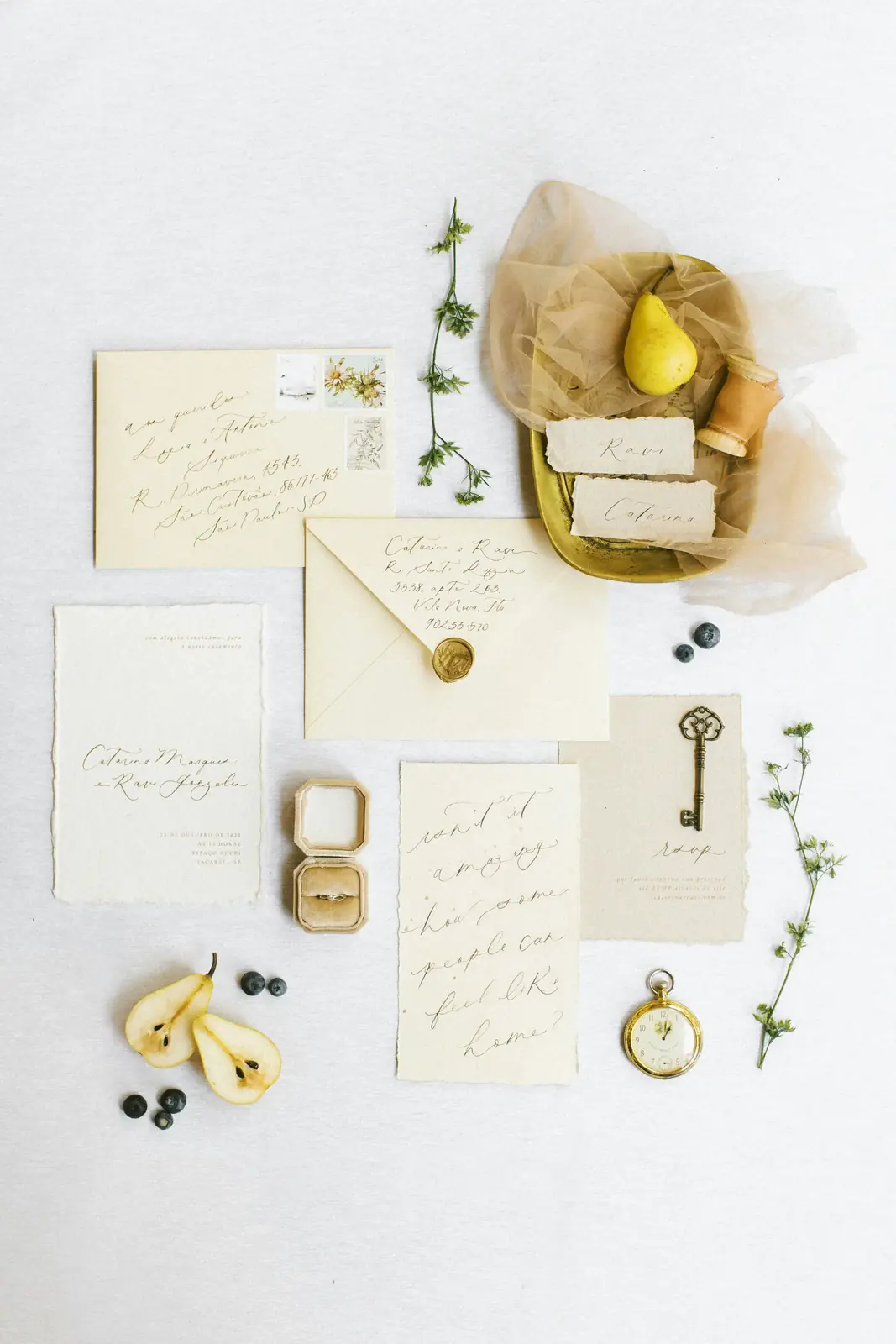
Address the envelope to exactly the people who are invited: named individuals mean those individuals, a family name includes the children. Use titles only if the rest of the invitation is formal, never guess a title you are unsure of, and never merge two different surnames into one.
How you address an invitation is the most binding statement in the whole envelope. The card says when and where; the envelope says who. If it reads "The Berger Family", four people consider themselves invited. If it reads "Maria Schulz and Tom Berger", two do.
That makes addressing a question of clarity rather than etiquette, although etiquette is where most of the anxiety sits. Titles have also shifted in the last decade: Ms is now the default for women whose preference you do not know, Mx is used by people who do not use gendered titles, and plenty of couples drop titles entirely.
This article gives a table of wordings for the common cases, then works through the ones that need thought — plus-ones, children, doctors, judges, and guests whose circumstances have changed since you last wrote to them.
1. Titles, or none at all
Decide once whether your invitations use titles, and apply it to the whole list. A stack in which half the envelopes say "Ms Maria Schulz" and half say "Maria Schulz" reads as inconsistency rather than as informality.
Titles suit a formal invitation — a church or synagogue ceremony, a black-tie reception, an older guest list. Without them the invitation reads as contemporary and slightly warmer, and for most weddings that is now the more natural choice.
If you do use them, the current conventions are straightforward. Ms is the safe default for any woman whose preference you do not know; it says nothing about marital status. Mrs only where you know it is preferred. Miss is largely reserved for children now. Mx for guests who use it — and the only way to know is to ask.
Professional titles override social ones. A guest who is a doctor is "Dr Maria Schulz"; a military rank, a judicial title or a clerical one works the same way. Where one person in a couple holds a title and the other does not, name them separately rather than trying to combine.
And a rule that saves more trouble than any other: when in doubt, drop the title rather than guess it. An envelope with a plain name never offends anybody. An envelope with the wrong title does, and it is the kind of thing people remember.
The envelope, not the card, says who is invited. Everyone reads it that way, whether or not you meant it.
2. The common cases
These wordings cover the great majority of any guest list.
| Guest | Formal | Contemporary |
|---|---|---|
| Married couple, shared surname | Mr and Mrs Thomas Berger | Maria and Tom Berger |
| Married couple, different surnames | Ms Maria Schulz and Mr Tom Berger | Maria Schulz and Tom Berger |
| Unmarried couple living together | Ms Maria Schulz and Mr Tom Berger | Maria Schulz and Tom Berger |
| Family with children invited | Mr and Mrs Berger, Lina and Paul | The Berger Family |
| Single guest with a plus-one | Ms Maria Schulz and Guest | Maria Schulz and guest |
| Single guest, no plus-one | Ms Maria Schulz | Maria Schulz |
| Guest with a professional title | Dr Maria Schulz and Mr Tom Berger | Dr Maria Schulz and Tom Berger |
| Two guests sharing a flat, both invited | Ms Maria Schulz and Ms Lena Frei | Maria Schulz and Lena Frei |
One row is worth pausing on. "The Berger Family" is warm and convenient and it includes every child in the house — which is either exactly what you want or exactly what you do not. If children are not invited, never use it.
Never merge different surnames. "Mr and Mrs Schulz-Berger" is correct only if that is genuinely their name. Where a couple use different names, list both in full, and put first the person you are closer to.
3. Children and plus-ones
Naming children on the envelope is the friendliest way to say they are invited, and the clearest. Children named are invited; children not named are not — that convention is widely understood, though not universally, which is why it is worth backing up with a line on the details card.
If you have decided against children at the wedding, leave the names off and add one sentence: "We're keeping the celebration adults-only and hope you can still join us." The second half matters. It acknowledges that you are asking for something.
Children over about eight appreciate their own envelope. The cost is one card from your reserve and one more envelope, and the effect is out of proportion: children that age rarely receive post, and an invitation addressed to them personally gets kept until the day.
For plus-ones the same principle applies. If you know the partner's name, write it — that is far warmer than "and guest". If you do not, "and guest" is correct, but only once the place has actually been allocated. If the decision is still open, write nothing; a plus-one offered cannot be withdrawn.
For guests bringing nobody, write nothing that draws attention to it. An invitation to one person needs no note about coming alone, and adding one is the most common way of making a single guest feel counted rather than invited.
Related articles
4. Situations that need care
Divorced or separated parents. Each parent gets their own invitation at their own address, even if both are attending. A joint envelope to a separated couple is read as a statement, whether or not one is intended.
Widowed guests. Use their own name in their own right. Traditional etiquette sometimes retained the late spouse's name; that is now uncommon and can be painful. If you are unsure whether a companion would be welcome, offer a plus-one — it does not have to be used.
New partners you have not met. Ask for the name rather than writing "and guest". A two-minute message reads as attentiveness, and the name on the envelope makes the person feel invited rather than admitted.
Guests who changed their name this year. Marriages, divorces and deed polls all happen between your list being made and your envelopes being written. Check anyone whose circumstances you know have changed.
Same-sex couples. There is no inherited order to follow, which is a small advantage: choose one — alphabetical, or the person you know better first — and apply it consistently across the whole list.
Households where the doorbell name differs. Add a care-of line above the street rather than below it, and check spelling with the guest. A correctly addressed invitation to a name that is not on the door is still an undelivered invitation.

5. Inner envelopes and handwritten lines
Traditional formal invitations use two envelopes: an outer one with the full formal address, and an inner one — unsealed, no address — naming exactly who is invited. "Mr and Mrs Berger" on the outside, "Mr and Mrs Berger, Lina and Paul" on the inside.
The inner envelope exists precisely to solve the who-is-invited problem, and it does it well. It is also an extra piece of paper, extra cost and extra weight, and it is now optional at all but the most formal weddings.
If you skip it, the outer envelope has to do that work alone — which is exactly why the wording in section two matters. Either be specific on the envelope, or add a line on the details card, but do not leave it to inference.
A handwritten line is the other way to make a printed card personal, and it is where warmth belongs. "Maria — it wouldn't be the same without you." Two sentences at most, written after the cards arrive rather than before, in case anything has to be reprinted.
Split the list between the two of you, each writing to the people you know better. It is faster, it sounds truer, and both of you should still sign every card. Keep a note of who was addressed how — three weeks later, when you order ten more, nobody will remember.
One consistent decision about titles, envelopes that name exactly who is invited, children written out or explicitly excluded, and a handwritten line for warmth: that is addressing solved. The next step is your guest list — add a column for the exact envelope wording before you write the first one.
All things wedding
Plan your wedding
Bring your tasks, costs and guests together for the day.
Invitations and wording
Find the right words for your wedding invitation.
As a wedding guest
Write a personal message and choose a thoughtful gift.
Wedding anniversaries
Explore anniversary names, traditions and celebration ideas.
Planning your dream wedding?
Create your own wedding website in minutes – with RSVP function, photo gallery, and more.