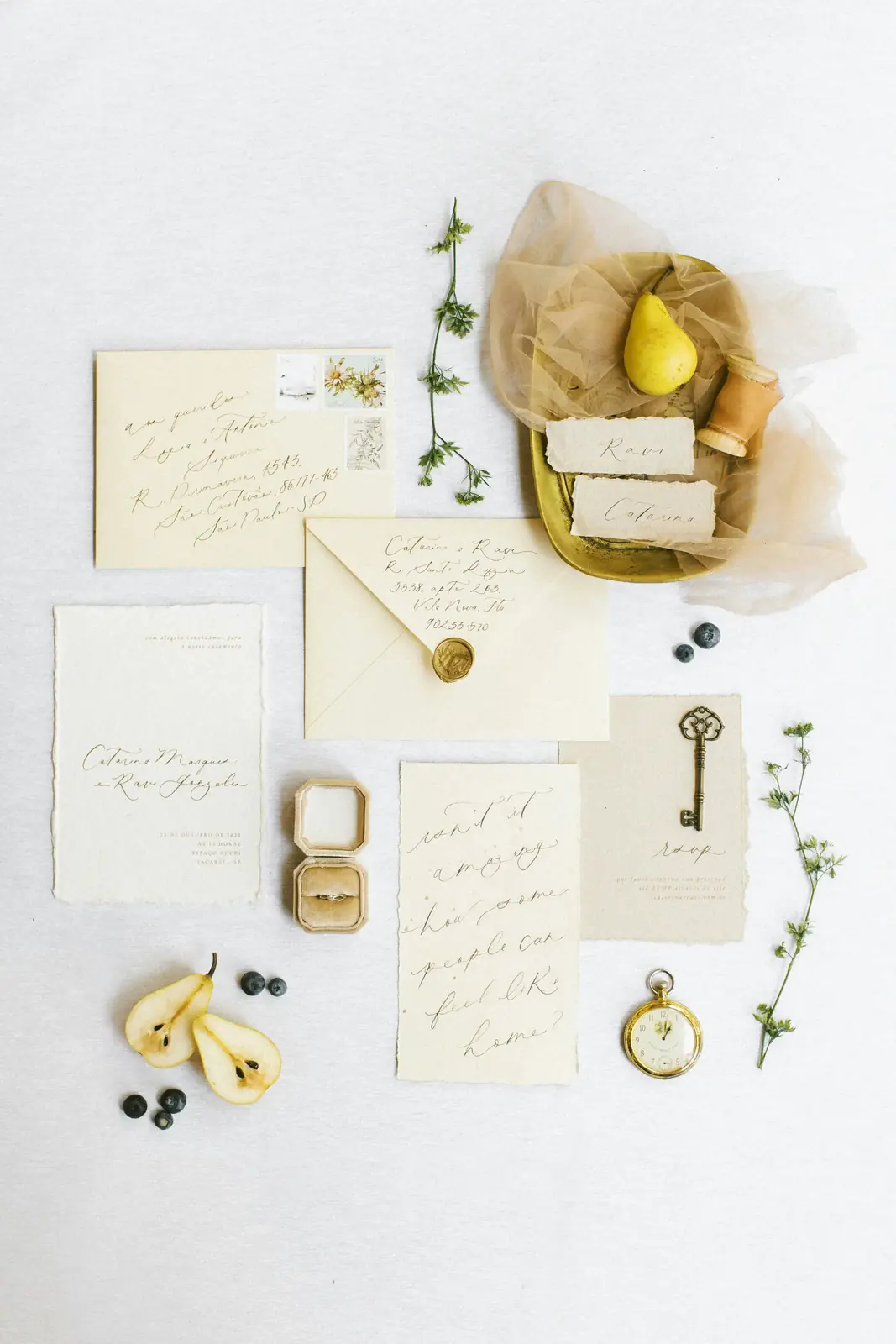
Open with congratulations, name both people, add one specific line that only you could write, and close with a wish for the future. Four sentences is plenty. If money is enclosed, one short line about what it is for is enough, and it belongs at the end rather than the start.
Write your wedding card
Choose a complete template, add your personal details and edit the finished text to make it your own.
Your finished text
Family
Your details stay in this browser. Copy or print your finished text to keep it.
Make it personal
Explore complete templates
Family
Dear Alex & Sam, Congratulations on your wedding! We are so happy for you both. Celebrating you as a family means so much to us. May you keep finding time for each other through every season of your marriage. With love, Robin
Friends
Dear Alex & Sam, You’re married! Congratulations to two of our favourite people. Some of our happiest memories are of laughing with you both. Here’s to many more, and to a home full of kindness and laughter. Lots of love, Robin
Colleagues
Dear Alex & Sam, Warmest congratulations to you both on your wedding. Wishing you joy, trust and many happy memories as you begin this new chapter together. With best wishes, Robin
Not very close
Dear Alex & Sam, Congratulations on your wedding and best wishes for your life together. Thank you for including us in your special day. May the years ahead bring you friendship, happiness and shared adventures. Warm wishes, Robin
Unable to attend
Dear Alex & Sam, Sending heartfelt congratulations on your wedding from afar. We’re sorry we cannot be there today, but we’re thinking of you both. We look forward to celebrating with you soon. Thinking of you, Robin
With a cash gift
Dear Alex & Sam, Wishing you both a wonderful wedding and a happy marriage! Please put this little gift towards a shared wish. We hope it helps you make a memory you’ll enjoy looking back on together. With love and best wishes, Robin
The card outlives the gift. Couples keep them, reread them in the first year and often keep a box of them for decades, which is a lot of weight for something usually written in a parking lot ten minutes before the ceremony.
This article gives a structure that works, wording for the awkward relationships, and the small etiquette around mentioning money, second marriages and absent people. The examples show the structure and are meant to be adapted: the sentence people remember is always the specific one.
1. A structure that works every time
Four moves, in this order. It takes about ninety seconds once you know the shape.
- Congratulate them, by name. Both names. A card addressed to only the half you know reads exactly as it sounds.
- Say something only you could say. A memory, a detail, something you noticed about them together. This is the whole card; everything else is packaging.
- Look forward. A wish for the marriage rather than for the day, which is nearly over by the time they read it.
- Sign off warmly. With love, from, all our love. Match it to how you actually speak to them.
Two habits improve almost any card. Write it before the day, at a table, rather than balanced on a knee. And read it back once, because the most common error is a card that mentions one partner three times and the other not at all.
If you are stuck on the second move, three prompts unlock it: when did you first hear about the other one, what changed when they got together, and what do you actually think they are like as a pair.
Nobody has ever reread a wedding card for the greeting. They reread it for the one line that could only have been written by the person who wrote it.
2. Wording for each relationship
The register shifts more than the content does. Use the table as a starting point rather than a script.
| Relationship | Tone | Opening that works |
|---|---|---|
| Close friend | Warm, specific, a little funny | Congratulations, both of you. I have been waiting for this one. |
| Sibling or child | Direct and unguarded | We could not be happier for you both today. |
| Parent to a child | Emotional is fine here | Watching you two today has been the best part of our year. |
| Colleague | Friendly, not familiar | Wishing you both every happiness on your wedding day. |
| Distant relative | Warm and simple | With very best wishes to you both for a long and happy marriage. |
| Someone you barely know | Short and sincere | Congratulations to you both. Thank you for including us. |
Two things to avoid across all of them. Jokes about the loss of freedom, which were tired thirty years ago and read badly to whichever partner picks the card up. And advice, unless it was asked for; a card is not the place for what marriage has taught you.
Two complete examples for each relationship, to adapt rather than copy:
Close friend
- Congratulations, [Name] and [Name]. I knew something had changed the night you left [place] early without even pretending to have a reason. Today made perfect sense. All my love, [Name]
- To two of my favourite people: watching you become a team has been the best thing to see. Here is to every adventure still ahead. Love, [Name]
Sibling or child
- [Name], I have known you all your life and never seen you this happy. [Name], welcome properly to the family; you have been part of it for a while. With all our love
- To my little brother and the best decision he ever made. Thank you for letting me stand beside you today. I could not be prouder of you both. Love, [Name]
Parent to a child
- Our darling [Name], seeing you today is a memory we will keep for the rest of our lives. [Name], we are so glad it is you. All our love, Mum and Dad
- We have loved you every day of your life, and today we get to love one more person as well. Welcome to the family, [Name]. Your very proud parents
Colleague
- Wishing you both a wonderful day and a very happy marriage. Enjoy the honeymoon; the office will cope, just about. Best wishes from everyone in [team]
- Congratulations on your wedding, [Name]. It is a pleasure working alongside you, and we hope the years ahead bring you both every happiness. Warm regards, [Name]
Distant relative
- With love and very best wishes on your wedding day. We are so pleased for you both and hope to see you again before the next family occasion. [Names]
- Congratulations to you both. It was lovely to see the family together for such a happy reason. Wishing you a long and joyful marriage. With love, [Names]
Someone you barely know
- Thank you for including us in your wedding day. Wishing you both every happiness for the years ahead. Kind regards, [Names]
- Congratulations on your marriage. It was a pleasure to share the day with you, and we wish you a long and happy life together. Best wishes, [Names]
More texts by relationship and tone are in the collection of wedding wishes, and one-liners for a gift tag in the short wedding wishes.

3. Mentioning money without it being strange
Cash is now the most common wedding gift in Britain and Ireland, and the card is where it is acknowledged. The etiquette is simpler than people fear.
- Put it last. The message first, the money line at the end. A card that opens with the contribution reads as a receipt.
- One line is enough. Something towards the honeymoon, or towards the house. Naming a purpose makes it a gift rather than a transaction.
- Do not name the amount. Ever. Not in the card, not in the message that goes with a transfer.
- Do not apologise for it. A small amount with a good card is a good gift. Writing sorry it is not more makes the recipient responsible for your feelings.
- If you have transferred it, say so. One sentence, so nobody spends the evening looking for an envelope that does not exist.
If the couple have asked for contributions to something specific, mirror their wording. Couples who name a fund have usually thought about how to phrase it, and echoing their language is the least awkward route. Where they have set it out in their wedding details, that is also where the payment information will be, which saves everyone an exchange of messages.
If you are giving no gift at all, write the card anyway and say nothing about it. The absence explains itself, and the card is what gets kept.
Related articles
4. The situations that need care
Five cases come up often enough to think about in advance.
A second marriage. Write it exactly as you would a first. Avoid this time and finally, both of which point backwards.
Blended families. If children are part of the day, naming them is generous and almost always appreciated. Check the names and the spellings.
Someone significant has died. A single sentence acknowledging an absent parent is one of the kindest things a card can contain, provided it is brief and does not become the subject of the card. If you are unsure, err towards including it: most people would rather their person were mentioned than passed over.
You could not attend. Say you were thinking of them, not that you were sorry to miss it, and skip the explanation. The card is not the place to relitigate your absence.
You are writing on behalf of several people. One person writes the message and everyone signs. A card with six separate paragraphs in six hands is a compliments slip.

5. The practical bits
Small things, and they are the ones that go wrong.
- Write the names on the envelope. Cards get separated from gifts constantly, and an unsigned card with cash in it is a genuine problem for the couples thank-you list.
- Sign with your full name if you are anything other than a close friend. Two Sarahs at a wedding is not a rare event.
- Add your address if you want a thank-you card to reach you. Couples spend a surprising amount of January chasing addresses.
- Seal it properly if there is money inside, and put it in the card box rather than handing it to whoever is nearest.
- Keep it in one pen. A card finished in a different colour was finished in the car.
On the card itself: a plain card with four handwritten sentences beats an elaborate one with a printed verse and a signature. If you buy a card with a printed message, cross nothing out, just write underneath it.
And write it in advance. Every couple can tell which cards were written at the venue, and it is not because of the handwriting.
If you are giving as a couple or a family, one card and one message signed by everyone is the norm. Separate cards from a household read as a mix-up rather than as generosity, and they double the couples thank-you list for no gain.
Congratulate both of them, write one line only you could write, look forward, sign warmly. If money is enclosed, one sentence at the end and no figure. Do it at a table a few days early rather than in the car, and put your name on the envelope so the couple can thank you properly. That leaves the one question the wrapping does not settle: how much to give.
All things wedding
Plan your wedding
Bring your tasks, costs and guests together for the day.
Invitations and wording
Find the right words for your wedding invitation.
As a wedding guest
Write a personal message and choose a thoughtful gift.
Wedding anniversaries
Explore anniversary names, traditions and celebration ideas.
Planning your dream wedding?
Create your own wedding website in minutes – with RSVP function, photo gallery, and more.