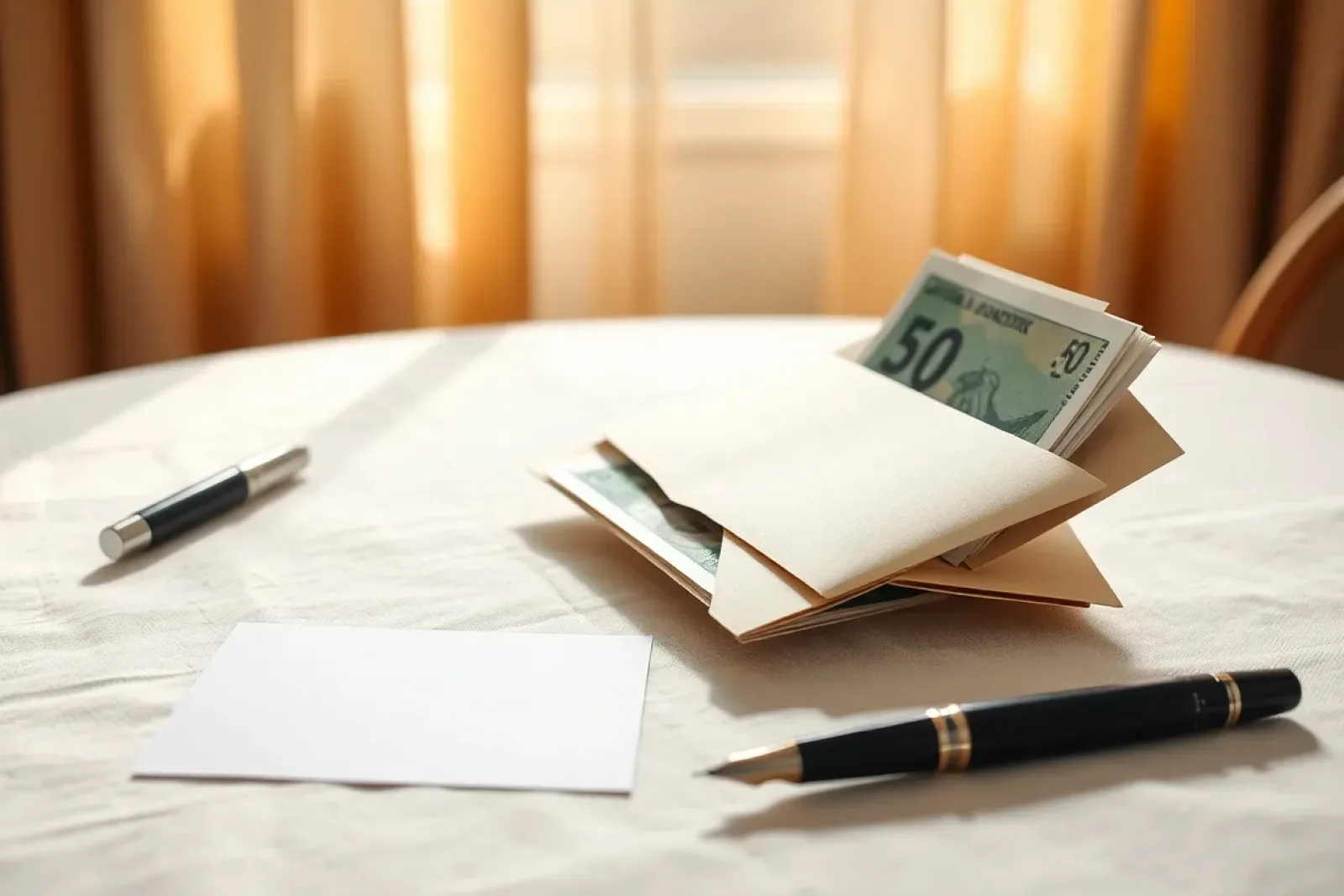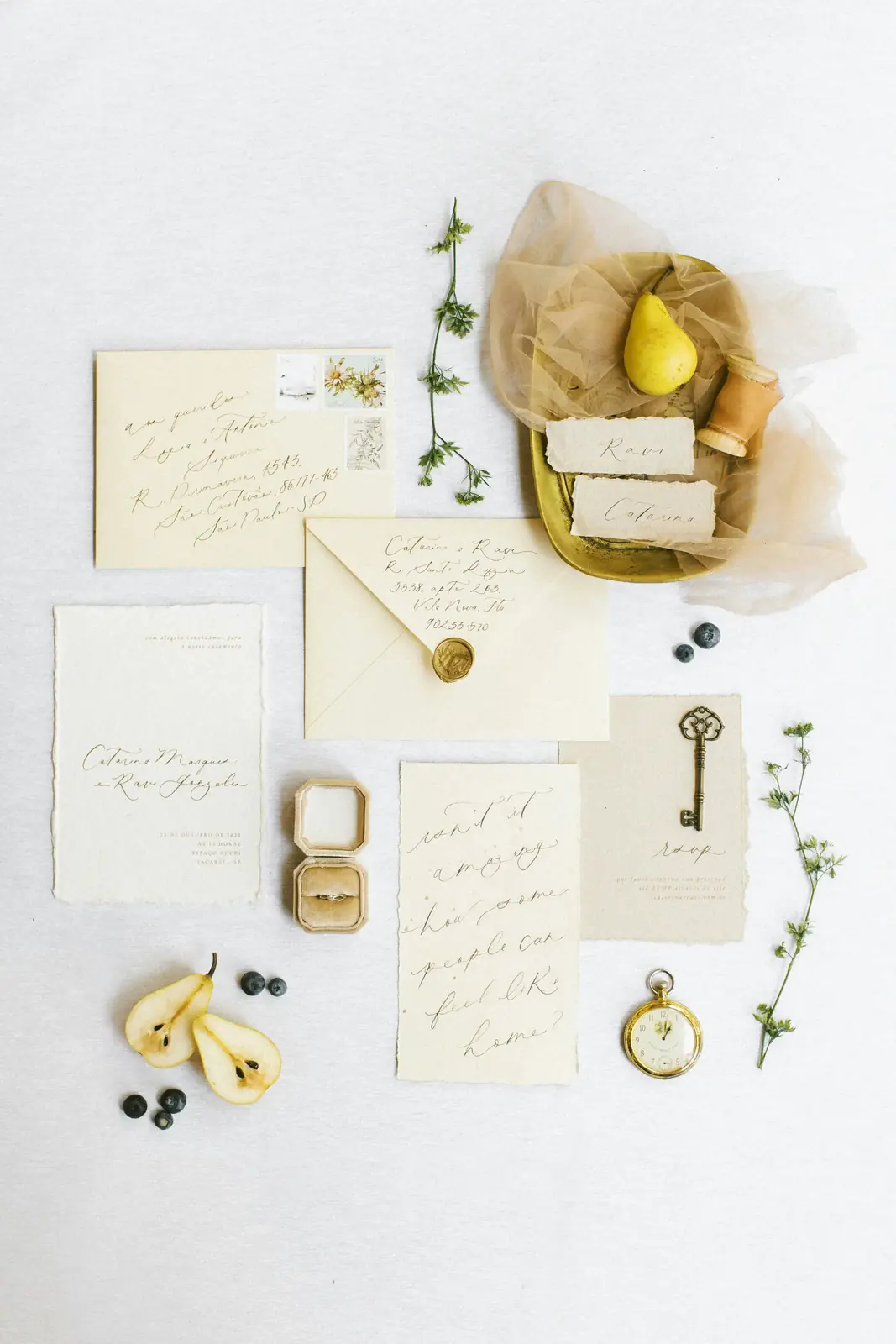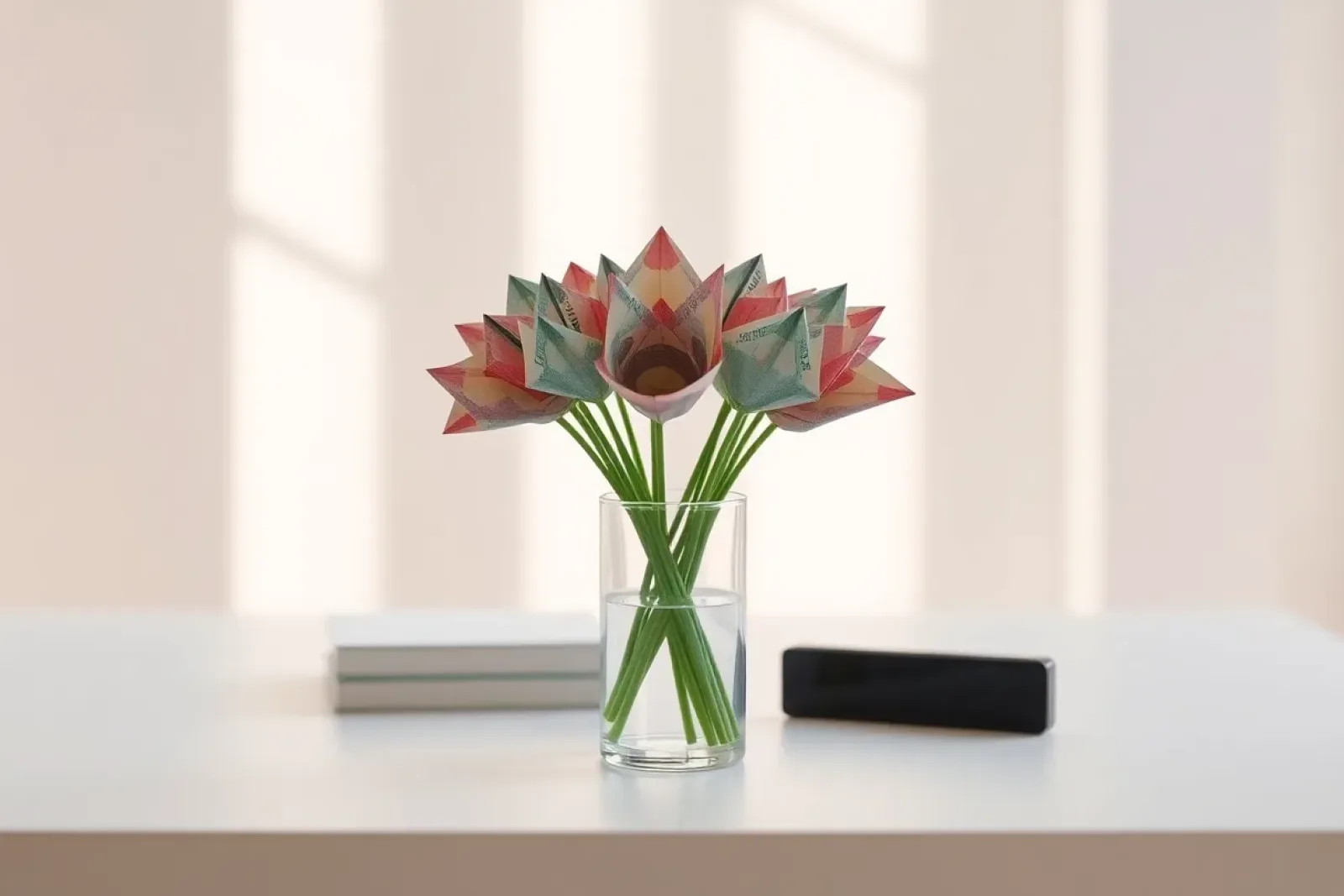
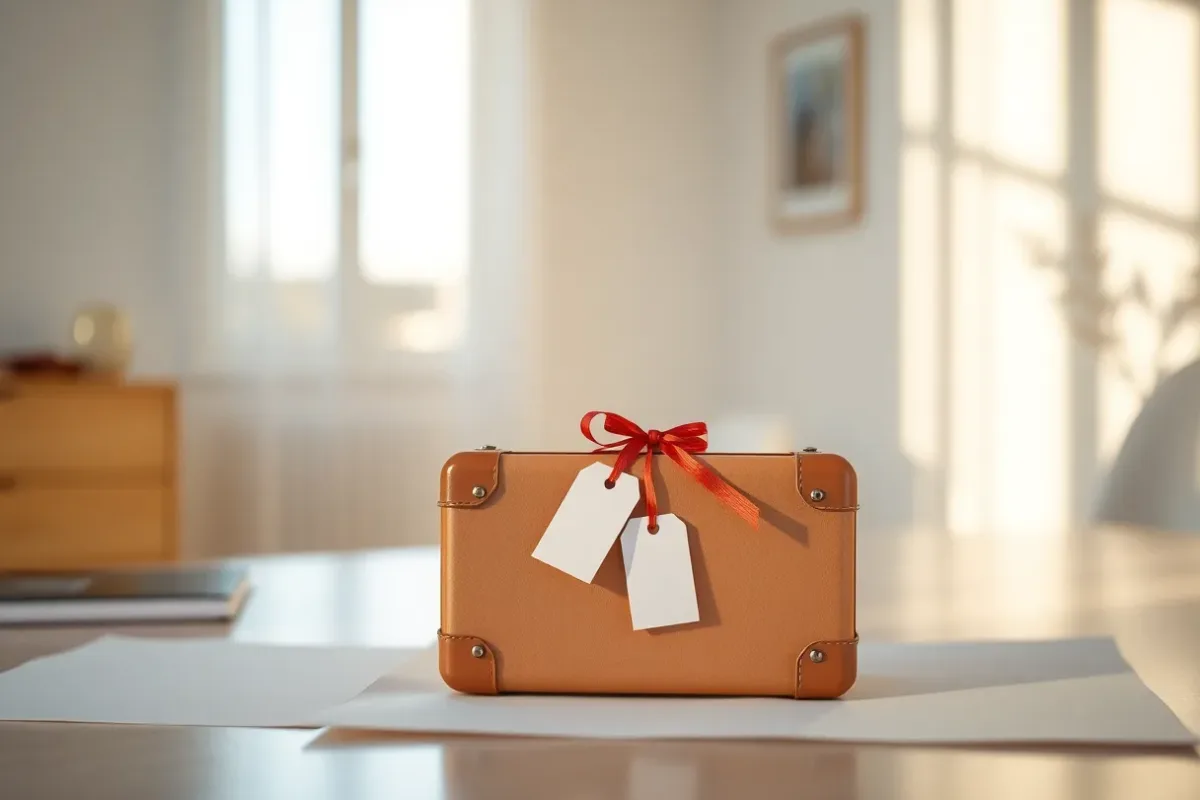
In Germany, Austria and Switzerland money is the ordinary wedding present rather than an awkward one, and a bare envelope counts as the minimum. Guests build the notes into something: a framed panel, a small tree, folded paper flowers, a holiday fund in a toy suitcase. The making is the message; the sum is a separate decision.
Pack a cash gift safely
These options accompany the customs described here. If you attend a wedding in a German-speaking country, a plain envelope is also suitable. Ask the couple if unsure.
Envelope with an insert
Materials: envelope, card, paper strip and pen. Write the card, loosely wrap the notes in the paper strip and slide both into the envelope. Seal it; never glue or staple banknotes.
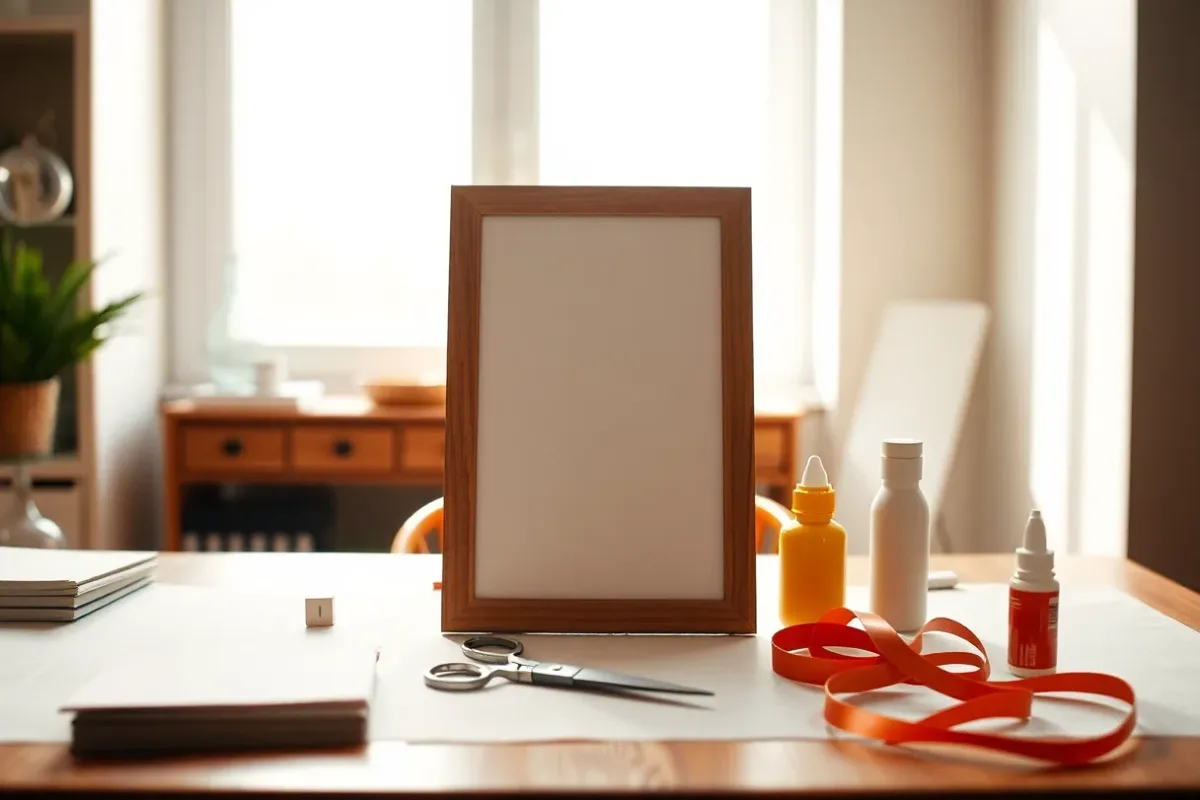
Picture frame
Materials: deep frame, card backing, small paper envelopes and photo adhesive. Label the envelopes, attach only the empty envelopes to the backing and then insert the notes. Before closing the frame, check that the notes can be removed without tearing.
Travel fund
Materials: small box, paper map, ribbon and separate envelope. Decorate the box with a destination you know the couple has chosen, place the money in the envelope and put it inside. Add your name outside and check that the box travels securely.
If every wedding you have been to ran on a gift list, the German gift table is a mild surprise. There are hardly any boxes on it. There are envelopes, and there are objects that turn out on closer inspection to be banknotes arranged into a shape.
What follows explains what you are looking at: how money became the default present, which forms recur often enough to be recognisable, the unwritten handling rules everyone in the room already knows, and the question a visiting guest actually has, which is whether any of this is expected of them.
The short answer to that last one is no. The longer answer is more interesting, because the craft is neither a contest nor a way of dressing up a small amount. Once you see what it is for, the whole table becomes legible.
1. Why money, and why anyone wraps it
Asking for money is not thought grasping in German-speaking countries in the way it can be elsewhere. Couples commonly share a flat for years before they marry, so a list of pans and towels answers a problem they solved long ago. The money goes towards the honeymoon, the flat, the kitchen or the day itself, and saying so on the invitation reads as helpful rather than bold.
That leaves one small difficulty, and the wrapping is the answer to it. An envelope carries no information about the person who handed it over. Two guests who have known the couple since school and two who met them last spring hand over identical objects. So the envelope is replaced by something made, and the made thing carries what the envelope could not.
It is worth being blunt about what this is not. Nobody reads an elaborate parcel as an attempt to make a modest sum look bigger. A carefully built frame holding very little is understood as attention, and as nothing else. Separate the two decisions — how much, and how it arrives — and the genre stops resembling a competition and starts resembling a card with more work in it.
The wrapping says how well the guest knows the couple. It says nothing about the amount inside it.
2. What you will see on the gift table
A few forms recur often enough to be recognised across regions, and each carries a slightly different signal.
| Form | What it involves | What it signals |
|---|---|---|
| Notes behind a cut mount in a picture frame | Flat, stackable, hangs on a wall afterwards | The safe default, suitable for any couple |
| A money tree: rolled notes tied to twigs in a pot | Needs floor space, and warning in advance | Garden receptions, couples with a house |
| A travel fund in a small case | Mock tickets, a folded map, miniature sun cream | The giver knows where the honeymoon goes |
| Flowers or hearts folded from notes | Origami from small denominations, slow to make | Guests who enjoy folding for its own sake |
| A washing line with wooden pegs | Quick, informal, easy to carry home | Barn weddings and relaxed outdoor parties |
| Dated envelopes inside a book | One envelope per married year, each with a task | The kind kept long after the money is gone |
Offices and friendship groups pool. When colleagues club together the convention is one substantial object rather than ten small ones, usually a single frame carrying a note and a signature from each person, which also tells the couple whom to thank.
The shortcut for anyone short of time is a bought base with one handmade element: a plain wooden box, lined with paper, a handwritten ribbon around it. The ribbon is what reads as personal.
3. The handling rules nobody says out loud
Banknotes are still money while they are being used as craft material, and that governs nearly everything guests do with them.
- Folding is fine. Origami presses out again and a bank takes a creased note without comment, which is why folding, rolling and pegging dominate the genre.
- Glue, scissors and pens are not. A note that has been stuck down, trimmed to fit or written on is a damaged note, and a damaged note is a great deal more trouble to exchange than an intact one.
- Nothing sealed shut. Laminate or resin turns a present into an ornament, because what cannot come out cannot be spent.
- Keep water and sand away. Both photograph beautifully in a treasure-chest arrangement and both wreck paper reliably.
The format rules are about the evening rather than the money. Whatever arrives has to survive a car boot and a rain shower, sit on a table already carrying thirty other things, be carried out again in the small hours by somebody tired, and not advertise its contents to the room. Flat formats therefore dominate, and the money tree, the famous exception, is announced to the couple beforehand.
One rule visitors break most often: put in a card and sign it with your full name. Couples open the table days later and match presents to thank-you notes from what is written inside.
Related articles
4. Where a visiting guest stands
None of this is a duty, and it is worth saying so before anyone books a craft weekend.
- You are not expected to make anything. A good envelope, a handwritten card and a sentence showing you know the couple is a complete present, and always has been.
- Get the notes early, and get clean ones. Euros in Germany and Austria, Swiss francs in Switzerland. Small denominations mean a bank counter rather than a cash machine on the morning itself.
- Learn the two delivery routes. Envelopes and flat parcels go on the gift table. Anything large is handed over during the congratulations, the only moment it will be looked at.
- Say nothing about sums. Amounts are not announced, compared or asked about, and a guest who raises it at a table has made a real misstep rather than small talk.
- Read the invitation first. A named honeymoon or house fund outranks every clever idea in this article.
One genuine trap for guests travelling in: sending money ahead by bank transfer is normal here and often the stated preference, but a cross-border transfer is slower than a domestic one and can land after the day. Send it early or carry it with you.
How much to put in is a separate question, and the answer does not shift because of how the money is wrapped. If you are unsure, what guests usually give is the place to start, adjusted for what the trip has already cost you.
5. Joining in without spending a weekend on it
Plenty of guests want to gesture at the local form without folding paper roses all weekend. Three routes work.
Buy the structure, write the meaning. A plain frame and a cut mount take an evening at most, and what people remember is the line written beside the notes rather than the frame around them.
Name the purpose. One specific sentence outperforms hours of folding. A line saying the money is for the first evening in the new flat tells the couple you were listening; a beautiful but generic arrangement tells them you own a glue gun.
Combine a voucher with cash. Something booked for them, with notes in the same envelope, gives them a concrete idea and the freedom to change it.
If you are marrying into this rather than visiting it, say what you would like, plainly and early. Guests left guessing guess uncomfortably and often expensively. Couples here put the request beside the timings and the directions on their wedding website, where it reads as information rather than as an ask.
And if the request is for no presents at all, take it at face value. Arriving with an elaborate parcel anyway is not generosity; it reads as a correction, and it strands every guest who took the couple at their word.
Money is the normal present here, and the wrapping is how a guest signs it. Bring clean notes, a card with your full name on it and no questions about amounts, and you have done everything the occasion asks. If you want to go further, buy the structure and spend the effort on the sentence, because that is the part that outlives the evening. Where it goes is the card.
All things wedding
Plan your wedding
Bring your tasks, costs and guests together for the day.
Invitations and wording
Find the right words for your wedding invitation.
As a wedding guest
Write a personal message and choose a thoughtful gift.
Wedding anniversaries
Explore anniversary names, traditions and celebration ideas.
Planning your dream wedding?
Create your own wedding website in minutes – with RSVP function, photo gallery, and more.