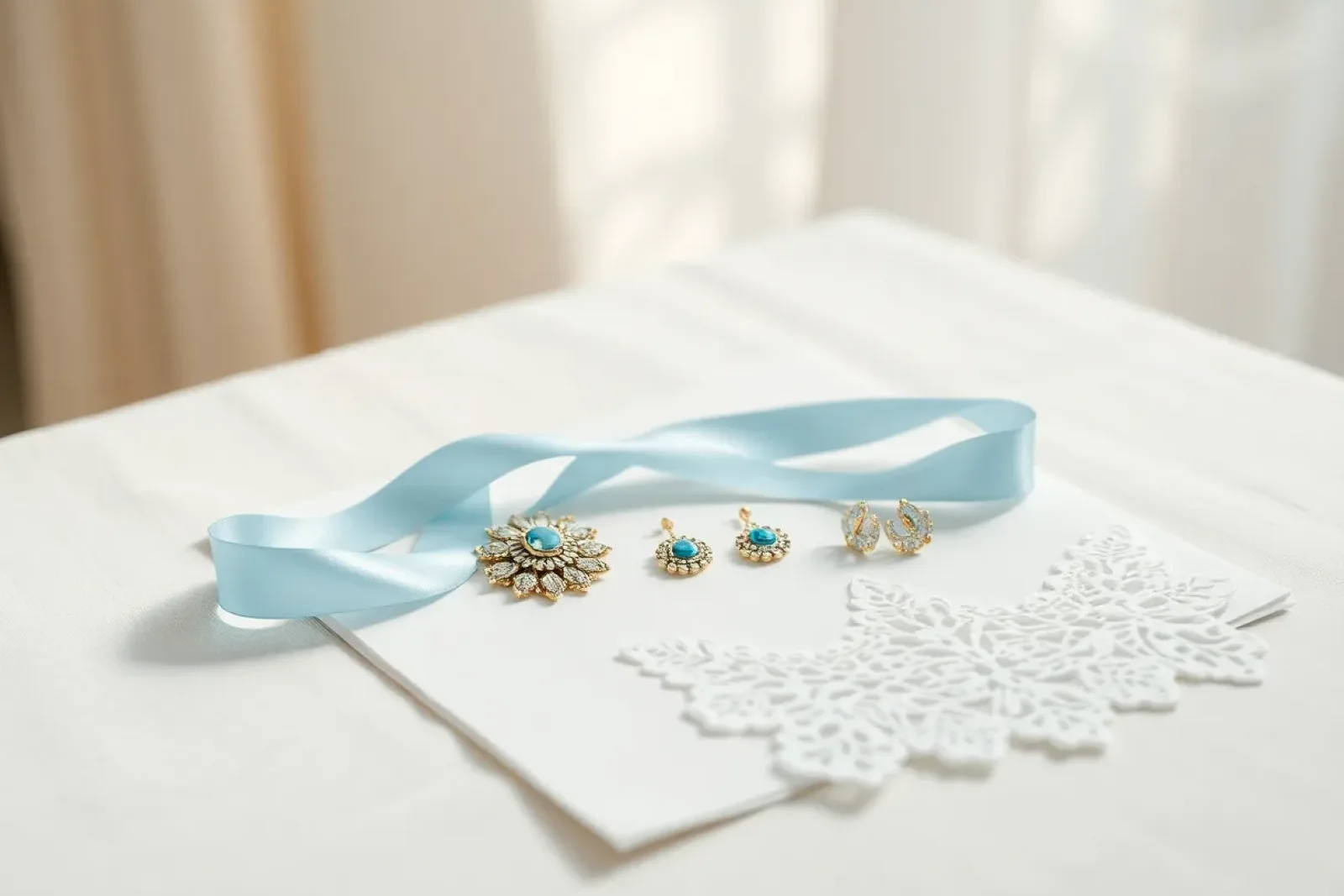
It is a Victorian English rhyme listing four good-luck items a bride carries: something old for continuity with her family, something new for the future, something borrowed from a happily married woman, and something blue for fidelity. A fifth line adds a silver sixpence in her shoe, for prosperity.
The rhyme is one of the few wedding customs that has survived almost unchanged into weddings that have dropped nearly everything else. Part of the reason is that it costs nothing, requires no audience and can be done entirely in private.
This article covers where it comes from, what each of the four items is supposed to mean, the sixpence line that dropped out, and what people actually use today. It also looks at the versions that work when the traditional reading does not fit your family.
1. Where the rhyme comes from
The full version runs: something old, something new, something borrowed, something blue, and a silver sixpence in her shoe. It is English, and it is usually traced to Lancashire in the late nineteenth century, appearing in print in collections of local sayings from around the 1870s and 1880s.
That makes it Victorian rather than medieval, which surprises people. It arrived at roughly the same time as the white dress became standard, and both spread through the English-speaking world along the same route: printed etiquette, magazines and photography.
The sixpence is the part that fell away, and for a practical reason. Silver sixpences were withdrawn from British circulation in 1980, so the coin became a keepsake item rather than something in a purse. They are still sold as wedding gifts, often mounted or in a small box, at roughly 5 to 20 pounds in Britain and 10 to 25 dollars from American bridal sellers.
Outside Britain the rhyme travelled well to Ireland, North America, Australia and New Zealand, and hardly at all elsewhere. In continental Europe it is largely unknown, which is worth remembering if you are marrying into a family that has never heard of it.
Three of the four items are about other people. That, rather than the luck, is probably why the rhyme has lasted.
2. What each item is meant to mean
The readings below are the traditional ones. They are folklore rather than doctrine, and different sources phrase them differently.
| Item | Traditional meaning | Common choice |
|---|---|---|
| Something old | Continuity with family and the past | A grandmothers brooch, a handkerchief, a piece of lace sewn inside the dress |
| Something new | Optimism for the marriage ahead | The dress itself, shoes, earrings bought for the day |
| Something borrowed | Borrowed happiness from a marriage that works | Jewellery from a mother, aunt or friend |
| Something blue | Fidelity, constancy and love | A ribbon inside the hem, blue shoes, a stone in the bouquet |
| A silver sixpence | Prosperity | A coin in the shoe, or taped inside it for comfort |
The borrowed item carries the most specific instruction: it should come from a woman whose marriage is happy, the idea being that some of that luck transfers. It is also the item that most often produces the best story, because asking somebody for it is a conversation in itself.
Blue is often said to have been associated with fidelity and purity long before the rhyme, and there is a plausible line of descent from older European bridal dress. It is repeated everywhere, but it is not firmly documented, so treat it as the received explanation rather than as a fact.

3. What people actually use
The four items are meant to be small and mostly hidden. Nothing here needs to be visible in a photograph.
Old. A relative's ring worn on the right hand, a locket pinned inside the dress, a fragment of a mother's or grandmother's wedding dress sewn into the hem, a family rosary or prayer book, a watch. Where a parent has died, this is frequently the item that carries them into the day.
New. The easiest of the four, because the outfit usually supplies it. If you want it to mean something, make it the item you will keep wearing afterwards rather than the one you will wear once.
Borrowed. Earrings, a bracelet, a veil, a hair comb, a handbag. The point is the lending rather than the object, so ask for something the lender actually cares about and give it back promptly.
Blue. The most inventive category. A ribbon stitched inside the hem, blue thread in the initials, blue soles on the shoes, a sapphire, forget-me-nots or thistles in the bouquet, blue nail polish, a blue label sewn in by whoever made the dress.
A note on the garter, which is the item most often assumed to be the blue one. It works perfectly well, but it is only one option among many, and it comes attached to a separate reception tradition that not everyone wants.
Related articles
4. When the traditional version does not fit
The rhyme assumes a bride with a family archive, a mother to borrow from and a wedding built around her. Plenty of weddings are not that, and the custom adapts easily.
- No family heirlooms. Old does not mean antique. A book you have owned since childhood, a ticket, a piece of costume jewellery from a market, a friends old necklace all qualify.
- Estranged or absent family. Borrow from chosen family instead. The rhyme says a happy marriage, not a blood relative.
- Two brides, or two grooms. Both can carry all four, or split them, or ignore the gender of the tradition entirely. Nothing in the rhyme requires a bride at all beyond its own history.
- A second marriage. The items work identically. Old can be something from the years in between rather than from childhood.
- You are not superstitious. Read it as four categories of memory rather than as luck, which is closer to how most people treat it anyway.
The one version that does not work is the shopping-list version: four items bought new in a week specifically to tick the boxes. Old and borrowed both derive whatever meaning they have from the fact that somebody else had them first.

5. Who organises it, and when
In practice this is a job for the morning of the wedding, but the collecting starts weeks earlier and often falls to whoever is closest to the bride.
- Six to eight weeks out: ask for anything borrowed. Asking on the day puts people on the spot and rules out anything that is not in the room.
- Two weeks out: check that the item works with the outfit. A brooch with no safe place to pin it is a problem better discovered early.
- The week before: put all four in one bag, with the shoes.
- The morning: whoever is helping to dress checks them off. This is the traditional moment, and it is usually quiet and quite short.
- Afterwards: return the borrowed item within a week, with a note. This is the part most often forgotten.
If several people are contributing something, keep a list; three aunts each quietly supplying a borrowed brooch is a real outcome. Small logistical notes like this are easiest to keep alongside the rest of the day's plan on your wedding website, where whoever is helping you dress can see them.
One last thing worth saying plainly: nothing bad happens if an item is missing. The rhyme is a piece of Victorian folklore, not a checklist with consequences, and a bride who arrives with three out of four is not owed a worse marriage.
Treat the four items as prompts rather than as requirements: something from your past, something for what is next, something lent by someone whose marriage you admire, and a small piece of blue nobody else will see. Ask for the borrowed item early, and give it back with a note. If nothing in the family archive fits, invent your own version and let it become the thing your children hear about.
All things wedding
Plan your wedding
Bring your tasks, costs and guests together for the day.
Invitations and wording
Find the right words for your wedding invitation.
As a wedding guest
Write a personal message and choose a thoughtful gift.
Wedding anniversaries
Explore anniversary names, traditions and celebration ideas.
Planning your dream wedding?
Create your own wedding website in minutes – with RSVP function, photo gallery, and more.