A proposal rests on three decisions nobody else will check for you: how secret it stays, how public it happens, and whether the ring is bought beforehand or chosen together afterwards. Place, date and words follow from those, not the other way round. And because one person makes all three alone, what decides the outcome is not the scale of the effort but how closely that person has been listening.
A proposal is the only part of a wedding one person plans alone. Everything that comes after it — the date, the venue, the guest list, the money — is settled by two, and every idea passes through a second head that disagrees, does the sums, or has a better one. With the proposal that second head is missing.
That produces a particular kind of mistake: not sloppy ones, blind ones. What nobody reads back does not come out worse, it comes out one-sided. The correction is to work on those three decisions before touching the staging — and then to plan the thing almost everybody forgets, which is the hour afterwards.
What follows from one person planning it
Every other decision about this wedding gets made under observation. The proposal does not, and that has three fairly predictable consequences.
The first: the planning drifts towards your own taste. People who like a grand gesture plan a grand gesture. People who find attention unbearable plan something so quiet the other person nearly misses it. Both are well meant, and both describe the planner rather than the person being asked. A usable test is three things your partner has actually said about proposals — about a friend's, about a scene in a film, about a video someone passed round the table. If nothing comes to mind, what you are short of is not an idea but material. Two weeks of paying attention is the real preparation, and it costs nothing.
The second: the yardstick slips. Effort looks like the currency this moment is paid in, and it is not. A whole industry argues otherwise — proposal planners, hired musicians, drone footage, a message on a stadium scoreboard — and it sells effort because effort is the part that can be invoiced. People who were proposed to rarely describe, years later, how many lights were strung up. They describe what made it obvious the moment had been built for them and for nobody else. That kind of recognition is cheap to buy and cannot be replaced by scale.
The third: surprise is not a constant. For some people it is the best part of the whole business. Others hate being caught unprepared — unwashed hair, no words ready, a moment they will remember with a wince. For that second group a known frame with an unknown moment works far better: that it is going to happen is settled, when is not. That is not a watered-down proposal, it is the right one.
This is the one decision of the whole wedding that nobody checks, including whether the idea actually suits the person it is meant for.
Secrecy or involvement is a scale, not a question
At one end sits the complete surprise. At the other sits the openly agreed proposal, where you both know you are getting married and only the moment is left open. In between lies what most couples actually do, and that middle has a worse reputation than it deserves.
The agreed version buys things that surprise rules out: the right ring, washed hair, a dress if a dress is wanted, parents waiting nearby, somebody to take a photograph. If you know the other person would like all of that, secrecy costs you more than it earns.
Anyone who chooses surprise anyway pays for it in the days beforehand, and usually not where they expect to. Proposals rarely fall over because a friend talks. They fall over on a bank statement, on a calendar entry with an odd title, on a card alert lighting up a shared lock screen, on the jeweller's email in an inbox two people read, on a courier ringing the bell when the wrong one of you is at home. Keeping a proposal secret is mostly a matter of planning your own traces, not your speech.
For confidants, one is enough, and you choose for discretion rather than enthusiasm. The brief for that person is mostly a list of prohibitions: no hints, no meaningful messages, no checking in the day before.
Parents are where this stops being a private calculation, because the custom answers differently on either side of the Atlantic. In the United States asking for a blessing is still the norm — The Knot's surveys put around two-thirds of couples doing it. In Britain the same custom is openly contested: a YouGov survey found roughly half of respondents thought it should be dropped, against about a third who wanted it kept, with women likelier than men to want it gone. Neither figure tells you what to do. What they tell you is that in one market the silence gets noticed and in the other the asking might. Whichever way you go, the arithmetic holds: every additional person who knows is one more risk, and the order in which everyone else finds out only begins after the answer.
If the plan gets guessed, one rule applies: bring nothing forward, throw nothing out. A proposal that has been seen coming is still a proposal, and the scramble couples improvise at that point does more damage than the guessing did.
In public, or just the two of you
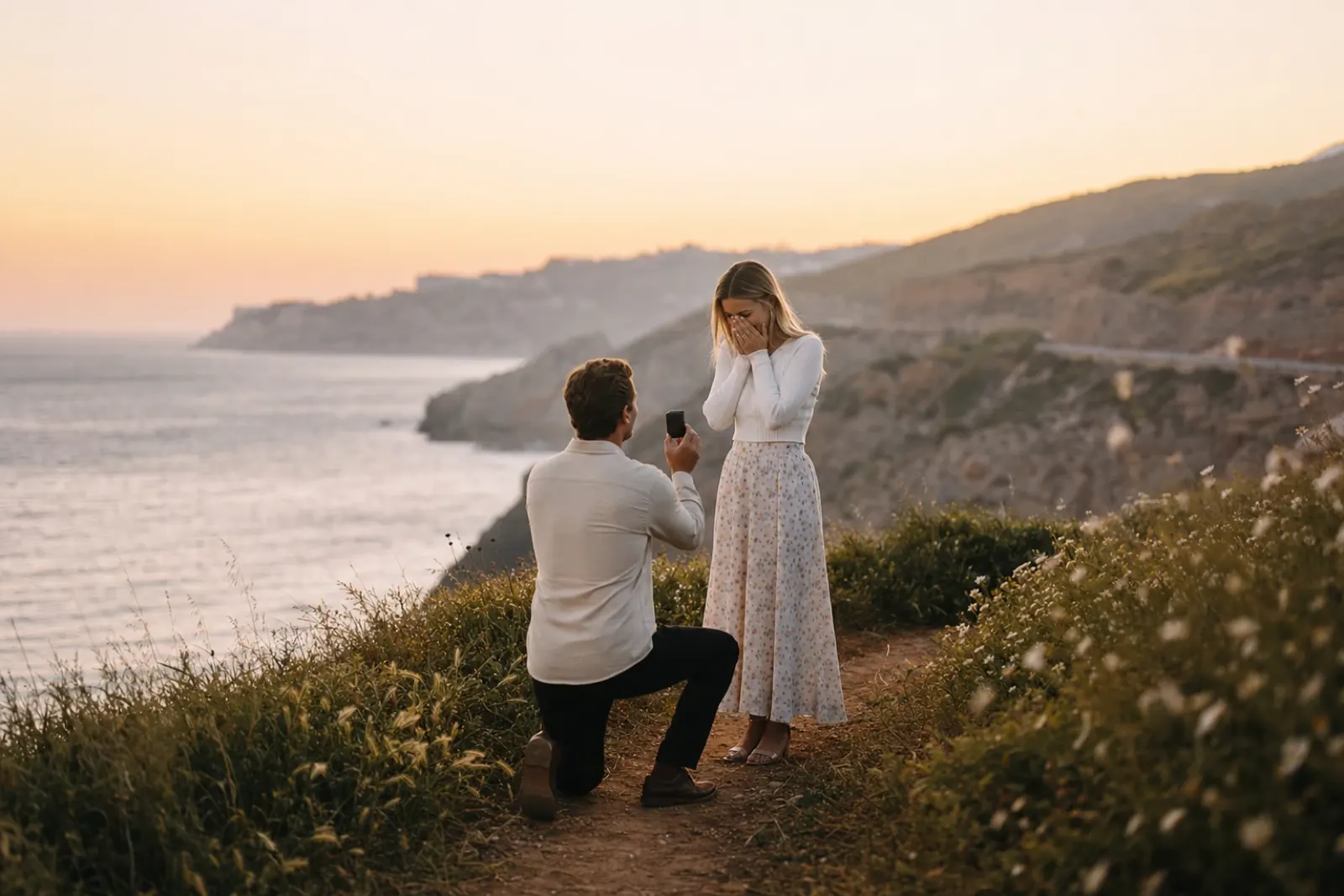
This decision carries the most risk, because it is taken about a person who has no say in it. Being watched is a matter of taste, not a general setting, and anyone who does not know which taste their partner has already has their answer.
There is a harder reason as well. In front of an audience, not yet cannot be said. A proposal is a question, and a question whose no has become technically impossible is no longer one. If you are not completely certain of the answer, that is an argument against spectators heavier than any idea about the picture.
An audience is also not one thing. A square, a beach, an observation deck supply anonymous onlookers who clap briefly and walk on — unbearable for some people, exactly the salt for others. Family and friends as an audience is something else entirely: that is a party somebody has been invited to without being asked whether they want to be celebrated. That version needs knowledge, not a guess.
The shape closest to what most couples actually want combines the two: the moment alone, the people ten minutes later. The next room, the restaurant round the corner, the parents' place on the way home. The question stays private and still gets shared the same evening.
Which leaves the photograph. Wanting one is entirely reasonable. Proposal photographers are a real service on both sides of the Atlantic, usually booked by the half hour, and the difficulty with them is not the fee. A stranger with a long lens changes the moment more than the pictures are worth — at least once they are spotted, and they usually are. A friend at a distance is more reliable, a propped-up phone is surprisingly often enough, and the most honest solution is the pictures from the ten minutes afterwards: hands, ring, two faces with nothing yet under control. Those are the ones that get shown later, not the staged ones.
Related articles
The ring does not have to be part of the moment
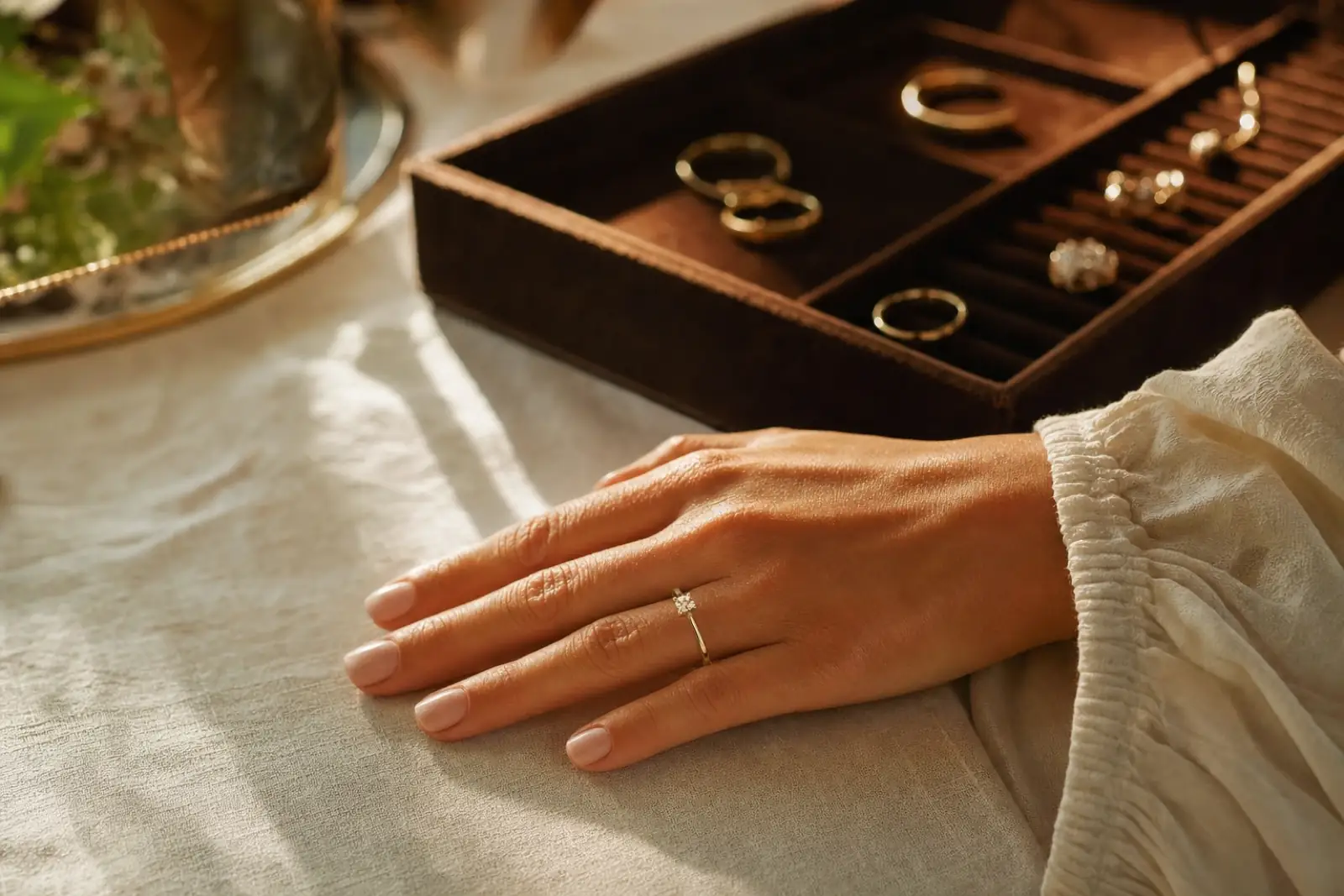
The ring is where planning alone gets most expensive, because a lasting decision is taken without the person who will wear the thing for years. The stock picture of a proposal has it finished and in a pocket. Nothing anywhere requires that.
For the moment itself only one question matters: does anything have to go on a hand at all? A plain band, a piece from the family, or nothing at all carries the proposal just as well, and some couples then choose two rings together afterwards, which removes the imbalance of only one person wearing a visible answer. Wanting the finished ring means taking on a decision chain of its own — taste, size, budget, returns — and that chain is long enough to be run as its own project rather than squeezed in behind a date.
What belongs here is the timing. A ring bought before the proposal creates a pressure of its own: it sits there, it wants to be used, and more than one proposal has been brought forward because a box in a drawer would not settle. Reverse the order and ask first, and that pressure disappears completely.
Timing, place, and the hour afterwards
For timing there is one rule with a long shelf life: pick a date that has nothing on it yet. It is also the rule most widely ignored, and the figures show it. In the United States, The Knot puts roughly 47 per cent of engagements in the stretch between Thanksgiving and Valentine's Day, with Christmas Day the single most common date of the year. British surveys land in the same place: December is comfortably the biggest month, and Christmas Day, New Year's Eve and Valentine's Day take the top three days. Those dates are popular because they are convenient, and convenience is what they cost. Two occasions merge for good, and most of those days come with relatives already at the table. Wanting the family there is a reason. Not having thought about it is not.
On a trip, go early rather than on the last evening. Then the rest of the holiday is the celebration instead of the wait, and if the first day is washed out there are days left over. The last evening also means a whole week spent next to somebody behaving strangely and checking their bag.
For the place, shared history beats scenery every time. Somewhere something happened between the two of you can be visited again; a backdrop works once. Spectacular locations fail reliably on small things: closed, crowded, scaffolded, or forty minutes uphill in the wrong shoes. If you have a place in mind, go and look at it beforehand on the same day of the week at the same hour. What is deserted at eleven in the morning can be a bus stop at seven in the evening.
One plan B is enough, and it should be indoors and minutes away — which in practice usually means home. A proposal at the kitchen table is not a fallback, it is the place where you actually live your life.
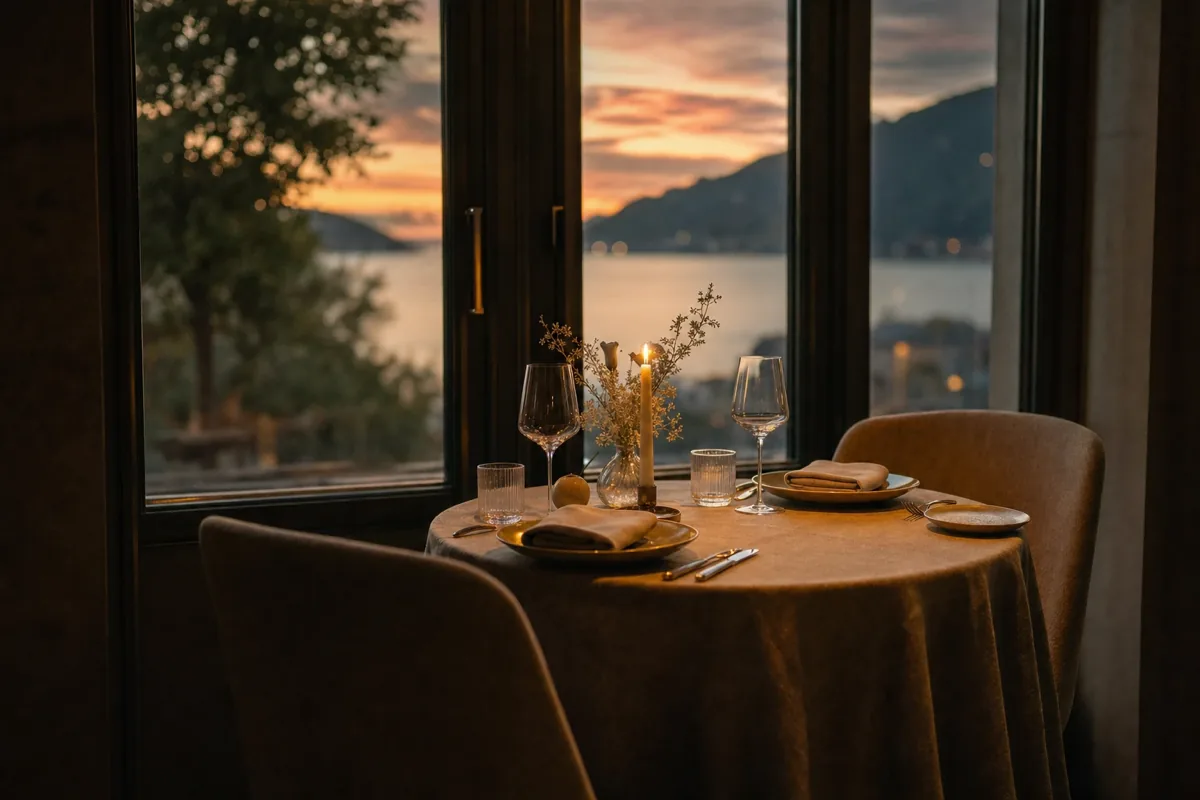
What goes wrong most often lies behind the moment. Nobody plans the hour afterwards, and that is exactly where the evening comes apart: the restaurant has no table, nobody is hungry, and the calls start before either of you has taken a breath. Two provisions cover it. First, the first half hour belongs to nobody but the two of you, and the phones stay away. Second, something to eat and drink is within reach regardless of how good the restaurant is later. After that comes a question you will answer a hundred times over the next few years, which is how it happened. The version you settle on that evening is the one that stays.
Secrecy, audience, ring: decide those three deliberately instead of letting them fall out of habit, and the proposal is planned. The rest is a place, the weather, and a sentence that will come out differently from the one you practised. With the answer, the only stretch of this wedding that one person carried alone comes to an end — from there everything is settled by two, starting with the conversations worth having before you marry. That is what the question was about in the first place.
All things wedding
Plan your wedding
Bring your tasks, costs and guests together for the day.
Invitations and wording
Find the right words for your wedding invitation.
As a wedding guest
Write a personal message and choose a thoughtful gift.
Wedding anniversaries
Explore anniversary names, traditions and celebration ideas.
Planning your dream wedding?
Create your own wedding website in minutes – with RSVP function, photo gallery, and more.