The ring is bought before the question is asked, so the first decision of an engagement is made before the proposal: choose it alone and keep the surprise whole, or go to a jeweller together. Only the solo route asks you to be right about taste and size in advance. Budget, returns and resizing all follow from that one choice.
A great deal is written about engagement rings and very little of it is usable. Most of it starts at the stone and finishes at a rule of thumb that came out of an advertising campaign. The questions that actually hold people up barely appear: how to find out a ring size without giving yourself away, how to read a taste nobody has ever stated out loud, and what happens when the ring turns out not to fit.
All three have answers. They are only unromantic enough that few people bother to write them down — and practical enough that they decide whether the ring is still being worn in twenty years.
Alone, together, or the third way
This decision is rarely made. It is usually inherited: the ring gets bought alone because that is how the picture of a proposal goes. Two real things are in tension, though, and both of them count — a moment that happens once, and a piece of jewellery worn every day on a hand everybody sees.
Choosing alone keeps the proposal completely intact. The price is a taste risk that no amount of research removes: setting, height, metal colour and stone shape are preferences many people only develop once they have seen rings on their own hand.
Going together takes the surprise out of the ring but not out of the proposal. Choose in the spring and ask in the autumn and it still surprises — in timing, place and wording, which are the parts anyone actually remembers afterwards.
The third way is underrated: propose with a stand-in and buy the real ring together afterwards. A plain band, a ring from the family, something openly provisional. The proposal happens as planned, and the ring decision moves to where it is better made — by two people, in a shop, with the ring on the hand that will wear it.
Two things settle this faster than any weighing up. If the person who will wear the ring has ever said they want a say, the question is already answered: that is not a request for less romance, it is a request for a ring they like. And not every couple follows the pattern at all — some wear two engagement rings, some buy them together, and for a great many there is no script about who is supposed to surprise whom.
Two months' salary was never a measure of a ring. It was a sales target, and it worked.
Reading a taste nobody has stated
Anyone buying alone has more evidence available than it feels like. The strongest of it sits in the jewellery box: metal colour. People are remarkably consistent about it. Somebody who has worn nothing but white metal for years is rarely happy in yellow gold, and the reverse holds just as firmly. It is the preference that changes least and the one hardest to correct afterwards, because it is the whole ring rather than a detail.
The second clue is the hand at work. Nursing, kitchens, labs, workshops, gardening, climbing: tall settings and splayed claws catch on gloves, fabric and hair, and a ring that catches ends up in a drawer. Low settings and closed bezels survive a day in which the hands do things.
Three points travel with the ring for decades and almost never come up at the counter:
- Nickel. Some white gold alloys contain it. In the UK and the EU, how much nickel an item may release onto skin is capped by regulation; in the US there is no federal limit of that kind, so nickel-free is a seller's claim rather than a threshold. For sensitive skin, platinum or palladium white gold is the safer answer in either market.
- Rhodium plating. White gold is usually rhodium plated. The plating wears through and is redone every few years — routine, inexpensive, and almost nobody is told beforehand.
- The wedding band. In the UK and the US the band goes on the same finger, directly below the engagement ring. Very tall or asymmetric settings leave a gap, which is why shaped bands exist and why they cost more.
Saved images are weak evidence by comparison: a ring that looks right on a screen is a mood, not a purchase. Which leaves the reliable route — one person let in on it, chosen for discretion rather than for closeness. Whoever is told has to hold it for weeks, and those weeks are the real test.
Getting the size without asking
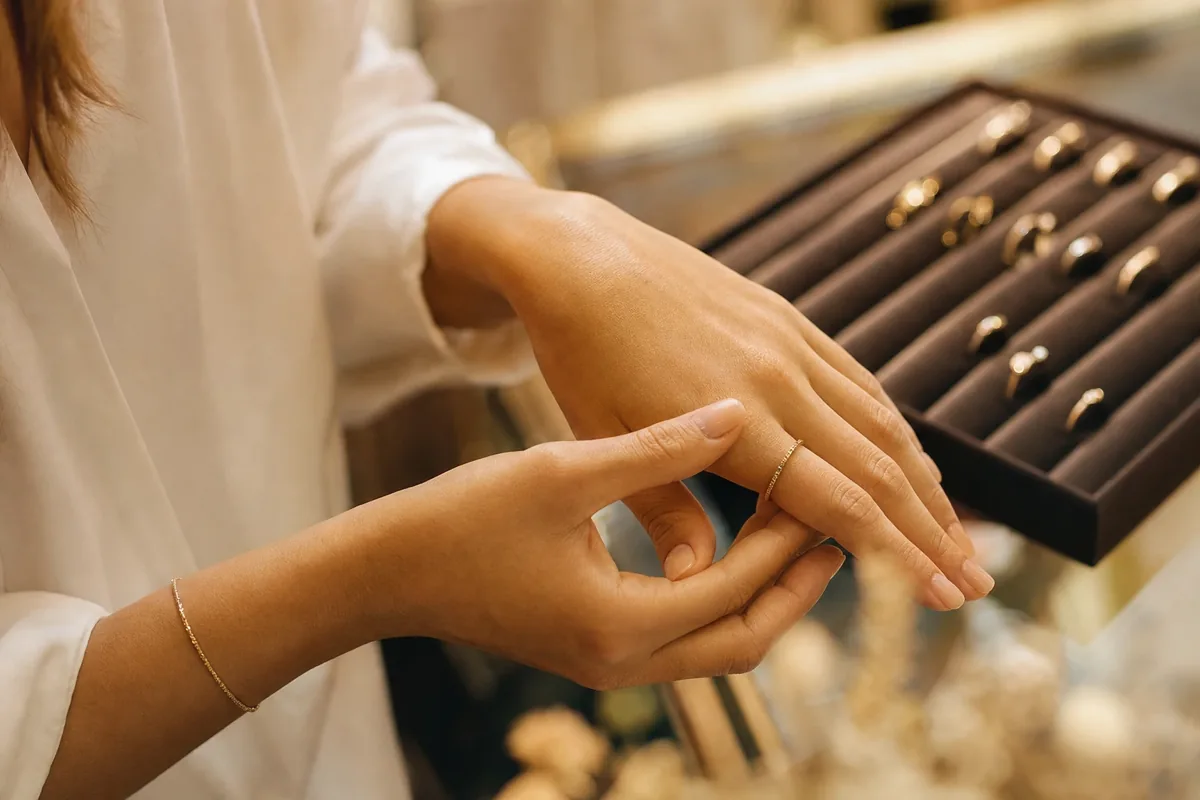
Two markets, two scales. The UK sizes rings by letter, A upwards; the US and Canada by number, with halves and quarters. Both are derived from the same measurement, the inside diameter of the ring, so that diameter in millimetres is the figure worth writing down. Any jeweller converts from it in seconds, and it still means something if you end up buying in the other market.
Which hand matters more than people expect. In the UK and the US the engagement ring goes on the left ring finger, so a ring borrowed from the right hand is the wrong template: for most people the dominant hand runs slightly larger, and the difference is often enough to leave a ring either stuck or spinning.
- Borrow a ring. One that is missing for a few hours is rarely noticed, and a jeweller measures it in minutes. The most accurate method there is.
- Take an impression. Press the ring into plasticine or a bar of soap if it has to be back the same evening.
- Trace the inside edge. Ring on paper, draw round the inside, measure across. Less precise, and better than nothing.
- Send somebody. A sister, a mother, a best friend — briefed to ask in passing rather than to investigate.
The thread tied round a sleeping person's finger appears in every guide and is the weakest suggestion in it: thread stretches, a knot sits either too tight or too loose, and the knuckle is not measured at all.
Two things make any measurement less reliable than it looks. Fingers move through the day — thicker in heat, after salty food and after exercise, thinner in the morning and in the cold. One measurement on a warm evening is not a size; two on different days is. And the knuckle has a vote: the ring has to pass it and then sits looser at the base, and a wide band fits tighter than a narrow one at the same nominal size.
If the number stays uncertain, there is a clear direction in which to be wrong: slightly too big. A loose ring can be held on the finger for the length of a proposal and adjusted the following week. A ring that will not go over the knuckle fails in exactly the moment it was bought for. And if you are guessing outright, guess near the middle of what shops sell most — L, M and N in the UK, 6 and 6.5 in the US — while remembering that this is a guess and not a measurement.
Related articles
Budget: the rule that never was one
Two months' salary is the best known number on the subject and the least useful one. It did not come from a survey. It came from the advertising agency De Beers hired in 1938, and the figure moved with the market it was being sold into: one month at first, two in the US by the 1980s, three in Japan, where diamond engagement rings had barely existed before the campaign arrived. A benchmark set by a sales target is not a description of a budget.
The second design fault sits deeper. The rule ties the spend to one person's income, when the money is either already shared or about to be. An engagement ring is often the last large purchase one of you decides alone, and the first that lands in a joint account.
What works instead is a plain frame: the amount that is there without moving anything else or borrowing. A ring on finance opens the engagement with a commitment only one of you agreed to, at precisely the point where the real spending starts.
Where the money actually shows is rarely the size of the stone. Wearability beats carat: workmanship, setting and metal decide whether the ring is still on the finger in ten years or only comes out for occasions. Lab-grown diamonds are chemically the same material as mined ones and cost substantially less; in the US, sellers are required to say so plainly rather than let the origin be assumed. They resell badly, which is an argument against the whole line of thought rather than against them — almost no jewellery returns what it cost. An engagement ring is not an investment and does not need to be.
Nor does it need to be final. Anniversary rings, resettings, a second stone after fifteen years: all of it is ordinary, and none of it takes anything away from the first ring. What it does take away is the pressure to get the perfect version of something the two of you have never once discussed.
Returns, resizing and insurance
The part that decides how happy you are three years later is negotiated before you pay. In the UK, buying in a shop carries no legal right to change your mind: a return is the retailer's policy, and only what is written on the receipt counts. Online, the Consumer Contracts Regulations give 14 days from delivery to cancel, but not for a ring made to your specification or clearly personalised, and engraving normally puts it in that category. In the US there is no federal equivalent in either direction — the window is whatever the store's policy says, and no returns on custom or engraved pieces is standard wording.
Weeks usually pass between buying and asking, and every window runs from the purchase or the delivery, not from the proposal. Buy in October, ask at New Year, and the return period has quietly gone. Raise it at the counter: plenty of jewellers will extend it when asked, and very few offer.
Four things belong in writing:
- Returns. Whether at all, until when, and for money or for credit.
- Resizing. Whether one is included, how many sizes the ring can take, and what further ones cost.
- Time. How long a resize takes — the reason a ring sometimes spends the first weeks of an engagement in a workshop rather than on a hand.
- Paperwork. The receipt, the metal and its fineness, and the certificate if there is a stone. An insurer will ask for all of it. In the UK the metal claim is checked by somebody other than the seller: gold over one gram, platinum over half a gram and silver over 7.78 grams has to carry an assay office hallmark before it can be sold as precious metal. The US has no assay office, so a stamp there is the maker's own statement about its own product.
Not every ring can be altered, and that is settled at the counter rather than in the workshop. Full eternity rings and settings that run right around have to be rebuilt; very fine work suffers; titanium, tungsten and ceramic can be neither soldered nor stretched. One or two sizes is the ordinary range, beyond which a ring is remade rather than adjusted. If the size is the uncertain part, a simple setting leaves you in a far better position.
Then the insurance, which almost nobody thinks about until afterwards. UK contents policies pay out only up to a single article limit — commonly somewhere between £1,000 and £2,500 — unless the ring is named on the policy, and cover away from the home, along with accidental loss, usually sits in a personal possessions add-on. In the US, standard homeowners and renters policies typically cap jewellery theft at around $1,500 and exclude loss and unexplained disappearance altogether; a ring scheduled separately on a rider is covered for those, and the insurer will want a valuation. In both markets the commonest way a ring goes missing is being left somewhere, which is the one event basic cover does not pay for. Keep the receipt, the hallmark or stamp details and the valuation with everything else the wedding is already generating — a folder, a shared document, or a wedding website of your own.
Three decisions sit in front of the proposal: alone, together or with a stand-in; a size taken from two measurements rather than one; and an amount that follows from your account rather than from an advertising campaign. Everything after that can still be changed — provided it was written on the receipt first.
All things wedding
Plan your wedding
Bring your tasks, costs and guests together for the day.
Invitations and wording
Find the right words for your wedding invitation.
As a wedding guest
Write a personal message and choose a thoughtful gift.
Wedding anniversaries
Explore anniversary names, traditions and celebration ideas.
Planning your dream wedding?
Create your own wedding website in minutes – with RSVP function, photo gallery, and more.