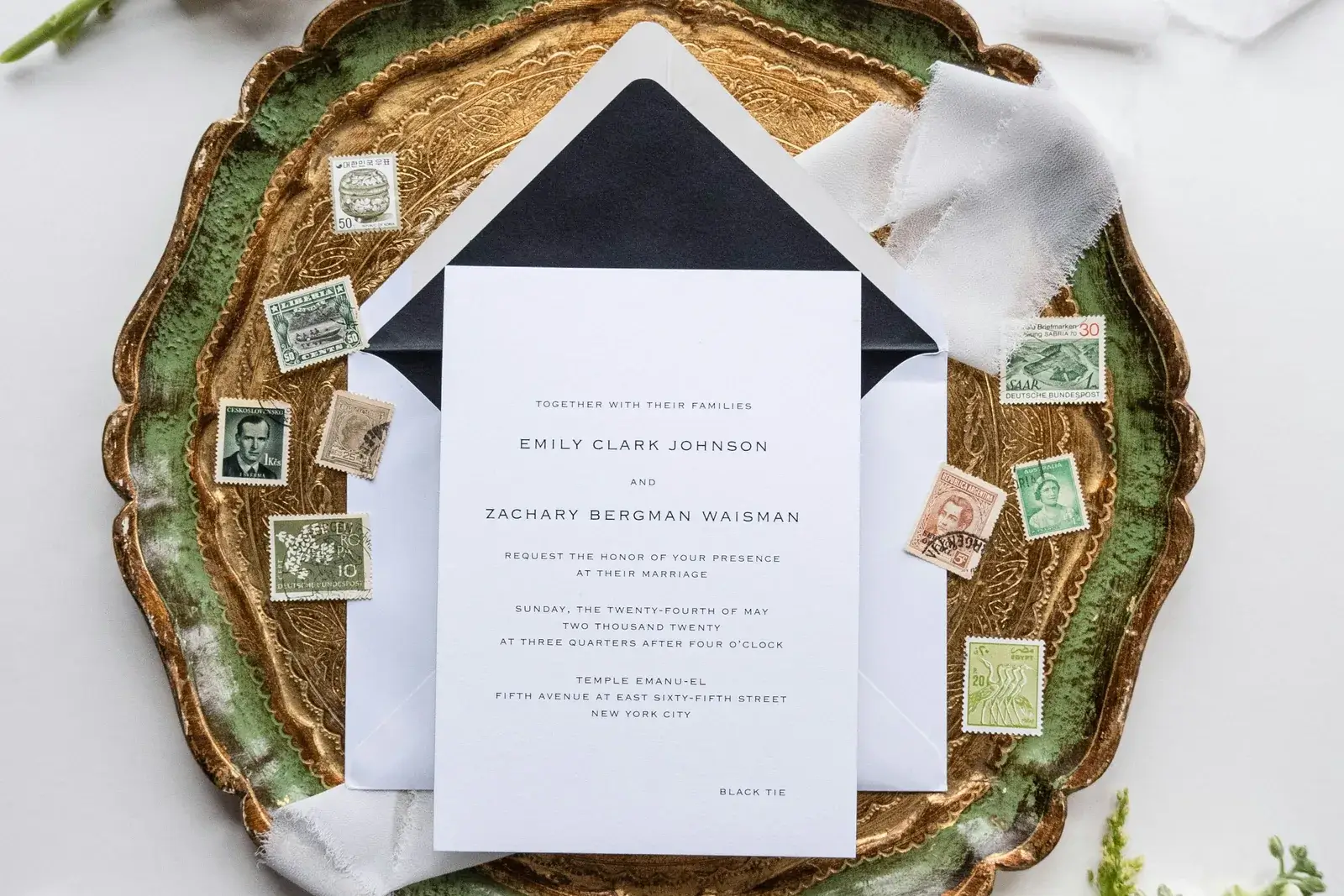
Do both: enclose a reply card and offer an online route beside it. Most guests reply faster and more completely online, while the card reaches the rest. What matters is not the medium but that the deadline, the route and the number of people are stated unmistakably on the card.
The reply is the part of your stationery that carries the most weight. Your final headcount, the seating plan, the menu and the room bookings all come out of it. It is also the part that most reliably goes wrong — not out of rudeness, but because replying is a small hurdle.
Every action you place between the question and the answer costs you replies. A card has three of them: fill it in, stamp it, post it. An online form has one.
This article covers what belongs on a reply card, where it gets in guests' way, how an online reply makes the same thing easier, and how to run both without keeping two sets of books.
1. What belongs on a reply card
A reply card is a form and should be built like one: short, unambiguous, with nothing left to interpretation. Six elements are enough.
- A name field with enough room — not the word "Name", but a line two names will fit on.
- Accepts and declines as two tickable lines, not as an open question.
- Number of people, asked explicitly. Without this field you are guessing.
- Menu choice or dietary requirements, where there is a served meal.
- Accommodation, if you are holding a block of rooms.
- The reply deadline, with a full date, clearly visible.
What does not belong on it: song requests, arrival times or lift-sharing. Every extra field lowers the chance of the card coming back at all. Those things can be collected later, once the acceptance is in.
A small detail with a large effect: number the cards discreetly on the reverse and keep a matching list. Cards reliably come back with no name filled in — with a number you still know whose it was.
Format is a decision too. Postcard-sized or smaller is usual, so the card travels with the invitation without pushing the envelope into the next postage band. Leave space between fields: a card where two names and a menu choice are crammed into three centimetres gets filled in illegibly, and you will decipher it together later.
Word the decline as warmly as the acceptance. "We're so sorry, we can't be there" is a complete answer and should not read as a confession. Guests who have to decline otherwise put it off — and those are exactly the replies missing from your final count.
Every extra action between question and answer costs replies. Fill in, stamp and post are three of them.
2. Stamped or unstamped?
If you enclose a reply card, enclose it stamped. This is the one place in wedding stationery where money converts directly into reply rate: an unstamped card asks the guest to find a stamp, and that is precisely where the reply stalls for two weeks.
The arithmetic is straightforward. At current US rates a USPS Forever stamp costs 82 cents, effective 12 July 2026, and the return envelope needs one of its own. Sixty stamped reply envelopes come to roughly $49 — a manageable line item set against sixty chasing messages.
Buy those stamps in the same visit as the outbound ones. A Forever stamp keeps its value whatever the rate does afterwards, so a return envelope stamped in June is still fully franked when the card comes back in August. The only thing to check is the shape: if the reply envelope is square, it needs the non-machinable surcharge as well, and a guest asked to top up postage on a reply card will simply not send it.
Two practical notes. The return envelope must carry your full address, printed rather than handwritten, or it will reliably come back without one. And the stamp goes on the envelope, not in it — a loose stamp gets lost.
If you would rather not enclose a stamped envelope, drop the printed reply card altogether and run replies online. The half-measure — a card with no stamp — is the only option that performs measurably worse than either clear choice.
For guests abroad, a domestic stamp is useless. Give those guests the online route, or accept that their reply will come by message. Sorting the international pile at the addressing stage means you notice this before you buy stamps rather than after.
3. Where online replies are better
The obvious advantage is speed: a guest who reads the invitation in the evening replies in the evening. The more important advantage is completeness. A paper card with a blank field still comes back; a form can ask for the missing information before it accepts the answer.
It also removes a round of follow-up questions. Dietary requirements, allergies, plus-one names and accommodation preferences all arrive in the same list that will later produce the seating plan and the place cards. That saves time and removes an entire class of error: transcription.
And it allows changes. Guests accept and later withdraw, partners change, someone remembers an allergy two weeks out. On paper that means a phone call and a handwritten correction; online it is an update you can see.
The drawback is real but limited: some guests will not reply online, either because they prefer not to or because the route is unclear. That is why the paper card sits beside it — and why the online route belongs in one clearly written sentence on the card rather than in a footnote.
Do not require an account. The single biggest cause of abandoned online replies is a sign-up screen between the guest and the form. A guest who has to create a password to say yes will say yes by text message instead, and your list will be incomplete again.
Related articles
4. Wording for both routes
For the printed reply card, complete and ready to use:
- "We'd love to come — ____ person(s)." / "We're so sorry, we can't be there."
- "Names: ______________________________"
- "Menu: meat [ ] · fish [ ] · vegetarian [ ] · vegan [ ]"
- "Dietary requirements: ______________________"
- "We'd like a room: yes [ ] · no [ ]"
- "Please reply by 15 August 2026."
For the line pointing at the online route, on the invitation or details card:
- "The quickest way to reply is online at [address] — or send back the card enclosed."
- "Please let us know by 15 August, online at [address] or with the card in the envelope."
- "Everything else — directions, accommodation and the running order — is at [address]."
Two details decide whether those sentences work. The address has to be short and dictatable, and the QR code has to be large enough to work in poor light. A code under two centimetres square will not scan reliably in a living room in the evening.
Test both before you print. Dictate the address to someone over the phone and have them type it. If a hyphen, an accent or a confusion between the digit zero and the letter O appears, the address is too complicated. And scan the code from a printed proof rather than a screen — on uncoated paper a code loses noticeable contrast.

5. Managing replies instead of hoping
Expect a quarter of replies to be missing at the deadline. That is the normal case rather than the exception, and it should be planned for rather than resented.
Set the deadline at least ten days before the date you have to give final numbers. One week after it passes, run a chasing round for everyone who has not replied, split between the two of you, with a friendly sentence and a new, specific date.
Keep the running total in one place. The most common failure is not the missing reply but the duplicated ledger: one list in your head, one in a message thread and a stack of cards on the sideboard. When answers arrive through two channels, one list still has to be the truth — enter paper replies immediately rather than in one batch at the end.
And decide in advance what a non-reply means. What works in practice: anyone who has not replied a week after the chasing round counts as a decline and is not catered for. That sounds harsh, and it is fairer than a number based on hope — and it can be said on the phone in one sentence.
Keep the returned cards until after the wedding. They carry dietary requirements, plus-one names and the occasional handwritten note, and more than one couple has needed to check a card again the week before the day.
Enclose the reply card stamped, offer an online route as the faster alternative, set the deadline with ten days to spare and keep everything in one list: that is replies organised. Next, check your catering contract for the date final numbers are due — that date sets your deadline.
All things wedding
Plan your wedding
Bring your tasks, costs and guests together for the day.
Invitations and wording
Find the right words for your wedding invitation.
As a wedding guest
Write a personal message and choose a thoughtful gift.
Wedding anniversaries
Explore anniversary names, traditions and celebration ideas.
Planning your dream wedding?
Create your own wedding website in minutes – with RSVP function, photo gallery, and more.