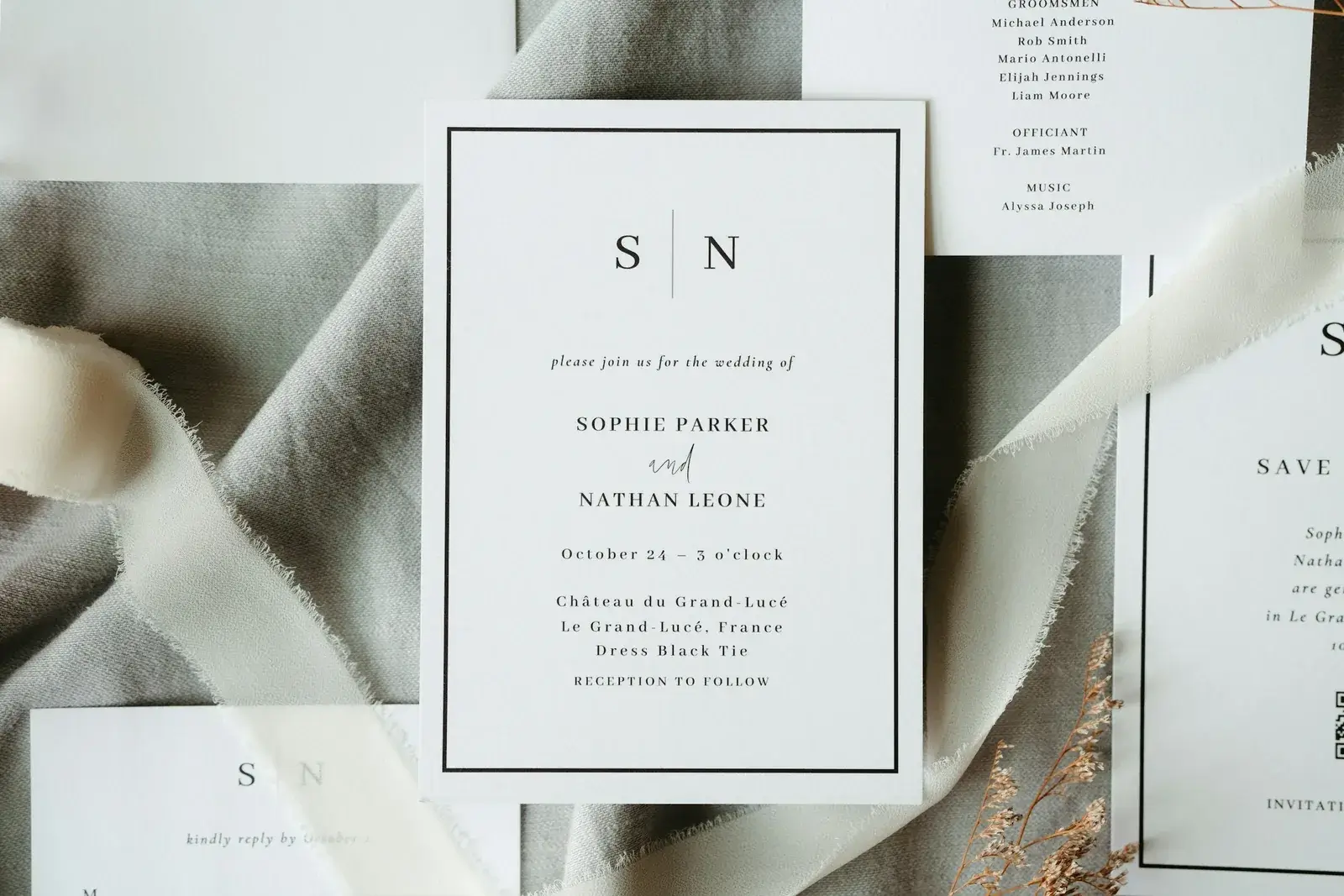
Paper wins for mixed guest lists; digital wins for short notice, scattered guests and tight budgets. The most reliable answer is the hybrid: a printed invitation for everyone, with replies and changeable details online. The card still lands on the doormat, and the replies collect in one place.
The question is usually framed as a matter of taste and is really a question about your guest list. A thirty-guest wedding where everyone is between twenty-five and thirty-five can be invited entirely digitally. A hundred-guest wedding where twenty of them are over seventy cannot.
Both routes have one clear strength and one clear weakness, and both are routinely misjudged — usually in the same direction, because the printed card feels more serious and therefore seems more likely to be answered.
This article compares them across six criteria that genuinely differ, then describes the split that most couples end up choosing.
1. The honest comparison
Six criteria, side by side.
| Criterion | Paper | Digital |
|---|---|---|
| Cost per household | Printing plus postage; the postage is the part you cannot negotiate. | Close to nothing, regardless of how many people receive it. |
| Reply rate | The reply card has to be filled in, stamped and posted — three actions. | One tap, often the same evening; reply rates are usually higher. |
| Work for you | Artwork, proofing, stuffing, addressing, stamping, transcribing replies. | Set up once, then almost none. |
| Effect | Stays on the side, gets kept, often ends up on the fridge. | Disappears down a thread if it is only a message. |
| Reach | Reaches practically everyone, whatever their age. | Requires an address, a device and a willingness to use both. |
| Changeability | Printed is printed; changes mean a second mailing. | Times, places and running order can be corrected to the last minute. |
Two rows are regularly misjudged. The first is reply rate: most couples assume a printed card is taken more seriously. In practice it is taken more seriously and answered later, because three actions sit between good intention and mailbox. The second is workload: printing is not the laborious part — stuffing and addressing are.
The last row has grown in importance. Anyone who has had to change a start time after printing knows that a corrected detail online saves an entire second mailing.
The medium does not decide your reply rate. How easy it is to answer decides your reply rate.
2. When paper is the right choice
Paper wins outright in three situations. First, mixed guest lists: as soon as a meaningful share of guests are older or only intermittently reachable online, the printed card is the only route that reaches everybody — and a wedding where twenty per cent of the list needs special handling is more work overall than one that runs the same way for everyone.
Second, when the invitation is meant to be part of the occasion. A card on heavy paper with a pressed name is an object people keep. That is not a rational argument, but it is a real one: plenty of guests still have invitations from years ago, and nobody keeps a message.
Third, at religious or formally structured weddings, where a printed invitation is simply expected. Invite digitally there and you will explain yourself in every branch of the family — which costs more energy than the postage.
Little argues against paper except cost and effort, and both are real. For sixty households, allow half a day for stuffing and addressing, and a postage line that changes class quickly once you add enclosures.
One thing paper does that nothing else does: it arrives without competing for attention. An envelope on the doormat has no notifications next to it, and for a share of your guests that is precisely why it gets answered.

3. When digital is the right choice
Digital wins on short notice. If there are fewer than two months between decision and wedding, the print lead time alone is a problem — a digital invitation goes out the same day.
It also wins where guests are spread internationally. International post is slow, expensive and, in practice, unreliable; an invitation that spends three weeks in transit loses exactly the planning time your guest needed.
And it wins on a tight budget. Paper is the one part of stationery that scales linearly with your guest count and charges twice — once at the printer and once at the post office. For a hundred and twenty households the saving is substantial and visible somewhere else.
Digital also handles the things paper cannot: dietary requirements, plus-one names, accommodation preferences and changes of mind after the fact. All of those arrive as data rather than as handwriting to be deciphered.
It comes with one condition, though: the invitation needs a fixed address where it can be found again. A message in a thread is gone in three days. A wedding website solves exactly that, because the date, place, running order and reply form stay in one place guests can still find a month later.
Related articles
4. The hybrid that usually wins
In practice most couples choose neither one nor the other but a split by function:
- Printed: the invitation itself — names, date, time, place and a line saying where everything else lives.
- Digital: the reply, including dietary requirements and allergies, plus-ones and accommodation.
- Digital: directions, parking, hotel suggestions, running order — anything that might still change.
- Printed as an exception: reply cards for the guests who would genuinely rather answer on paper, usually ten to fifteen per cent of the list.
This split is not only a compromise; on several counts it beats both pure forms. The invitation stays an object. Replying becomes easy, which lifts the reply rate. Changeable details live where they can be changed. And answers collect in one place instead of across reply cards, messages and two phone calls.
The extra effort is small: one sentence on the card and a short, legible link or QR code on the details card. What matters is that the route to replying is explained in a single sentence and does not require guests to create an account.
One warning belongs with it: the hybrid only works if both routes feed the same list. Enter every returned card into the same place as the digital replies on the evening it arrives, or you will end up with two versions of the truth and count three times.

5. What actually decides it
Three questions settle this faster than any discussion of principle.
How many guests can you reach digitally with confidence? Go down the list and mark the ones you are unsure about. Under ten per cent, a digital route with a few printed exceptions makes sense. Over that, paper becomes the base case.
How much can still change? Is the running order settled, or will things move until four weeks out? The more that is open, the stronger the case for keeping changeable details out of print.
Who is doing the work? Stuffing, addressing and stamping sixty envelopes is a real evening for two people, and transcribing the replies is a second one. If those evenings have nowhere to go in your calendar, the decision has already been made.
What should not decide it is the worry that digital seems careless. That impression comes from the text and the care taken, not the medium. A thoughtfully written digital invitation with a personal line reads warmer than a printed form letter without a single handwritten character.
Paper for the invitation, digital for replies and changeable details, printed reply cards as an exception for those who prefer them: that split covers almost every guest list. The next step is counting — mark the people you can reach digitally with confidence, and the decision makes itself.
All things wedding
Plan your wedding
Bring your tasks, costs and guests together for the day.
Invitations and wording
Find the right words for your wedding invitation.
As a wedding guest
Write a personal message and choose a thoughtful gift.
Wedding anniversaries
Explore anniversary names, traditions and celebration ideas.
Planning your dream wedding?
Create your own wedding website in minutes – with RSVP function, photo gallery, and more.