A viewing is not a walk round, it is a measuring appointment. Take a tape measure, a phone with a compass and a printed list, work through the house in the order your guests will experience it, and ask on site every question whose answer you want in writing later. For everything else the website is enough.
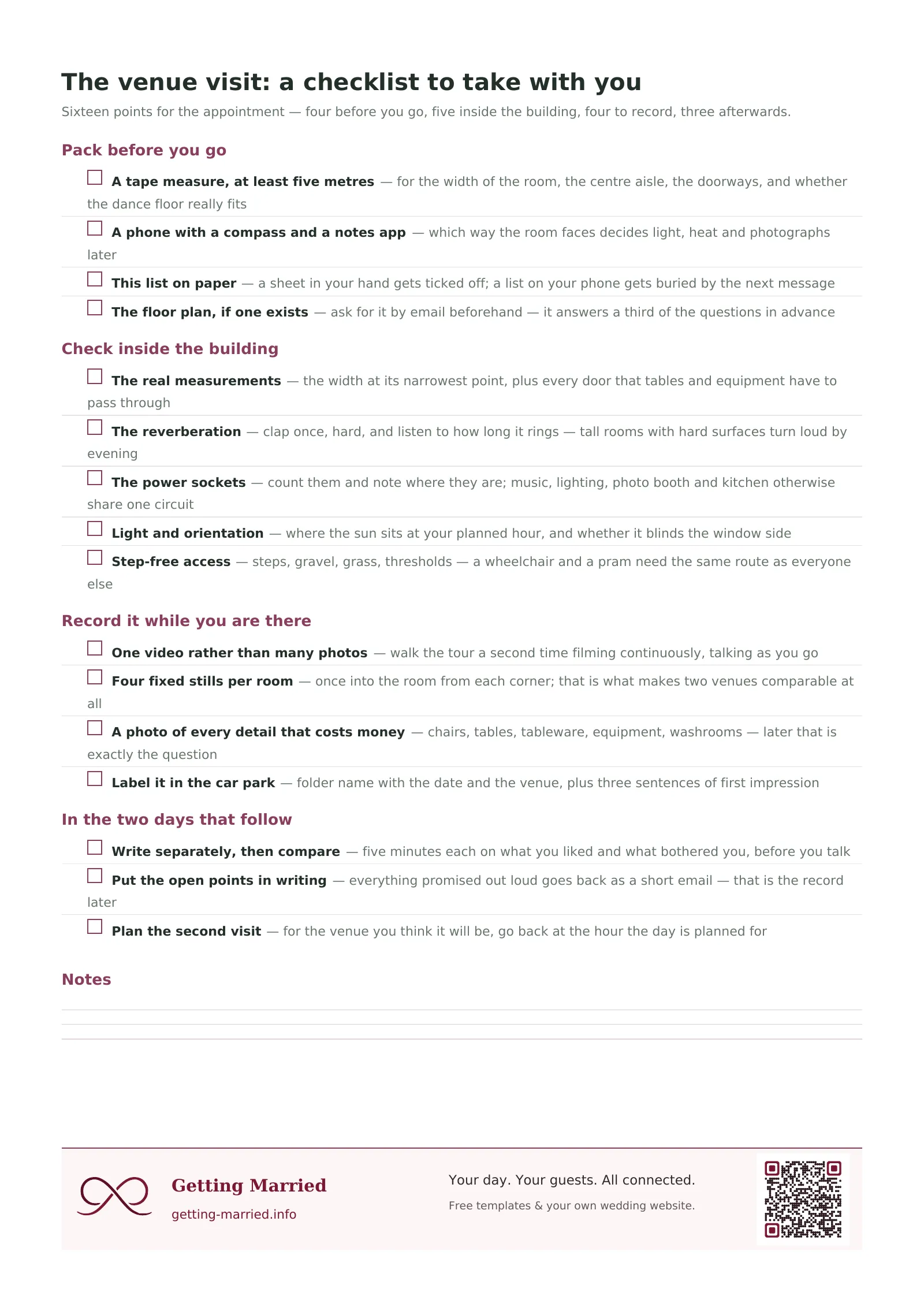
See the template before downloading
The preview shows the first page of the actual blank template. No account needed; your own details belong on your printed copy.
 Download PDF
Most couples drive home from a viewing with a good feeling and remarkably little information. That is not their fault: an empty, tidy room with a friendly host is a pleasant situation, and nobody enjoys asking about power sockets in one. Yet those are exactly the questions that decide later whether the wedding day is improvised.
What follows is what to prepare, in which order to walk the house, which five things can only be settled on site, and what has to happen in the two days after the appointment. The same sixteen points exist as a checklist to print out — a sheet in your hand gets ticked off, a list on your phone does not. The contractual points — finish time, catering tie-in, exclusivity — are deliberately left out; they are collected in the piece on the questions about the small print.
1. What you take with you, and what you agree beforehand
The kit is small, and it is the difference between an impression and a basis for a decision.
- A tape measure, at least five metres. For the width of the room, the aisle, the doorways, and the question of whether the dance floor really fits where the plan draws it.
- A phone with a compass and a notes app. Which way the room faces decides light, heat and photographs later.
- The list on paper. A sheet in your hand gets ticked off; a list on a phone gets pushed away by the next message.
- The floor plan, if one exists. Ask for it by email in advance; it answers a third of the questions before you arrive.
Agree two roles beforehand. One of you leads the conversation and listens, the other takes notes, measures and photographs. Try to do both at once and you do neither well. Swap impressions after the appointment, before you blend them — two separate assessments are worth more than one joint verdict formed in the car.
Settle as well which numbers you are working with: the head count you are planning on, and the times at which things are meant to happen. Without those the answers on site are non-binding, because every statement about capacity depends on them — how strongly is shown in the piece on the guest number a room really carries.
Whatever you did not measure on the viewing, you will measure on the wedding morning — with sixty people in the room.
2. The walk-through in your guests' order
Venues almost always begin a viewing in their best room. Turn that round and walk the route a guest walks on the wedding day. Gaps show up on that route that stay invisible in the beautiful room.
| Stop | What you check |
|---|---|
| Approach and parking | How many spaces, how far on foot, lighting for the walk back at night |
| Arrival and welcome | Where guests stand in the rain, is there a cloakroom, who staffs it |
| Ceremony or reception spot | How many seats, what surface, shade, route to the main room |
| The main room | Dimensions, pillars, sightlines to the top table, where the dance floor goes |
| Toilets | Number, distance from the room, condition, accessible cubicle |
| The way out at night | Lighting, trip hazards, taxi drop-off or turning space |
Two stops get skipped regularly and take their revenge reliably. The first is the toilets: event planners work to one toilet for every fifty guests, so that no queue forms during the break. Eighty guests and a single cubicle is the thing that gets talked about afterwards.
The second is the way out. A courtyard that looks charming at three in the afternoon is an unlit expanse of gravel at one in the morning. Ask which exterior lights are on at night and whether they can be switched.
3. Five things that can only be settled on site
Almost everything can be handled by email. Not these five — they need your body in the room.
- The actual dimensions. Measure the room at its narrowest point, and the doors that tables, kit and cake have to pass through. A doorway under 80 centimetres (about 32 inches) is a problem for anything on wheels.
- The reverberation. Clap once, hard, and listen to how long it rings on. In tall rooms with hard walls, nobody at eighty guests hears the speech from the far end of the table. That is not a reason to rule the room out, it is a line in the audio budget.
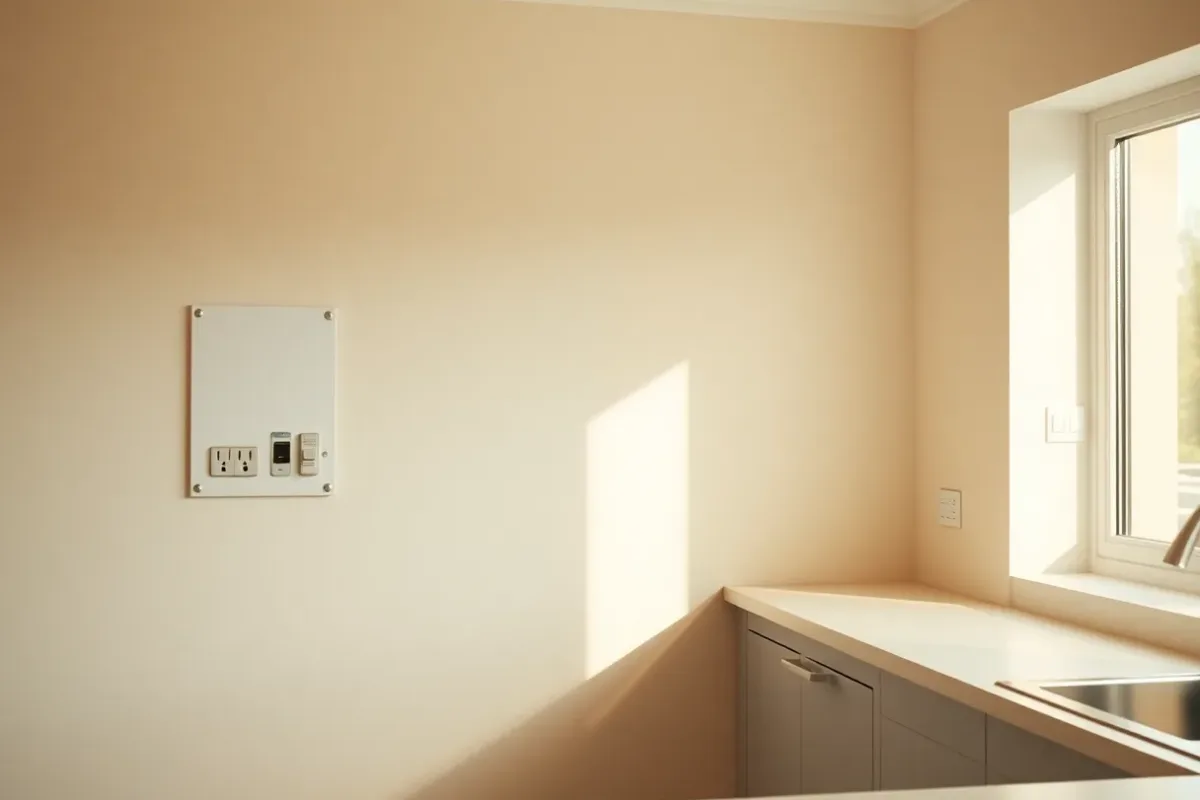
- The sockets. Count them and note where they are. Otherwise music, lighting, photo booth and kitchen all end up on one circuit. Ask at the same time what the circuits are rated at, and convert that rating into kilowatts before you plan anything on it: the same number of amps buys roughly twice the power on 230 V as it does on 120 V.
- Light and orientation. The compass tells you where the sun will be at the hour you are planning, and whether that wall of windows dazzles in the afternoon or turns the room into an oven.
- Step-free access. Steps, gravel, grass, thresholds. Guests with limited mobility, a wheelchair and a pram need the same route as everyone else, not the back door.
Write the room dimensions down regardless, even if you have no use for them at that moment. They are the basis for the seating plan later, and they are the only solid counterweight to the number printed in the brochure.
Related articles
4. Filming, photographing, labelling
After the third viewing the houses blur together. The only thing that helps is a fixed recording routine, and it takes less than ten minutes.
- One video instead of many photos. Walk the route a second time and film it in one continuous take while saying out loud what you are seeing. The sound matters more than the picture.
- Four fixed stills per room. One into the room from each corner. That gives you a comparable set for every house.
- A photo of every detail that costs money. Chairs, tables, crockery, technical kit, washrooms. That is exactly the later question: what was actually included?
- Label it in the car park, not at home. Folder name with the date and the venue, plus three sentences of first impression. Two weeks on you will not remember.
Ask briefly beforehand whether you may film — it is almost always allowed, but being filmed unasked is uncomfortable. If a house says no, note that down: a room you are not allowed to document is a room you can later only argue about from memory. The same set of recordings is worth having twice over, incidentally, because it is the basis for the conversation with your photographer; what belongs in that conversation is in the photography checklist.
5. The 48 hours after the appointment
The appointment does not end when you get in the car. Three steps still belong to it, and they are time-critical, because memory fades fast.
- Write separately, then compare. Each of you spends five minutes noting what you liked and what bothered you. Only then do you talk about it.
- Put the open points in writing. Everything promised verbally on site goes back as a short email: “We noted that … could you confirm that briefly?” That is not an act of mistrust, it is the groundwork for the contract.
- Plan the second visit. For the house you think it will be, a second appointment at the planned hour and, if you can, in a comparable season is worth it. Light, temperature and noise at five on a high-summer afternoon are not the ones at eleven on an early-spring morning.
The written follow-up is a test in itself. Houses that happily confirm verbal promises afterwards work cleanly. Houses that dodge are telling you something important. And as soon as two quotes lie side by side, it is worth reading them against your budget plan: the difference between the two shows up in every other line of it. Which of these points end up in the contract, and how they should be worded there, is taken apart in the piece on the venue contract.
A good viewing is unspectacular: you measure, you clap, you count sockets, you walk the guest route, and afterwards you write two separate sets of notes. What comes out of it is not a mood but a list, and a list can be compared with the list from the next house.
The next step: print the points from this article, add two questions of your own, and put the sheet in the car before you book the first appointment.
All things wedding
Plan your wedding
Bring your tasks, costs and guests together for the day.
Invitations and wording
Find the right words for your wedding invitation.
As a wedding guest
Write a personal message and choose a thoughtful gift.
Wedding anniversaries
Explore anniversary names, traditions and celebration ideas.
Planning your dream wedding?
Create your own wedding website in minutes – with RSVP function, photo gallery, and more.