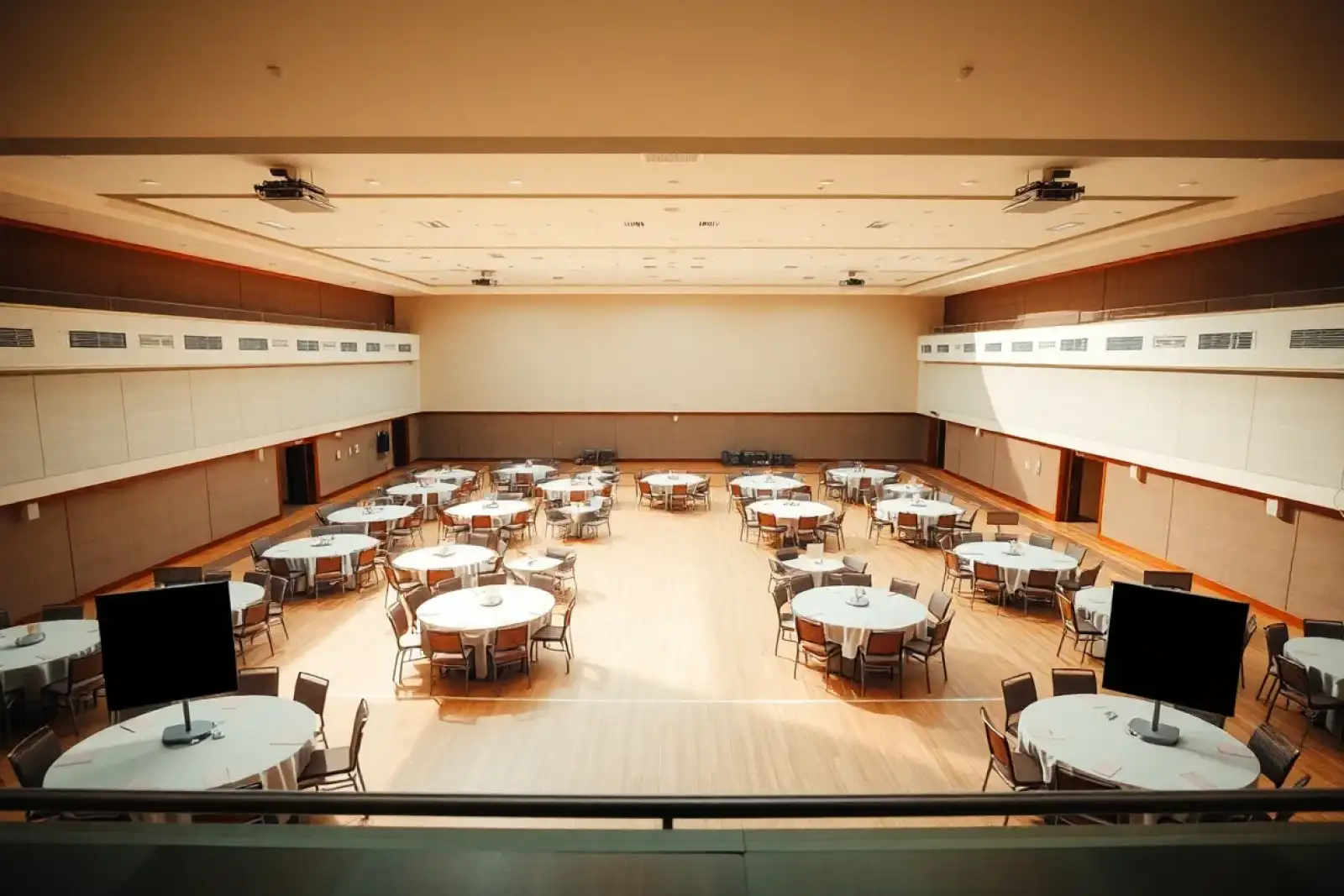
Search for a venue on numbers rather than photographs: a rough guest range, a budget ceiling, a region, and a date window several weeks wide. With those four figures an enquiry comes back as a real quote instead of a list of questions — and two thirds of your candidates drop out before the first site visit happens at all.
The venue search feels at the start like a matter of taste, and it is really a matter of sequence. Almost every couple who ended up replanning sat in the same trap: they fell in love with a place before they knew how many people they wanted to invite and what the evening was allowed to cost. After that every further decision becomes a compromise against a number that was fixed from the beginning.
This guide covers the road from the first idea to the point of signing: which figures you need beforehand, where to look, what an enquiry that gets answered looks like, and how to spot a mismatch in the quote itself. The questions for the visit are set out in detail in the piece on what to ask when you view a venue — this one is about everything before that.
1. The four figures that come before any search
Before you open a single website you need four rough values. Rough is enough — the point is not accuracy, it is being able to filter at all.
| Figure | How precise | What it filters |
|---|---|---|
| Guest range | A span, say 60 to 80 people | Rules out rooms that are too small and too large |
| Budget ceiling for room and food | An amount you do not want to pass | Decides between a package and free costing |
| Region | Travel time from where most guests live | Determines whether overnight stays become necessary |
| Date window | Several weeks, not one date | Triples the number of houses still free |
The date window is the underestimated one. Fix on a single Saturday in advance and you are effectively searching only among the houses still free on that exact day, which in peak season is the smallest set you will ever search — May to September across most of Europe and North America, the opposite half of the year in Australia and New Zealand. A window of four to six weeks, holding four to six Saturdays, opens the same search to a multiple of the houses.
With the budget ceiling it helps to divide it down to the head once, because that is exactly how venues cost their work. If you have set aside a fixed sum for room, food and drink and you are counting on 80 guests, that sum divided by 80 is your per-head figure, and that single number answers half the quotes by itself. What else sits in a wedding budget is worked through in what a wedding costs, and budget planning shows how far the venue block shifts everything else.
A venue that fits your guest count takes four weeks to find. A guest count that fits your venue takes six months.
2. From twenty candidates down to three site visits
Searching is easy; ruling out is the work. What holds up is a funnel in three stages, which takes about four weeks and leaves three serious candidates at the end.
- Longlist, around twenty houses. Everything that could work at all on size, region and price bracket. Nothing is checked here, only collected: name, place, website, rough capacity.
- Enquiries, around eight houses. From the longlist, the ones whose capacity fits and who have any dates at all inside your window. The same enquiry goes to all eight.
- Site visits, three houses. Whoever answers quickly, completely and warmly makes the shortlist. Whoever has not answered after two weeks and a reminder will be exactly that reachable on the wedding day.
Where you search matters less than how widely. The usual directories show you who pays to be listed there; they are a start, not a complete picture. Add three sources that reliably turn up houses no directory carries: the map view of your region, worked through systematically; the portfolios and blog posts of photographers who shoot locally, because those show real celebrations in real rooms; and a question to the local council or town hall about which halls, yards and houses are let out nearby.
One warning about image searches. Interior shots on venue websites are almost always taken wide-angle and without guests. A room that looks generous in the photograph can be tight with sixty people, their chairs, a buffet and a dance floor in it. So the next stage runs on the number rather than the picture — how many people genuinely fit is covered in venue capacity.

3. The enquiry a venue actually answers
Venues get a lot of enquiries in season and answer first the ones they can cost a quote from. A message saying “what does a wedding with you cost?” is not one of those. These six details make it one:
- Date or window — say whether you are flexible.
- Guest numbers as a range — daytime and evening separately, if those differ.
- Time window — from when to when you need the room, set-up included.
- Kind of celebration — dinner only, whole day, ceremony on site, dancing.
- Catering preference — set menu, buffet, or open to suggestions.
- Two specific questions — on the minimum spend and the finish time, for instance.
The last two points are the trick. Ask two precise questions and you get two precise answers, and you can tell from them straight away whether the house suits you. Ask nothing and you get a standard PDF.
Send all eight houses the same text. It sounds impersonal, and it is the only way to lay the answers side by side afterwards: same question, same guest number, same time window. The moment you write something different to each house, you end up comparing quotes that contain different things. Save the enquiry once as a template and change only the greeting.
For collecting the answers a shared place you can both reach is worth setting up — a table with one row per house is enough. If you are putting up a wedding website anyway, use its private area later for the address and directions; for the quote stage a table you can both edit does the job.
Related articles
4. What to read in the quote before you drive out
Four points rule out a venue more often than the price does, and all four are already in the first quote — usually in the small print under the total.
| Point | Why it decides | What to ask |
|---|---|---|
| Minimum spend | Replaces rent: you pay a sum whatever you consume | How much, what counts towards it, does it hold on a winter Saturday? |
| Catering tie-in | No caterer of your own — the per-head price is set with it | In-house kitchen, fixed partner list, or free choice? |
| Finish time | Decides how long the celebration may run | When does the music stop, when must the room be cleared? |
| Exclusivity | Whether a second party shares the house that day | Is the house exclusively ours, and is that in the contract? |
The minimum spend is where two apparently similar quotes differ most. Take an illustrative comparison, in dollars and as arithmetic rather than as market rates: a house with no room rental but a minimum spend of $6,000 is dearer for sixty guests than a house charging $1,500 rent with free costing, as long as your food stays under $75 a head. Sixty times $75 is $4,500, plus $1,500 rent makes $6,000 — level. A cheaper menu tips the comparison towards the rental house, a dearer one towards the minimum spend. Put your own two quotes through the same three lines; the ratio is what carries, not the amounts.
The finish time carries a question that has a different answer in every country, and it is worth asking in the transferable form. How late music may run indoors and out is almost never the operator's goodwill: it follows the permit the building holds and the local noise rules behind it. The instrument is called different things from place to place — a premises licence with fixed hours in England and Wales, a municipal noise ordinance in much of the United States, a closing hour set by the state in Germany and Austria — so do not ask whether you may celebrate longer. Ask what the house's own permit says, and who has to agree if you want an extension.
5. Deciding between two good houses
When two houses are left after the visits, another walk-through helps nobody. What helps is three questions you answer separately and then compare.
- Which house needs fewer further decisions? Every line that is not included — seating, crockery, technical kit, staff — is a later appointment and a later invoice.
- Where is the wet-weather plan real? An indoor room that seats all your guests is a plan. A gazebo for thirty is not.
- Who answered faster? Communication during the quote stage is the best available evidence of communication on the wedding day.
If that still leaves a tie, your guests' journey decides it — it is the one factor you cannot change later. A house that means an overnight stay for half your guests costs that half extra money and costs you, in practice, a handful of declines. How to explain the route clearly afterwards is set out in directions for guests.
One step remains before signing: read the quote line by line against what was actually discussed. Verbal promises during a visit are quickly made and rarely appear in the contract. Which clauses matter is taken apart in the piece on the venue contract.
The venue search gets short as soon as it runs in the right order: guest range, budget ceiling, region and date window first, then a longlist, then one identical enquiry, then three visits. Do it that way and you have a decision after four to six weeks — one that fits your own numbers rather than the other way round.
The next step is unspectacular and effective: sit down today and fix the four values from the first section. Everything after that is craft.
All things wedding
Plan your wedding
Bring your tasks, costs and guests together for the day.
Invitations and wording
Find the right words for your wedding invitation.
As a wedding guest
Write a personal message and choose a thoughtful gift.
Wedding anniversaries
Explore anniversary names, traditions and celebration ideas.
Planning your dream wedding?
Create your own wedding website in minutes – with RSVP function, photo gallery, and more.