Two people hold up a white sheet with a heart drawn on it. The newlyweds each take a pair of scissors and cut along the outline until their lines meet, and then one of them carries the other through the opening. The whole thing is over in a few minutes, and unlike most wedding games it needs no strength, no space and no nerve.
This is the gentle twin of the sawing custom, and it turns up in the same slot: the loose stretch between the ceremony ending and everybody moving on to the drinks.
Because it is quiet and takes almost no room, it survives where a trestle and a blade would be absurd — a courtyard, a function room, a garden with twelve people in it. That is worth knowing if you are trying to work out what you are about to see.
The sections below cover the sequence as a guest experiences it, what the two halves of the custom are taken to mean and how much of that is honest, where in the German-speaking world you will and will not meet it, and the parts guests are genuinely welcome to join in with.
1. The sequence, from where you will be standing
The shape barely varies between the regions that keep it.
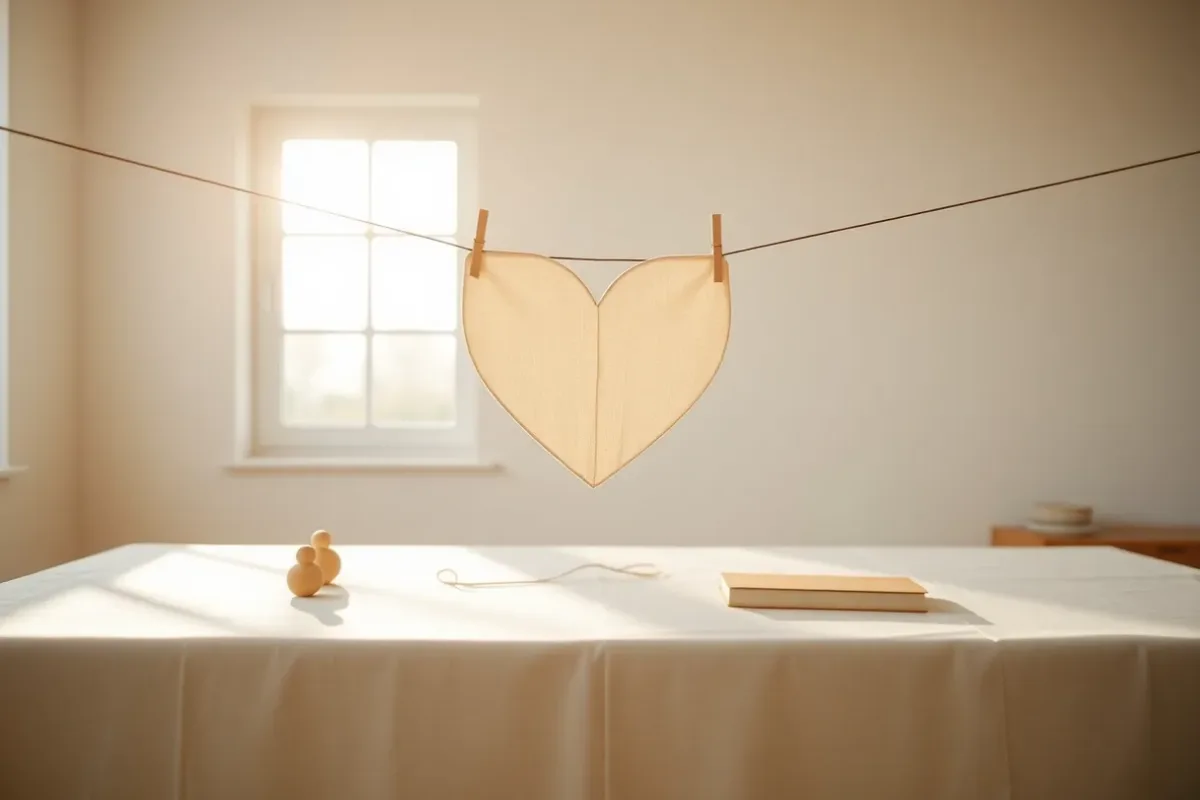
- Before anyone appears, two helpers string a white sheet between posts, poles or a pair of trees, or simply hold it up between them. A heart has already been drawn on it, usually in fabric pen, sometimes stitched.
- The cutting. The couple take a pair of scissors each and work along the line from the bottom upwards, one on each side, until the two cuts meet at the top and the shape drops out.
- Going through. One of them carries the other through the hole. Which way round varies; walking through hand in hand is an equally standard version and is increasingly the one chosen.
- The end. Applause, photographs, somebody gathers the sheet up.
Where the sheet is hung decides what the pictures look like. With the guests massed behind it, the camera sees backs. With the guests to one side, both faces appear inside the opening, which is the shot the whole custom exists to produce.
One feature separates it from the noisier games: it needs no crowd urging anyone on. Two people concentrate on a line, and everyone else watches without having to do anything. That is why it works at very small weddings, where a loud group game would feel forced, and why it can be staged indoors at a reception rather than outside a church.
Two people, one sheet, and an opening they have to make themselves before either can go through it.
2. What it means, and what is later invention
The reading comes in two halves, and they are not equally well founded.
The cutting is the straightforward half. Two pairs of scissors, one outline, a result that only appears if both people work at a similar pace: it is a shared job with a visible outcome, staged in front of the people who will be watching the marriage from now on. Nothing about that needs explaining to a guest from anywhere.
Stepping through the opening is the older half. Passing across a threshold into a different life is an image that turns up across a great many cultures and long predates any particular wedding game. The couple make the opening themselves and then use it, which is a neat piece of staging whether or not anyone intended it.
The third reading is the one to treat carefully. You will often hear that the sheet stands for the obstacles of life, cut through together. It is a pleasing sentence and it is a later attachment rather than anything the custom brought with it. Wedding games of this sort appear in written collections rather late, spread by neighbours copying neighbours, and are very likely younger than the stories told about them. Use the obstacle reading if you like it; treating the whole thing as a game is equally correct.
What is not in doubt is the effect. Nobody can fail at it, nobody can get hurt, and guests of every age can watch comfortably.

3. Where you will meet it
Like the sawing, this is a regional custom rather than a national one, and it is worth resisting descriptions that present it as something German weddings simply do.
- Kept in pockets of Germany, Austria and Switzerland, with no clean border. Two families a county apart can have entirely different expectations of it.
- Absent from a great many German weddings, where nobody mentions it and nobody misses it.
- Chosen where a saw would not fit. Small guest lists, indoor receptions, town-hall weddings, city courtyards.
If you are attending and want to know in advance, the person who invited you is a better source than any general guide, because within one country the answer changes from family to family.
For a visiting guest the practical consequence is simple: do not expect it, and do not be surprised by it. It is not a test of anything, it does not require a gift, a speech or a costume, and missing it because you were parking the car costs you nothing more than a photograph.
Related articles
4. What guests are actually allowed to do
This is the most participatory of the customs in this corner of the day, which is a pleasant surprise if you were braced for a spectator sport.
- Hold the sheet. Two people are needed, and holders who move slightly with the scissors make the cutting far easier than a rigid frame does. Volunteering is normal and welcome.
- Sign it beforehand. A popular variation has guests write on the sheet before it goes up, so the same object works as a guest book and as the thing being cut. If pens are being handed round, that is what is happening.
- Give the children a job. Gathering the offcuts, holding a corner, going through the opening themselves afterwards. Scissors stay with adults, fabric or no fabric.
- Take the wide shot. Everyone photographs the faces in the hole. Almost nobody photographs the sheet going up or the couple concentrating, and those are the pictures the couple do not have.
- Collect it afterwards. Somebody has to. A cut sheet abandoned on the ground outside a church is a sad end for something that was meant to go home.
What you should not do is offer to take over the cutting, however slow it looks. Slowness is normal and it is not a rescue situation.
5. Variations, and marrying into it
The custom bends easily, and every version below is a real one rather than a compromise.
- Walking through side by side instead of a carry. In several regions this is simply the standard form.
- Two hearts, a large one for the couple and a small one for the children.
- A signed sheet, framed afterwards or sewn into a blanket.
- A painted sheet, decorated the day before with names, flowers and the date, usually by whichever children are available.
If this is being proposed for a wedding that is half yours, the carry is the part worth weighing. It is optional, and it is the only element with any risk in it — lifting someone without warning, in a suit, in front of an audience, is how backs are pulled. Size matters more than neatness too: the opening has to be tall enough to step through without stooping, and a long skirt or a train needs more room again than anyone estimates.
The other thing is restraint. If a sawing, a heart and a bouquet throw are all on the list, cut one. Two set pieces after a ceremony feel like a celebration; three feel like a programme, particularly for guests who are standing.
Whoever ends up organising it needs to know who buys the sheet, who draws the heart, who puts up the poles and when it happens. Couples who write that down alongside the day's timings, often on their wedding website, spare their witnesses a morning spent hunting for scissors.
A sheet, a drawn outline and two pairs of scissors produce one of the calmest customs of the German-speaking wedding, and one of the few a guest can genuinely help with. Hold a corner, sign it if the pen comes round, and photograph something other than the obvious. If it is your own day, keep the opening generous, treat the carry as optional, and decide who is taking the sheet home before anyone starts cutting.
All things wedding
Plan your wedding
Bring your tasks, costs and guests together for the day.
Invitations and wording
Find the right words for your wedding invitation.
As a wedding guest
Write a personal message and choose a thoughtful gift.
Wedding anniversaries
Explore anniversary names, traditions and celebration ideas.
Planning your dream wedding?
Create your own wedding website in minutes – with RSVP function, photo gallery, and more.