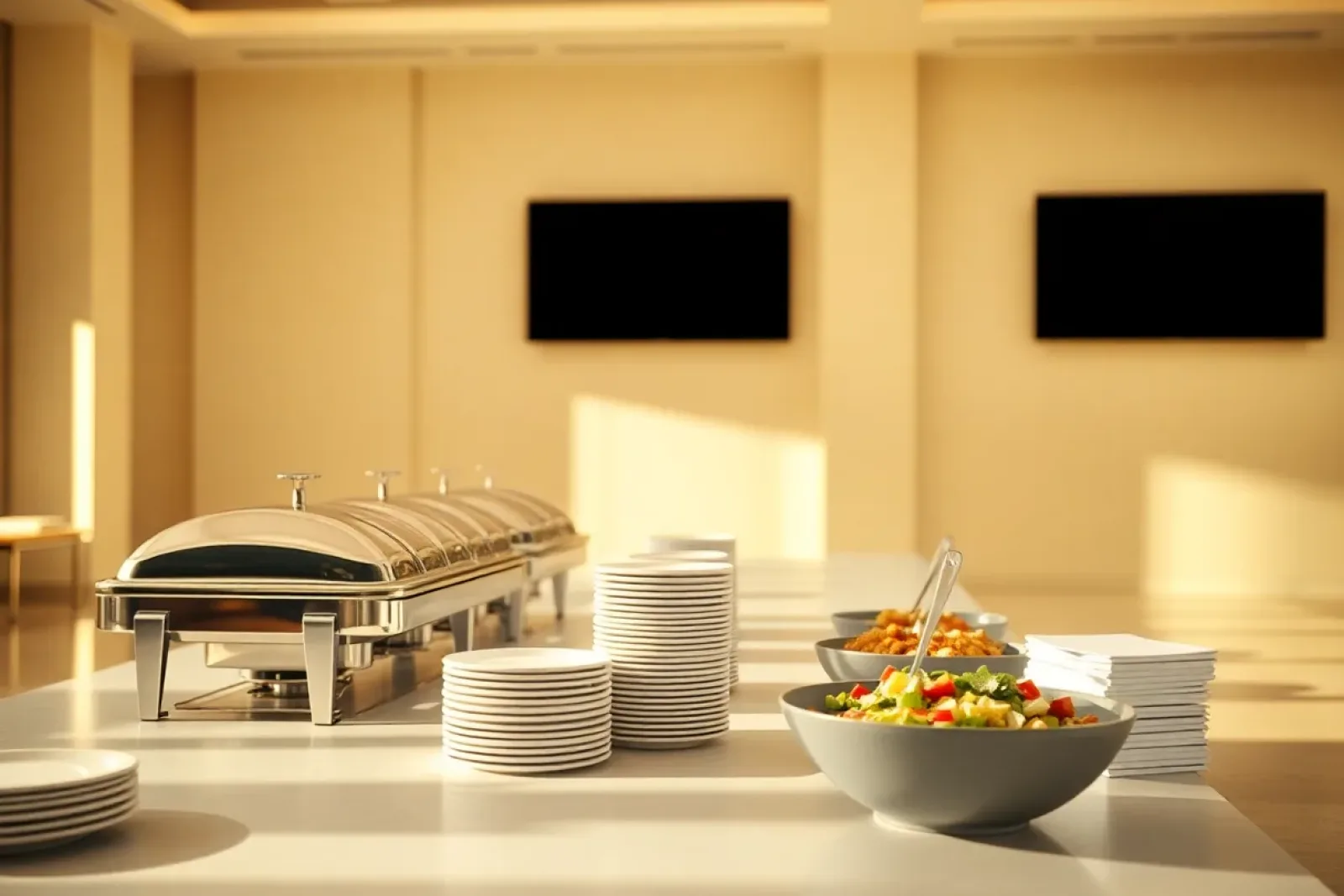
US wedding catering averages about $80 per person all-in, including food, drinks and staff. By style and before service charge, plated runs $65 to $85, family style $50 to $70, stations $45 to $75 and buffet $40 to $65. A food truck main with a side lands around $18 to $45.
Catering comparisons fail because quotes contain different things. A plated price usually includes service, china and linen; a food truck price almost never does. Comparing headline per-head numbers compares nothing.
So every figure below states what is normally included and what is added. National average is $80 per head, ranging regionally from $62 in the Midwest to $123 in the Mid-Atlantic — apply your own region before you plan against these.
1. The formats side by side
| Format | Food only, per person | Usually included | Added on |
|---|---|---|---|
| Plated | $65–85 | food, service, china | service charge, bar |
| Family style | $50–70 | food, platters, service | service charge, bar |
| Stations | $45–75 | food, station attendants | rentals, service charge |
| Buffet | $40–65 | food, chafing equipment | service staff, china, linen |
| Heavy passed appetizers | $35–55 | food, passing staff | seating, a main course |
| Food truck | $18–45 | one main, cooked on site | seating, china, sides, minimum, permit |
Gross the food-only figures up by a 20% service charge and an 18% gratuity and a $55 buffet becomes roughly $76 — right inside the $80 all-in national benchmark. The two sets of numbers reconcile once you know which population each describes.
Moving 100 guests from plated at $75 to buffet at $55 saves $2,000 before service charge — one of the largest single levers in the whole budget.
In-house, preferred list or open vendor
Before you compare formats, the venue decides whether you are allowed to compare at all. Three models dominate the US market, and they differ less in headline price than in how much room you have.
Exclusive in-house catering means the venue cooks or has a single tied caterer. The upside is a practiced operation with no load-in costs; the downside is a price you cannot hold against a competing quote. A preferred vendor list lets you choose among three to six approved caterers, which is usually the best compromise: real quotes become comparable and the caterers already know the site. Open vendor gives you the widest pricing range and hands you the ancillary costs — kitchen access, delivery, setup and strike.
The line most often overlooked under an open-vendor policy is the kitchen or plating fee. Venues that forgo catering revenue routinely recover it through a per-guest charge, commonly $10 to $25 a head, sometimes more where a full commercial kitchen is used. At 120 guests that is $1,200 to $3,000, which can erase the entire advantage of the outside caterer. Ask about that fee in the same breath as you ask whether outside catering is permitted.
The per-person price does not decide the invoice. What is missing from the per-person price decides the invoice.
2. What gets added to the per-head price
- Service charge: 18 to 22% of food and beverage from caterers, 20 to 25% at venues. On $9,000 that is $1,620 to $2,250.
- Gratuity: where it is separate from the service charge, another 15 to 20%. Read the contract for both words.
- Caterer minimum: commonly $2,500 to $4,000, independent of headcount.
- Cake cutting: $1 to $3 per slice on an outside cake.
- Vendor meals: 50 to 75% of the guest rate, typically $30 to $90 each.
- Rentals for a buffet: china, glassware, flatware and linen, roughly $8 to $25 per guest if the caterer does not supply them.
Staffing ratios matter here too: about one server per 12 to 18 guests for plated service, one per 20 to 30 for a tended buffet. Understaffing is the most visible economy at a wedding, and it produces lines rather than savings.
How the hours are counted
Billed hours are the item couples notice last. Staff are paid from the moment set-up begins until the last crate is back in the van, which commonly adds an hour or two at each end. A five-hour reception is therefore rarely five paid hours per person. At 80 guests on a tended buffet the ratio above puts three or four servers on the floor, each of them billed for something closer to eight hours than five — and none of that sits inside the per-head figure you were quoted.
Fees and tax behave the same way: they attach to the level of service, not to your negotiating. A drop-off caterer who hands over trays and a full-service caterer who plates, pours and clears do not carry the same load on the same amount of food, and neither of them can move it for you. What you can do is compare like with like. Ask every caterer for one all-in figure that includes staffing, the service charge, rentals and tax, and treat the per-head price as a headline rather than a total. Two quotes that sit within a few dollars of each other per head can finish hundreds apart once everything below the line is counted.

3. Cocktail hour, late night and cake
| Addition | Per person |
|---|---|
| Passed appetizers, cocktail hour | $12–25 |
| Late night snack | $6–18 |
| Dessert table beyond the cake | $5–12 |
| Coffee service | $3–6 |
| Wedding cake | average $540 total in the US |
Cocktail hour is the addition most often left out of a first budget and the one guests notice most, because it fills the gap between the ceremony and dinner. Budget it deliberately rather than discovering it in the final proposal.
Where the cake sits
At an average of $540, the cake is a modest line — until the venue adds a cutting fee. At 130 guests and $3 a slice that is $390, which can approach the cost of the cake itself. Ask about the fee before you order from an outside bakery.
Related articles
4. Beyond price: what separates the formats
Cost is half the decision. In practice the formats differ on four axes:
- Time: a three-course plated dinner holds the room for two to two and a half hours. A buffet is more flexible but creates lines if there are too few serving points.
- Seating: mandatory for plated, optional for buffet, unnecessary for a cocktail reception — which removes tables, chairs, linens and centerpieces from the budget entirely.
- Dietary needs: easier to accommodate on a buffet; for plated service they must be collected in advance and counted.
- Quantity risk: plated bills the exact guaranteed count. Buffet caterers build in surplus, and you pay for it.
For weddings under about 40 guests, plated is frequently no more expensive, because the per-head overhead of a full buffet rises as numbers fall.
A fifth difference is worth adding, because it decides staffing costs as much as format does: the length of the meal service window. A caterer quoting a fixed number of staff hours is pricing a specific schedule. Move the ceremony later, extend the cocktail hour, or add a long gap for photographs, and the same staff are on site longer at an hourly rate. Send the caterer your timeline with the proposal request rather than after it, and the quote you get back will be one you can actually hold them to.

5. Comparing quotes properly
Request every proposal on identical terms, or you are comparing setup times rather than food:
- same guest count, same start and end time
- service charge, gratuity and tax stated separately
- staffing shown as a line, with the number of staff and the hours
- china, glassware, flatware and linen shown as included or excluded
- vendor meal policy and the guaranteed count deadline stated
Then reduce every proposal to one all-in figure per guest. That is the only comparable number, and it is the one that belongs in your budget.
Quantities: how much food is enough
Under-catering is instantly visible; over-catering is money on the floor. Working benchmarks: three to five passed appetizers per person during cocktail hour, a late night snack for about 60% of guests since fewer remain, and one cake slice per guest — or 70% if there is also a dessert table. Ask which per-person quantities the caterer is costing; at 100 guests a 10% difference is several hundred dollars.
Tastings, menu deadlines and dietary counts
Catering carries more intermediate deadlines than any other category, and four of them cost money if missed.
The tasting usually happens three to six months out, and it tests not whether the food is good but whether the same dish still works as the eightieth plate out of a mobile kitchen. Many caterers charge per attendee and credit the amount against the contract if you book — confirm both the price and the credit, and confirm how many people may attend, since bringing four parents to a tasting priced per head is a line item nobody expects. The final menu is typically locked four to six weeks out; after that, changes are either refused or billed, because product has been ordered. The guaranteed count follows seven to fourteen days out and is the number you are billed for. And the dietary counts belong in the same submission rather than in a later phone call.
On dietary needs, ask how they are priced. Some caterers charge vegetarian and vegan mains at the standard rate, others add a surcharge for anything requiring a separate preparation. On a buffet the question is largely moot; on a plated menu it is not. In either case plan on roughly 10 to 20% of guests needing an alternative, and note that children are usually billed at a reduced rate that has to be requested rather than applied automatically.
Get two quotes in the same format and reduce both to an all-in price per guest. That comparison tells you whether the format or the vendor is driving the difference.
And settle the four dates in the same conversation: tasting, menu lock, guaranteed count and final invoice. The per-head price decides the proposal; those four dates decide what is actually billed.
All things wedding
Plan your wedding
Bring your tasks, costs and guests together for the day.
Invitations and wording
Find the right words for your wedding invitation.
As a wedding guest
Write a personal message and choose a thoughtful gift.
Wedding anniversaries
Explore anniversary names, traditions and celebration ideas.
Planning your dream wedding?
Create your own wedding website in minutes – with RSVP function, photo gallery, and more.