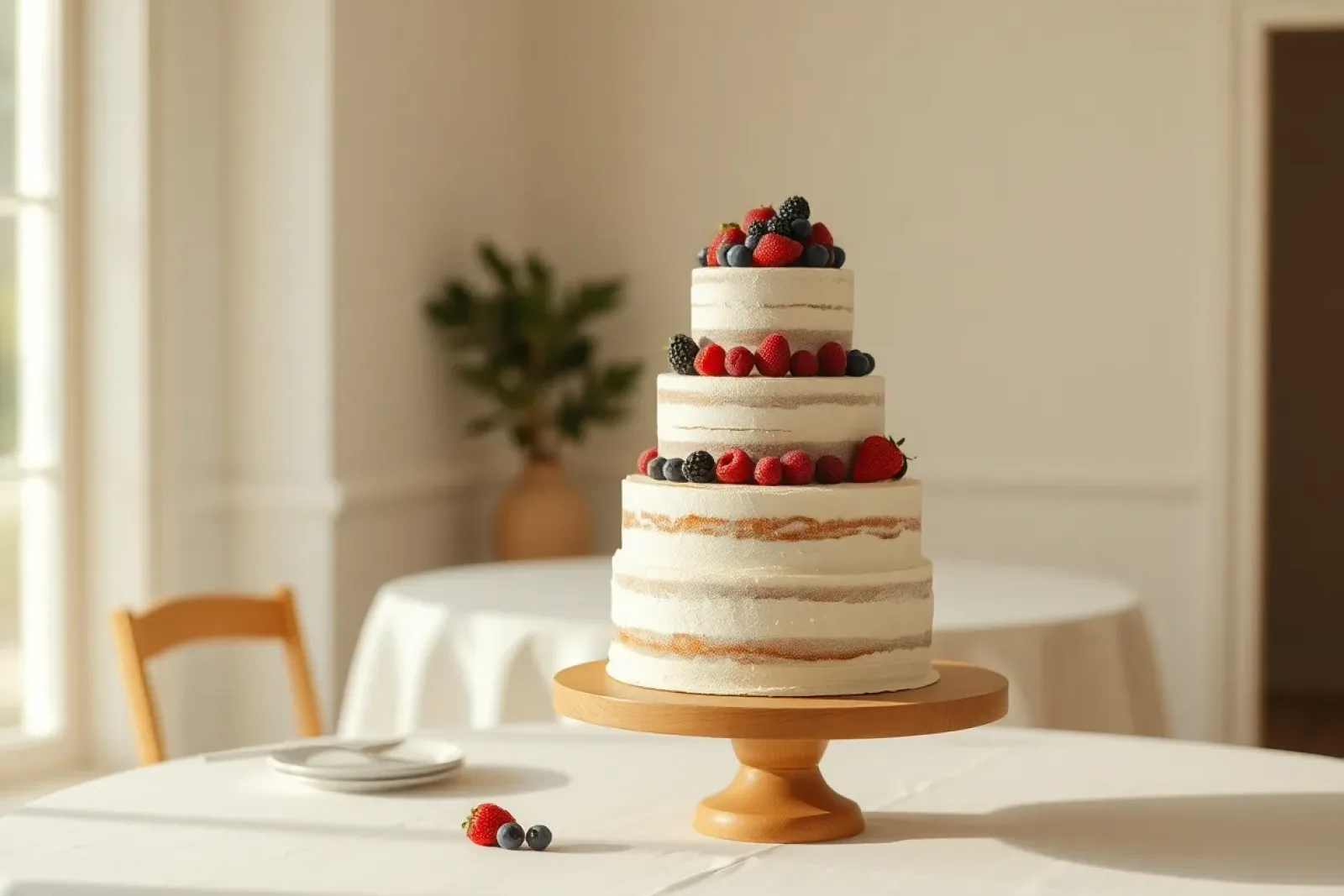
The decision is not made on flavour but on three technical questions: how long the cake stands unrefrigerated, who brings it and assembles it, and how many servings you actually need. Settle those three and you get a cake that still looks at ten at night the way it did at three in the afternoon.
The wedding cake is the only item that stands visible in the room for hours before it is needed. That makes it the centrepiece and the most vulnerable thing there: it stands warm, it stands a long time, and it has to be transported, often down a farm track.
So the decisive questions are technical ones. This piece goes through the three routes by which you get a cake at all, through how a tasting works, through standing time and chilling, through delivery and assembly — and finally through the sum with which you can check the size yourselves. Looks and style are under choosing a wedding cake.
1. Three routes to a cake
There is not one kind of supplier but three, and they differ less in skill than in how the service is cut.
| Route | Strength | Limit | Fits if |
|---|---|---|---|
| Local bakery or patisserie | Craft, reliability, short distances | Often conventional in design | You want a classic cake |
| A specialist wedding-cake maker | Elaborate design, tiers, sugar work | Higher price, longer lead time | The cake is meant to be a design element |
| Dessert through the caterer | One point of contact, no extra logistics | Usually simple in design | You want to keep the number of interfaces small |
The third route is underrated. If your caterer has a kitchen on site anyway, the whole block of transport, assembly and chilling disappears — and with it the commonest source of error. Ask about it before you look outside; many caterers do it and do not advertise it, because it is not their showpiece. How this item fits into the rest of the food is under menu planning for wedding catering.
A fourth route often gets considered on cost grounds: the cake from within the family. It can turn out wonderfully and has two honest drawbacks. First, the person baking it spends the day before in the kitchen and the wedding morning in a car. Second, there is nobody to step in. If you go that way, please go with a clear agreement about chilling, transport and a plan B — and not with a three-tier construction as a first attempt.
Settle one question with your venue early as well: do they charge a fee if the cake does not come from them? In English-speaking markets this turns up as a cutting fee, a plating fee or cakeage, and it is charged per guest often enough to matter. Whether it applies and how much it is is a question of your contract and your market — it usually sits in the small print and moves the sum noticeably.
A cake that looks magnificent at three in the afternoon is no achievement. One that still does at ten at night is.
2. How a tasting works
Unlike the catering tasting, this one is small, cheap and often does not need you to travel. Three forms are common: an appointment at the bakery with four to six flavours, a tasting box to collect or be posted, or a slice from current production if the business has a shop anyway.
What to look for is manageable:
- Moisture in the sponge. A sponge that seems dry will not get better after hours in a warm room.
- Sweetness of the filling. It reads differently in a small sample than in a full portion after a three-course meal. If in doubt, choose one step less sweet.
- The covering. Fondant looks flawless and many people do not like the taste; buttercream tastes better and is more sensitive to heat. That is a genuine trade-off, not a matter of taste alone.
- Fruit content. Fresh fruit is lovely and draws water. Ask how the baker deals with that.
- Combining the tiers. Two or three flavours are plenty. Four different ones create a queue at the serving table, because every guest stops to think.
Take one piece of information to the tasting that changes everything: the time of day the cake will be eaten. A cake at three in the afternoon with coffee is an afternoon slice; the same cake at nine at night after a three-course meal has to be lighter, or half of it will be left. Say the time, and be advised from there.
And settle beforehand whether the tasting is charged and credited against a booking. Both are common, and the handling differs between businesses and between markets — it is a question, not a negotiation.
3. Standing time, chilling, temperature
Here is the real professional core, and here a business that knows weddings separates from one that can make cakes. The question is: how many hours does this cake stand at what temperature before it is cut?
Count honestly. The cake often arrives in the morning and is cut in the afternoon or the evening. Five to eight hours is normal, and in summer, in a full room with sun coming in, that is a serious load.
| Condition | Risk | What helps |
|---|---|---|
| Above 25 degrees Celsius in the room | Buttercream softens, tiers settle | A cool side room until shortly before cutting |
| Direct sun where it stands | Local warming, colour changes | Fix the position beforehand, do not improvise |
| Set up outdoors | Insects, wind, heat | Only briefly, and covered |
| No chilling available on site | The recipe has to carry it | Say so early — it changes the filling |
| A long approach over farm tracks | Tiers shifted out of line | Assembly on site rather than transport assembled |
The fourth row is the most important thing you can tell them. Say whether there is a cold room before the recipe is chosen. If there is not, the baker picks different fillings — more stable creams, less fresh fruit, possibly fondant instead of buttercream. Making that decision afterwards does not work: by then the cake is planned.
Ask as well about the position in the room and fix it with the venue, not on the day itself. The table needs a stable, level surface — a three-tier cake on a wobbly bistro table beside the dance floor is a risk you can avoid with five minutes of planning. And settle who portions the cake after it is cut and returns it to the cold: usually the service staff, but it has to be agreed.
Related articles
4. Delivery and assembly
Transport is the moment when most can go wrong, and at the same time the one described most briefly in the quote. Ask six things:
- Do you deliver yourselves, or do we have to collect?
- Is the cake delivered assembled or assembled on site?
- What time do you arrive, and who receives it?
- Do you bring the boards and the internal supports — and do they have to go back?
- What happens if something is damaged in transport?
- Who puts the cake in its final position?
Question 2 is the decisive one. At two tiers and above, assembly on site is considerably safer, because the construction is only put together at the destination. That costs the baker time on site and you a little more — and it is the line where economising pays off least often.
Question 3 regularly becomes a problem, because there is nobody in charge at delivery time. The baker stands at a locked door with a cake and you are getting ready. Name a person with a phone number who takes delivery, knows where the cold room is and knows the position — the same person who is the contact for the florist and the caterer. Who needs which time is best collected in one overview, see sharing the timeline with your vendors.
Question 4 sounds incidental and creates work the day after the wedding: hired equipment has to go back, often within a few days. Settle the return deadline, the deposit and breakage in writing, and tell whoever is clearing up at the end.
On payment terms the same applies as for every other trade: deposit, balance and cancellation are contract matters and follow the law of the country you book in. With perishable goods the point from which a cancellation is charged in full usually sits closer to the date than with other services — ask explicitly from when production starts.
5. Size and servings: the sum you can check
The commonest question is how big the cake has to be, and the commonest answer is too vague. Do the sum yourselves — it takes two minutes and makes every quote checkable.
The basis is the footprint of one serving. A standard wedding-cake slice takes up about 1 by 2 inches of the surface, so 2 square inches. (In metric that slice is about 13 square centimetres — say 2.5 by 5 centimetres — and the sum below works exactly the same way. Do not round it to 3 by 5: that is 15 square centimetres, a sixth more cake per guest, and it quietly shrinks every tier count in the table.) The area of a round tier is the radius squared times pi. That gives:
| Diameter | Area | Servings at 2 sq in each |
|---|---|---|
| 6 in | about 28 sq in | about 14 |
| 8 in | about 50 sq in | about 25 |
| 10 in | about 79 sq in | about 39 |
| 12 in | about 113 sq in | about 57 |
A three-tier cake of 6, 8 and 10 inches therefore gives about 78 servings — 14 plus 25 plus 39. For 80 guests that is tight if everyone is meant to have a slice; add a fourth tier of 12 inches and you are at about 135, with a margin. Published serving charts run a little lower than the pure geometry, because the outer edge and the supports take their share.
Two corrections to that sum, both downwards:
- Not everyone takes a slice. After a full meal a noticeable share of guests takes nothing. Many couples therefore plan for considerably fewer servings than guests and add small pastries alongside.
- The top tier often stays whole. If you want to keep it or eat it the next day, it does not count.
And one correction upwards: if the cake is the only dessert, every guest needs a slice and some will take two. So decide first whether there is a dessert table as well — that decision changes the size more than anything else.
The defensible headcount comes from the same place as the caterer's: from the actual replies, not from the invitation list. How to have it in time is under online RSVP for your wedding; everything about the moment of cutting itself is under cutting the wedding cake.
Decide in this order: first the route — bakery, specialist or caterer — then chilling and standing time, then delivery and assembly, and only last the flavour. The sum at 2 square inches per serving keeps the size checkable at every point.
Next, ask your venue two things: whether there is a cold room, and whether a fee applies to a cake brought in from outside.
All things wedding
Plan your wedding
Bring your tasks, costs and guests together for the day.
Invitations and wording
Find the right words for your wedding invitation.
As a wedding guest
Write a personal message and choose a thoughtful gift.
Wedding anniversaries
Explore anniversary names, traditions and celebration ideas.
Planning your dream wedding?
Create your own wedding website in minutes – with RSVP function, photo gallery, and more.