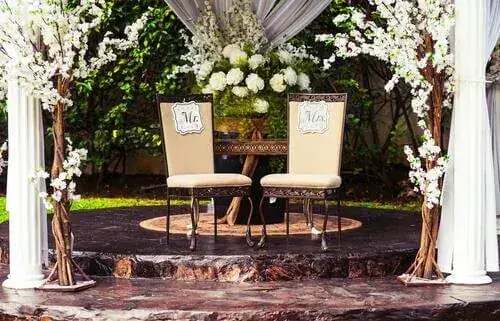
A rehearsal dinner is a meal on the eve of the wedding for the wedding party, immediate family and usually out-of-town guests. It follows the ceremony rehearsal, runs two to three hours, and traditionally the groom's parents host. Speeches happen here so the wedding day itself has fewer of them.
The rehearsal dinner is an American institution that has spread unevenly. In the US it is close to standard; in Britain and Ireland the equivalent is a looser welcome dinner or a pub evening, and it may not follow a rehearsal at all.
This article covers the dinner rather than the ceremony rehearsal that precedes it: who is on the list, who pays, what it costs, how the evening runs and where the tradition has been going. If your question is whether you need a ceremony rehearsal in the first place, that is a separate decision made with your officiant.
1. Who is invited
The core list is small and grows outward. Most couples stop at one of the first three rings below.
| Ring | Who | Typical size |
|---|---|---|
| Core | Couple, parents, siblings, officiant | 10 to 15 |
| Wedding party | Plus attendants and their partners, readers | 20 to 35 |
| Extended | Plus grandparents, aunts, uncles, godparents | 35 to 60 |
| Welcome dinner | Plus everyone who has travelled to be there | 60 and up |
Two conventions are worth keeping. Anyone with a job in the ceremony should be there, including readers, musicians and whoever is handling the rings, because half the point is that they have met each other before the aisle. And children in the wedding party come with a parent, or are collected early.
The awkward case is the guest who has flown in but is not family. The American convention is that out-of-town guests are invited, which is how the rehearsal dinner slides into being a welcome party. If that pushes the number past what you can host, the honest fix is to rename it: a welcome drinks at a pub from eight, open to all, costs a fraction and offends nobody.
The rehearsal dinner is where two families stop being two lists of names and become people who have eaten together.
2. Who pays
The traditional American answer is the groom's parents, as a counterweight to the bride's family paying for the wedding. That symmetry has largely dissolved along with the arrangement it balanced.
Three arrangements are all now normal, and none needs justifying:
- One set of parents hosts. Still the most common single answer, and often the groom's parents by inheritance from the old rule.
- The couple hosts. Increasingly usual where the couple are also paying for the wedding.
- It is split, or it is not a hosted meal at all. A pub evening where everyone buys their own is a perfectly good rehearsal dinner and is closer to the British norm.
Whoever is hosting, say so on the invitation. The one genuinely bad outcome is a group of thirty who each assumed somebody else was paying, discovering the truth when the bill lands.
Budget-wise, a hosted sit-down meal runs roughly 35 to 70 pounds a head in the UK and 50 to 120 dollars in the US, before drinks. Drinks are where these evenings quietly double. A bar tab with a stated limit, or wine on the table and everything else on personal tabs, keeps it predictable.
3. How the evening runs
Keep it short. Everyone in the room has an early start and something still on their list, and the rehearsal dinner that ends at one in the morning is a well-documented mistake.
- Rehearsal, if there is one: 30 to 45 minutes at the ceremony venue, late afternoon.
- Arrival and drinks: 45 minutes. Long enough for two families to actually mix.
- Dinner: 60 to 90 minutes, ideally seated so that people are forced to talk to somebody new.
- Speeches: 20 to 30 minutes total, and this is the natural home for them.
- Ending: a stated finish time. Ten or half past is normal and nobody minds being told.
Seating repays five minutes of thought. Mixing the two families rather than seating them in blocks is the single most useful thing the host can do, and putting the officiant next to whoever is most nervous about the ceremony is a close second.
Practical items that belong to this evening rather than the wedding day: handing over gifts to the wedding party, distributing anything people need to carry tomorrow, and confirming arrival times. Doing that here saves twenty messages on the morning itself.
Related articles
4. Speeches, toasts and the thank-you gifts
The most useful function of a rehearsal dinner is as a pressure valve for speeches. A wedding meal with seven toasts is long; moving three of them to the night before fixes it without silencing anyone.
The usual pattern: the host welcomes everyone, the couple thank people for travelling, and anyone who wants to speak but is not on the wedding-day list speaks here. That includes siblings, old friends, and parents who would rather not stand up in front of a hundred and fifty people. Keep each to two or three minutes and say so in advance.
This is also the traditional moment for the couple to give gifts to their attendants and to their parents. It works better here than on the day itself, when nobody has a free hand and nowhere is safe to leave anything.
One warning. The rehearsal dinner is the evening where the roast-style speech is most likely to appear, because the room is smaller and the mood is looser. The room still contains both sets of parents. The material that works at a bachelor party does not automatically survive the change of audience.
If you are hosting and would rather not risk it, there is a simple structural fix: invite the speeches rather than opening the floor. Ask three people in advance, tell them the length, and close the section yourself. An open microphone at half past ten is how these evenings overrun by an hour and how somebody says the thing that gets quoted for a decade.
5. The British version, and skipping it entirely
Plenty of weddings have no rehearsal dinner and lose nothing. In Britain and Ireland the more common shapes are:
- A pub evening. A table booked, no speeches, no formality, everyone buys their own. Often the best version of the idea.
- A welcome drinks. Open to every guest who has arrived, two hours, drinks and something to eat standing up.
- Family dinner only. Six to ten people, at home or at a restaurant.
- Nothing at all. Which is normal, particularly where most guests are local and arriving on the morning.
If you are hosting people who have travelled, the strongest argument for doing something is not tradition but logistics: it is the one point where you can hand over information in person. Where to park, when to arrive, which entrance, who to ask. Anything you would otherwise repeat forty times is better said once here and posted on your wedding website for the people who are not in the room.
The one thing to protect either way is the finish time. Whatever shape the evening takes, ending it early is a gift to yourself.
Decide the ring of guests first, then who is hosting, then say both plainly on the invitation. After that the evening mostly runs itself, provided somebody has announced a finishing time. If most of your guests are travelling, the next thing worth writing down is the arrival information, because that is what the evening is really for.
All things wedding
Plan your wedding
Bring your tasks, costs and guests together for the day.
Invitations and wording
Find the right words for your wedding invitation.
As a wedding guest
Write a personal message and choose a thoughtful gift.
Wedding anniversaries
Explore anniversary names, traditions and celebration ideas.
Planning your dream wedding?
Create your own wedding website in minutes – with RSVP function, photo gallery, and more.