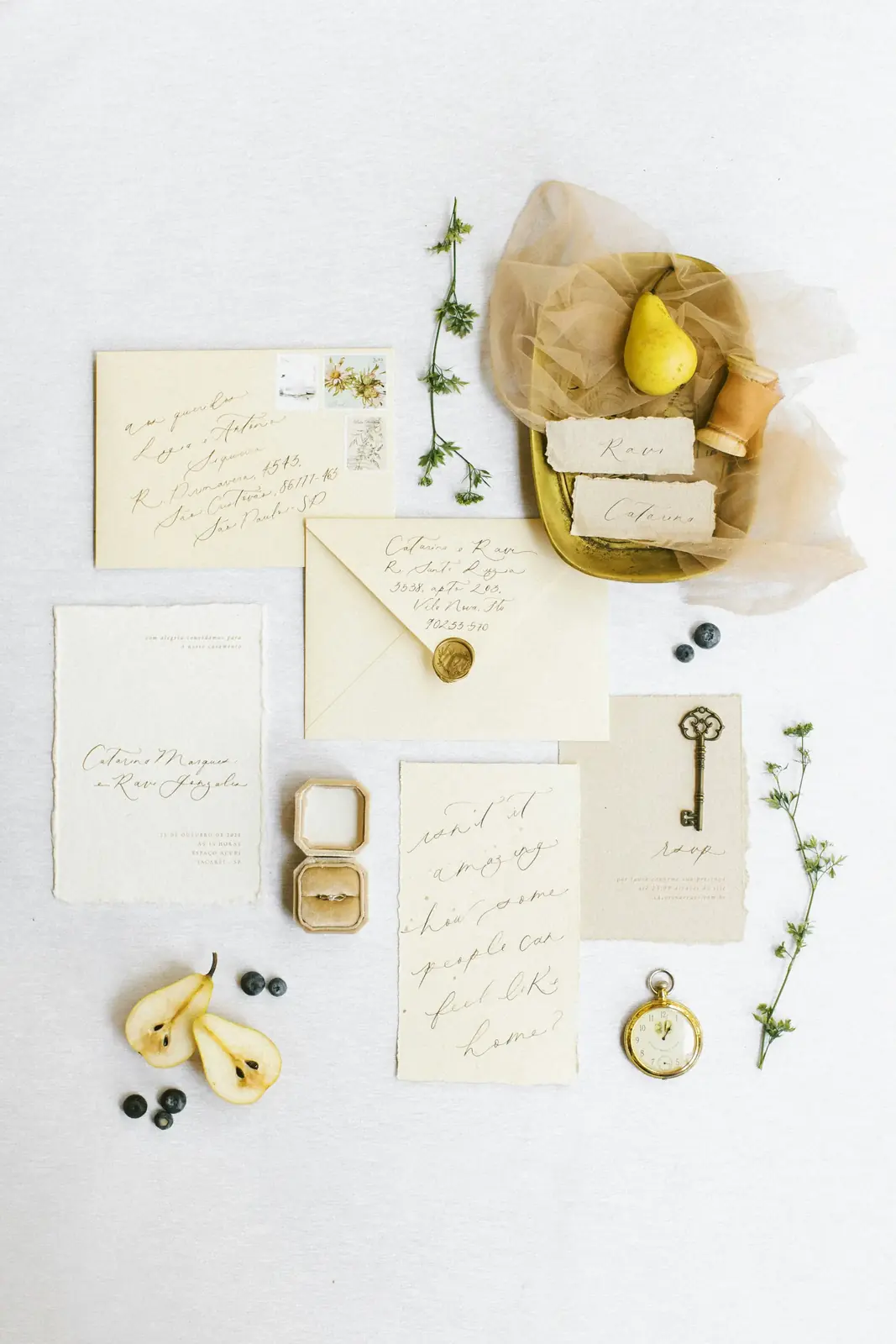
The host line names whoever is inviting, which today is usually the couple themselves regardless of who is paying. Parents appear when they are genuinely acting as hosts. Where parents are divorced, remarried or widowed, the rule is one line per household, worded the same way for each.
The host line is the first line of the invitation and the only one that makes a social statement. It says not just who is writing but in whose name the day is being held — which is why, in families with a complicated history, it is the line people agonise over longest.
Traditionally the answer was simple: the bride's parents invited, because they hosted. That link has largely dissolved. Couples now usually invite in their own name, even where parents contribute financially, and the phrase "together with their families" has become the most widely used compromise.
This article sets out the common variants with lines you can copy, separates paying from naming, and works through the difficult configurations one at a time.
1. The three common variants
The couple invites. The most common form today and the right one for most weddings. It is short, unambiguous and works whatever the family configuration. Example: "Anna Berger and Jonas Keller invite you to celebrate their marriage."
The parents invite. The traditional form, appropriate for formal weddings and where parents genuinely act as hosts and shape the guest list. Example: "Mr and Mrs David Berger request the pleasure of your company at the marriage of their daughter Anna to Jonas Keller."
Both together. The middle route, naming both families and presenting the day as a joint undertaking. Example: "Together with their families, Anna Berger and Jonas Keller invite you to their wedding."
All three are current and none is wrong. Base the decision on how the wedding is actually coming together rather than on what sounds more polite. An invitation in which the parents appear as hosts, when the couple has organised everything, reads oddly from both directions.
A practical note: if you are unsure, take the first variant. It needs no ordering of names, offends nobody, and can be supplemented by a line of thanks to both sets of parents on the details card or in the order of service.
The host line says who is inviting, not who is paying. Separating those two resolves most of the argument before it starts.
2. Paying and naming are two questions
The most common unspoken assumption is that whoever pays gets named. It comes from a period when one family hosted, and today it creates more problems than it solves.
Who is actually funding the wedding is rarely clear-cut. Both sets of parents contribute in different amounts; only one side contributes; grandparents contribute; or the couple pays and receives a lump sum. A host line that tries to represent that either becomes long or becomes unfair.
Separate the two questions deliberately. The host line answers: in whose name are guests being invited? The financial contribution finds another home — a sentence in a speech, a line in the thanks, a mention in the order of service.
Where a set of parents explicitly wants to be on the card, that is a conversation rather than a fight. What usually lies behind it is a wish to be visibly part of the day, and that is often better met by having them welcome guests or appear in the programme than by adding a name to line one.
And one consolation: guests pay far less attention to the host line than families do. What gets read is the date, the place and the reply deadline. That observation takes most of the heat out of the discussion.

3. Ready-made lines for every configuration
These can be used unchanged; only the names differ.
| Configuration | Wording | Why this way |
|---|---|---|
| Couple hosting | "Anna Berger and Jonas Keller invite you to celebrate their marriage." | Neutral, independent of family status and contribution. |
| Both sets of parents, married | "Mr and Mrs David Berger and Mr and Mrs Karl Keller request the pleasure of your company at the marriage of their children Anna and Jonas." | Equal billing, with neither side placed first by status. |
| Parents divorced, both involved | "Ms Renate Berger and Mr Peter Berger, together with Mr and Mrs Karl Keller, invite you to the marriage of Anna and Jonas." | Two separate names rather than one couple — factually correct. |
| One parent deceased | "Ms Renate Berger, together with her daughter Anna and Jonas Keller, invites you to their marriage." | Names the living parent without an awkward omission; remembrance belongs in the order of service. |
| Remarried parents | "Ms Renate Berger and Mr Thomas Lang, and Mr Peter Berger, invite you…" | One naming per household, in the same form. |
| Couple and parents together | "Together with their families, Anna and Jonas invite you to their wedding." | The shortest form that includes everyone without ordering names. |
The remarried row carries the most important rule in the table: one naming per household, in the same form. Naming one side with first names and the other as "the Kellers" creates a ranking nobody intended and everybody reads.
Related articles
4. Order and formalities
Traditionally the bride's family comes first. The rule is outdated, but it is still known well enough that departing from it gets noticed. If you would rather not follow it, use a visibly different ordering instead — alphabetical by surname, or by the age of the parents.
For same-sex couples there is no inherited order, which is an advantage: choose one that makes sense to you and hold it across the entire suite. The same order on the invitation, the order of service and the thank-you card reads as deliberate.
Titles belong on the host line only where the card is formal throughout. In an invitation that uses first names and contractions, a doctorate in the opening line sits awkwardly.
And a formality that is often missed: where parents are named as hosts, both members of the couple should appear in full — first and last names for each. Guests who only know one side need the other's full name for the reply card and later for the good wishes.
Finally, watch the length. A host line that runs to four lines because six people are named has stopped being a host line. Where more than two households are involved, "together with their families" is not a cop-out but the practical answer.

5. When the line becomes a conflict
The host line regularly becomes the flashpoint for older family conflicts. That is not the line's fault; it is that the line is the first public statement about belonging.
Three approaches work. First: decide it between the two of you before discussing it with the families. An invitation whose wording is still open invites suggestions; one that is finished is taken as read.
Second: when in doubt, choose the most neutral form. "Anna and Jonas invite you" names nobody and excludes nobody. That is not evasion — it is the factually correct answer when the couple is in fact hosting.
Third: offer another visible place. Anyone not in the host line can be named in the order of service, speak at the welcome, or appear on the thank-you card. The wish for visibility is usually satisfiable, just not in line one.
What you should not do is print two versions, one with parents and one without. It happens, and it reliably comes out, because guests show each other their invitations.
If the conversation gets difficult, one sentence helps: "The card names whoever is inviting — that you're making this possible for us is something we'll say on the day itself." The question is answered, nobody is placed behind anybody else, and the acknowledgement is promised rather than withheld.
The couple invites, parents are named where they host, one naming per household in the same form, and paying stays separate from naming: that settles the line. The next step is a short conversation between the two of you — agree the variant before you show the draft to anybody else.
All things wedding
Plan your wedding
Bring your tasks, costs and guests together for the day.
Invitations and wording
Find the right words for your wedding invitation.
As a wedding guest
Write a personal message and choose a thoughtful gift.
Wedding anniversaries
Explore anniversary names, traditions and celebration ideas.
Planning your dream wedding?
Create your own wedding website in minutes – with RSVP function, photo gallery, and more.