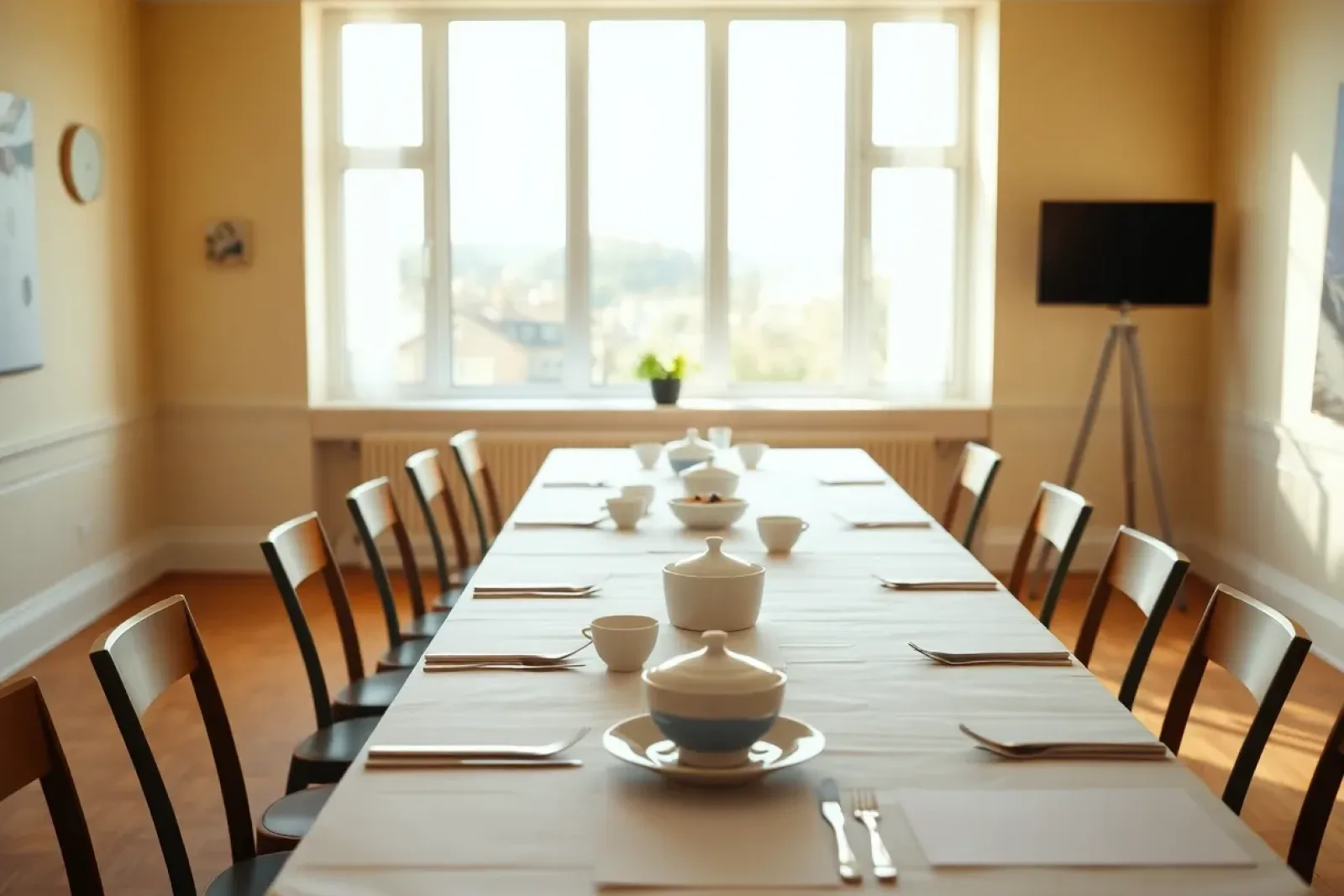
A first meeting between two families works best small, short and with something to do: six people at most, two or three hours, somewhere neither family lives. The two of you are the hosts, not your parents — and you decide beforehand which subjects stay off the table.
The picture is always the same: you put both families round a table and, since everybody is perfectly nice, it becomes a lovely afternoon. Sometimes that is exactly what happens. More often six to twelve people sit together with nothing much to say to each other but a clear sense that they are supposed to get along — and that is precisely what makes it hard.
It helps to treat the meeting not as the beginning of a friendship but as an encounter with a very modest aim: everybody should have met once before they find themselves opposite each other in a pew or across a table. Set that as the goal and it is almost impossible to fail.
Why first meetings go wrong
Three things converge, and none of them is about the people involved. First, expectations are too high: everybody knows this afternoon counts as a beginning, and beginnings make people stiff. Second, there is nothing to do — no shared task, only conversation, and conversation between strangers is work.
Third, and most powerfully: comparison happens whether anyone wants it or not. Whose house is larger, whose manner is easier, whose manners are better, who has more money. Nobody would admit to it, and it still sits at the table. In one family's home the comparison is physically staged, and that family automatically holds the host's role and its advantage.
That makes neutral ground the single most useful piece of advice on this subject. A restaurant, a café, a walk followed by lunch — anything where nobody is at home. It removes the question of rank before it can be asked, and both sides are equally guests.
The second lever is numbers. A meeting of four to six people is a conversation; one of twelve is an event, and it splits into groups within minutes — usually one family on the left and the other on the right. Siblings, grandparents and godchildren can come later. For a first meeting the parents are enough. And one more thing that changes the afternoon: the two of you are the hosts, even if you are the youngest people present. Whoever hosts sets the frame, opens the conversation and ends it. Leave that role to the parents and it goes automatically to the side more used to taking it.
The aim is not that two families like each other. The aim is that they are not strangers on the day.
The format that nearly always works
There is no recipe, but there is a format that rules out the common failures.
| Question | Suggestion | Why |
|---|---|---|
| Where | Neutral ground, nobody's home | Takes the host's advantage out of play |
| How many | Four to six people | Beyond eight the conversation splits into camps |
| How long | Two to three hours, with the end stated in advance | A finish makes unfamiliarity bearable |
| When | Lunch rather than dinner | Shorter, soberer, less freighted |
| Doing what | Something shared: a meal, a walk, a look round somewhere | An activity substitutes for a subject |
| Who pays | The two of you, settled beforehand | The bill is the classic status contest |
That last row is routinely underestimated. When two fathers reach for the bill simultaneously, a pecking order forms in thirty seconds and colours the rest of the afternoon. Settling it at the desk in advance removes the moment entirely.
State the finishing time when you invite people. From twelve until about three sounds businesslike and is experienced as a relief: everybody knows how long they have to make an effort, which is exactly why they make less of one.

When language, background or religion differ
As soon as two families do not share a language or come from different traditions, the task changes shape. It does not get harder, but it needs more preparation — and that preparation belongs to the two of you rather than to your parents.
On language: decide in advance who interprets, and do not leave it to happen. Whoever interprets for three hours has no conversation of their own and is exhausted afterwards. Two people taking turns is far better than one. And a few sentences in the other family's language, practised beforehand, do more than any explanation — they demonstrate effort, and effort is the actual message.
On food and drink: establish what works for both sides and choose the venue accordingly. A restaurant where one side can eat almost nothing, or where drinking is central while the other side does not drink, produces an hour of awkwardness that was entirely avoidable.
On customs and expectations: brief each side beforehand on what the other is used to — how people greet each other, whether a gift is normal, whether any subject would be considered rude. Two short phone calls in advance prevent most misunderstandings, and nobody has to learn a rule at the table.
Related articles
The subjects to take out of the room
The most effective preparation happens in two phone calls, which you each make separately to your own parents. You say who is coming, how long it will last — and what will not be discussed.
Top of that list is money. Who contributes what to the wedding is a matter between you and each family individually, never one to raise in front of the other. The moment it is on the table a meeting becomes a negotiation, and the hierarchy that forms will last until the wedding day.
The guest list and seating belong in the same category. Both generate claims instantly, and claims registered in the presence of the other family are almost impossible to withdraw later. We will talk about that with you separately is a complete sentence and can be used twice without embarrassment.
What does work is asking about the past. How the parents met, what their own wedding was like, what was customary then and what went wrong. Those questions are safe, everybody has an answer, and they produce the only genuine common ground available at that table.

Afterwards: who keeps in touch
A gap tends to open after the meeting. Everybody thought it was pleasant, nobody follows up, and next time you start from nothing. That is because nobody is responsible: each of you feels accountable for your own parents and neither for the other's.
A small agreement fixes it. Each of you keeps in touch with your own family and passes on whatever the other side ought to know. It sounds like very little and it prevents the most common complaint of the coming months, which is that one side feels less informed than the other.
What helps practically is that both families receive the same information at the same time — date, place, running order, where to stay. That is exactly what a wedding website of your own is for: it takes you out of the role of news distributor, and nobody can later claim they were told last.
And if the first meeting was not a success: that is not a verdict on the next thirty years. Two families remaining strangers is an entirely normal outcome. They do not have to be friends; they have to be able to sit politely near each other on one day a year, and the second meeting is nearly always easier than the first.
Neutral ground, a small group, a stated finish, two phone calls beforehand. Decide who is covering the bill and which two subjects are off the table, and the afternoon is effectively prepared.
All things wedding
Plan your wedding
Bring your tasks, costs and guests together for the day.
Invitations and wording
Find the right words for your wedding invitation.
As a wedding guest
Write a personal message and choose a thoughtful gift.
Wedding anniversaries
Explore anniversary names, traditions and celebration ideas.
Planning your dream wedding?
Create your own wedding website in minutes – with RSVP function, photo gallery, and more.