Table of contents
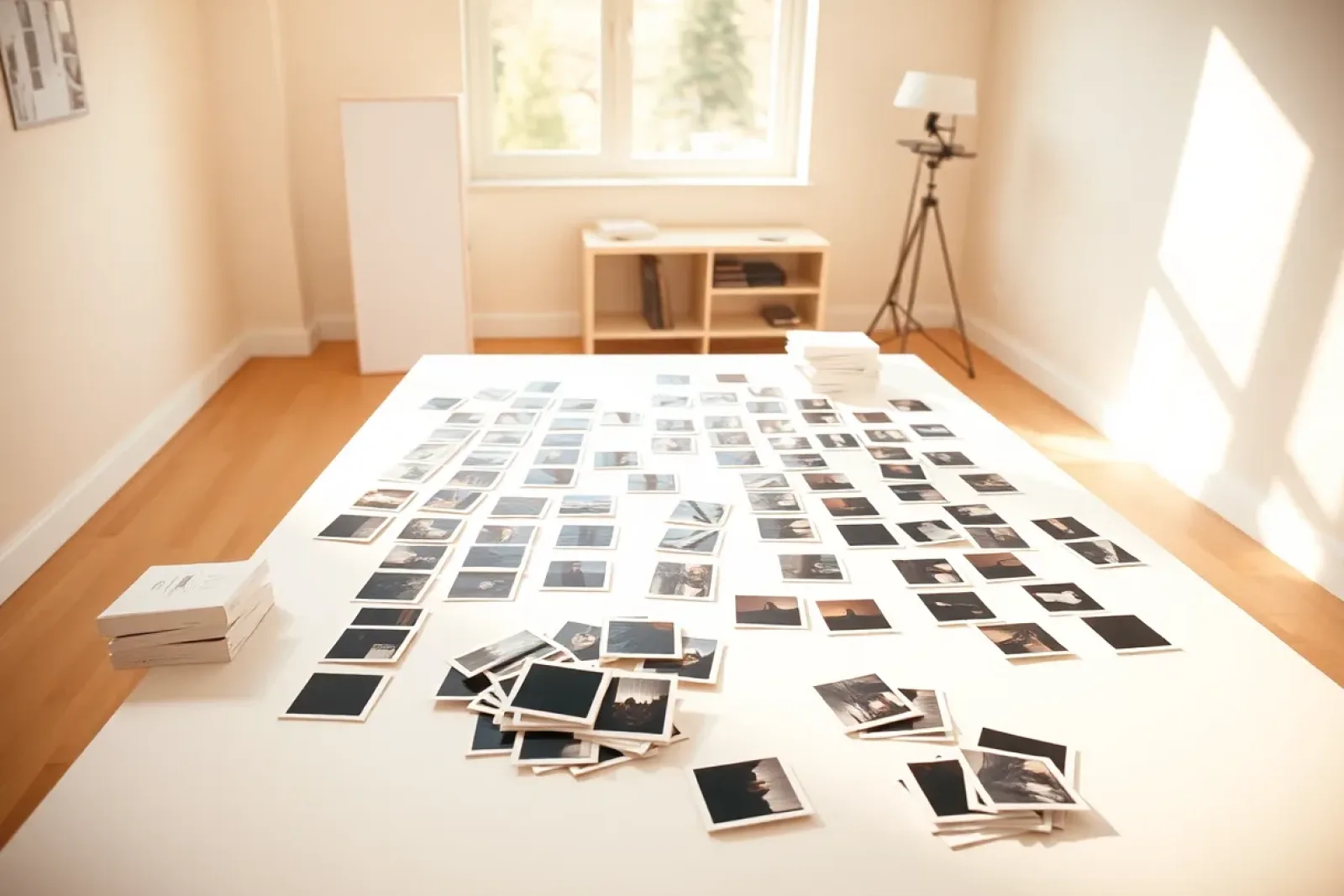
Select in three passes rather than one. First pass: delete anything technically unusable — usually 30 to 40 per cent. Second pass: keep one image per moment, not per frame. Third pass: cut to the target number for whatever you are actually making. Eight hundred images become sixty to a hundred, in an evening rather than a year.
Selection stalls not because there are too many pictures but because there is no rule. Open 800 files and ask of each one whether it is nice, and you have made 800 separate judgements against no standard at all. Sort first, compare second, and the job finishes. This article sets out the method, the target numbers for albums, walls, cards and guest galleries, and the three ways couples usually get stuck.
1. First pass: technical only
In the first pass you are not judging content or mood. You are judging craft, which is fast because it is not a matter of opinion. Out goes:
- anything soft where the softness clearly was not intended
- closed eyes, half-open mouths, heads clipped by the frame edge
- people mid-chew or mid-syllable with an unfortunate expression
- burst sequences where nothing actually changes between frames
- anything with a distraction across the foreground — a back, a phone, a glass in front of a face
Expect a high rejection rate. From 800 delivered images you will typically be left with 450 to 550, and that is healthy. A photographer who has already culled hard delivers fewer files and you will cut proportionally less.
Use a rating system rather than two folders. Almost every photo application, including the one already on your computer, supports stars or flags. One star for keep, nothing for reject, then filter at the end. Moving files around is slower and creates duplicates you will not be able to tell apart later. Keep moving, too: two seconds per image is enough to decide whether it is sharp. Eight hundred frames takes about half an hour at that pace.
You keep a photograph not because it is good, but because it tells you something no other photograph does.
2. Second pass: one moment, one picture
Now sort by moment rather than by image. A wedding contains roughly 25 to 40 distinguishable moments — the ones a photography checklist drawn up before the wedding already works through: getting ready, arrival, the processional, the rings, the recessional, congratulations, the reception, first speech, second speech, the cake, the first dance, and so on. For each one, keep exactly one photograph, plus at most one alternative if the two genuinely differ.
This sounds severe, which is precisely why it works. It forces the question of what a picture does rather than whether it is attractive. Two near-identical frames of the same kiss do not tell you anything twice; they tell you something once.
Two exceptions where you can be generous. First, group shots containing people who appear nowhere else — a great-aunt with no photograph of her own is a genuine loss, a second picture of the two of you is not. Second, sequences that describe a movement, such as the second-by-second arc of somebody’s reaction. Those runs of three or four frames work beautifully across an album spread and are the only good reason to keep multiples of one moment.
A useful test question removes taste from the decision entirely: what does this picture tell me that no other picture tells me? If the answer is that it is also lovely, it goes. If the answer is that you can see your father crying, it stays, even if it is technically the weaker frame. After this pass you should be at 90 to 140 images — still too many, but every one of them now has a reason.

3. Third pass: cut to a target number
Only now does it matter what the pictures are for. Without a target number there is no end to the selection.
| Use | Sensible number | What to select for |
|---|---|---|
| Photo book, 40 to 60 pages | 60 to 90 | chronological, moments over portraits |
| Photographer’s album, 30 spreads | 40 to 60 | fewer and larger; one image carries a page |
| Wall print or series | 1 to 5 | high resolution, calm background, check orientation |
| Thank-you card | 1 to 2 | both of you recognisable, room for text |
| Gallery for guests | 120 to 200 | every guest appears at least once |
| Parents and witnesses | 20 to 30 each | curated individually, not identical sets |
The guest gallery is the only row where more is better: it is not your edit, it is a place for people to find themselves. Every other row suffers from each additional file.
Decide the use before you cut. An album and a wall series need different pictures — the album lives on moments and eye-lines, the wall on stillness and resolution. And if you intend to print big, ask your photographer about file dimensions: for a print around 90 centimetres wide you want at least about 4,000 pixels on the long edge.
Related articles
4. Deciding as a couple without stalling
Selection rarely fails because of the pictures. It fails because of the process. Three rules prevent that:
- Separately first, together second. Each of you goes through and marks alone. Then compare. Anything both of you marked is settled and not discussed further — usually 60 to 70 per cent of the total.
- Three vetoes each. Each of you may strike three images with no justification required, however much the other likes them. Almost always this is about how you look in them, and that is not something to argue about.
- A window, not a season. Book one evening, and a second shorter session a week later for the final trim. Leave it open-ended and you will still be opening the folder next year.
Do not review on a phone. Small screens flatter almost every image; sharpness and composition only become visible at a decent size. Look at the shortlist once in the order it will finally appear, too — repetition is invisible one frame at a time and obvious in sequence.
If you still deadlock, show the shortlist to somebody who was there but not at the centre of the day. They can see instantly which pictures carry a story and which only mean something to you because you remember what happened two seconds earlier. Witnesses are good for this; your own parents less so, because they already have their own edit in mind.
5. What happens to everything else
The rejected images do not get deleted. The plain experience is that in five years a blurred picture of somebody who is no longer here matters more than the perfect portrait. Delete only the technically worthless files from pass one, and archive the rest.
A three-level folder structure works well: the photographer’s complete delivery, untouched; your selection; and the files that actually went to print. When a reprint comes up in two years, you will find the right file in seconds instead of an hour.
Remember the pictures that did not come from the photographer, too. Guests collectively shoot more frames than the professional does, and they capture angles no booked camera has — the table from the inside, the cigarette break, the child under the trestle. If you ran a wedding website with a shared gallery, those images are already gathered in one place, and they belong in the same selection before they disappear into fifty phones.
Three passes, clear target numbers and one evening together turn a task that many couples postpone for months into something with an ending. The only thing that really matters is keeping the order: reject on craft, then decide per moment, then cut to a number. The next sensible step is to back up the finished selection properly before you send it anywhere to be printed.
Planning your dream wedding?
Create your own wedding website in minutes – with RSVP function, photo gallery, and more.