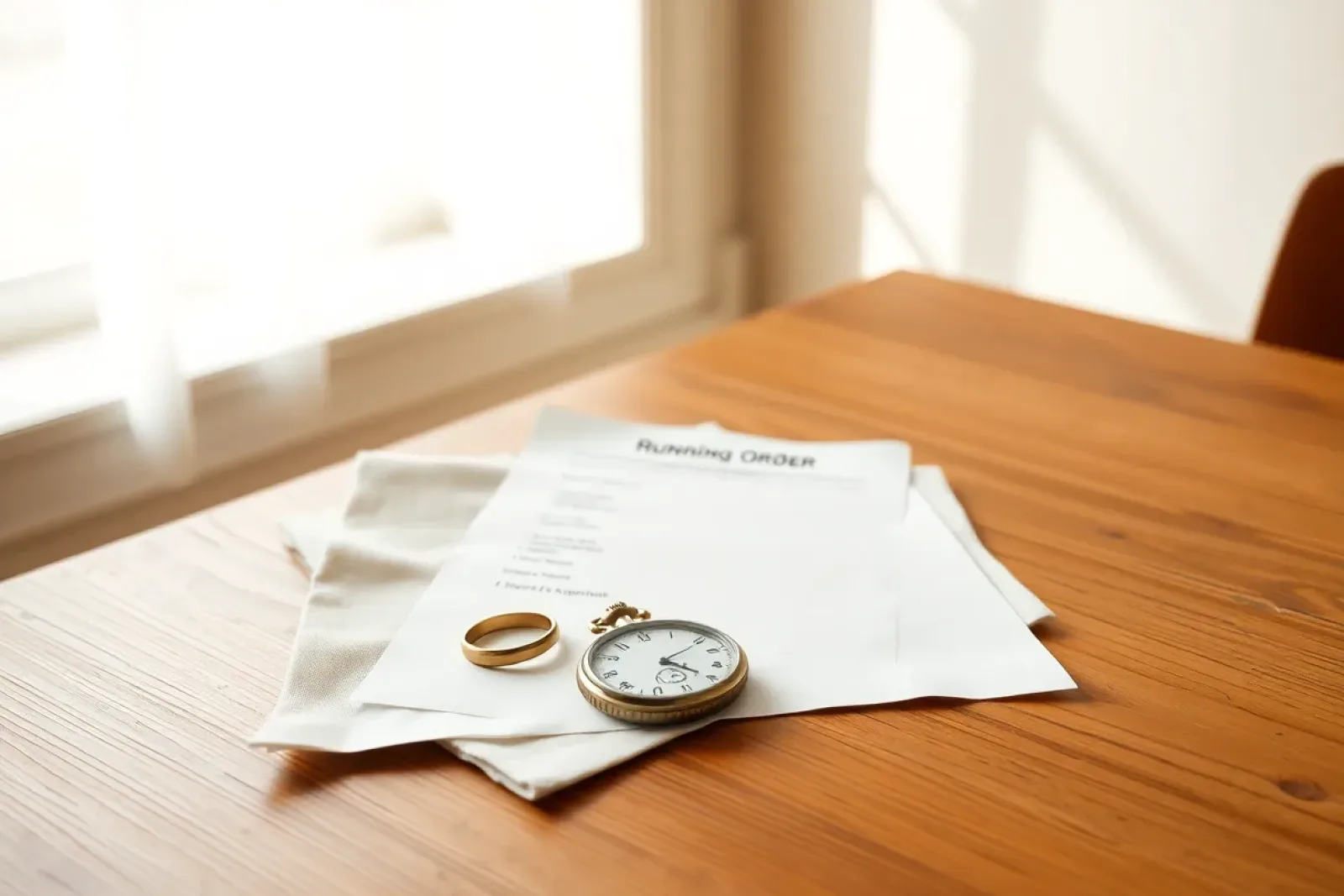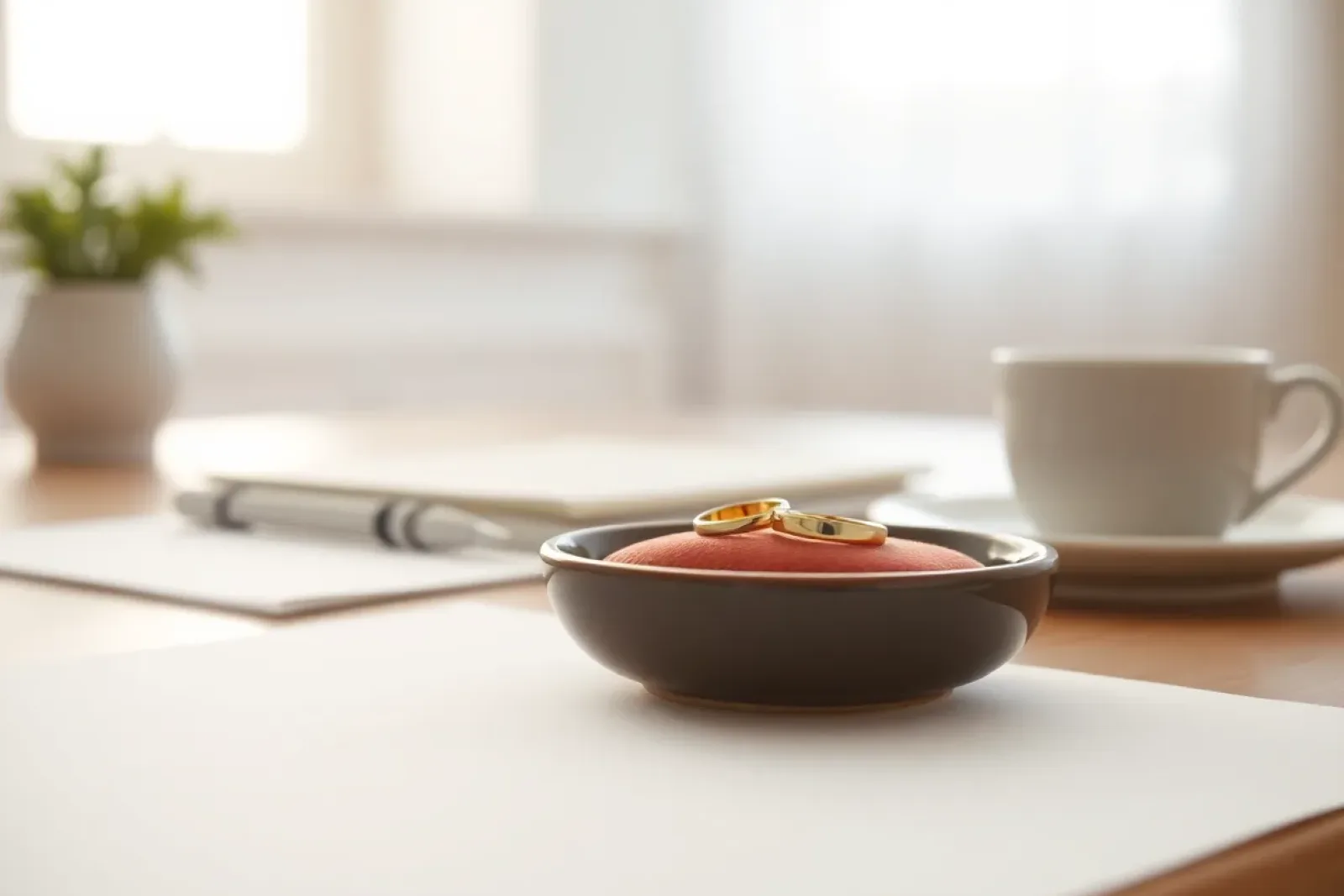
The exchange of rings follows immediately after the vows and takes two to four minutes. Until then they sit with a witness, on a cushion or in a box. In England, France and the United States the wedding ring is worn on the left hand; in Germany, Austria and Poland on the right. Who goes first is pure convention.
The ring exchange is the moment everyone photographs and almost no couple rehearses. That is where the three familiar mishaps come from: the ring is not there, it does not fit, or it drops.
This guide covers the position in the running order, who is responsible for what, which hand to use and what is said, and ends with a checklist for the day itself.
1. Where it sits in the ceremony
The ring exchange has a fixed position: straight after the vows. That order is logic rather than etiquette. The vow is the statement and the ring is its visible sign. Hand over the ring first and it has nothing to refer to.
In a church service the rings are usually brought forward and blessed before they are given. In a courthouse ceremony the exchange is optional, and the judge or clerk will tell you where it falls in their standard script. In a celebrant-led ceremony you place it yourself, and sensibly in the same spot.
How the block fits with the others is shown in the structure of a wedding ceremony, and the denominational detail sits in the church wedding ceremony order.
If you are marrying twice in one day, which some couples do for practical reasons rather than legal ones, the question is where the rings are exchanged. The answer that works is once, in the ceremony that matters more to you. A second exchange the same day almost always reads as a repetition, because the rings are already visibly on your hands. Leaving it out of the morning courthouse ceremony costs that ceremony nothing and gives the afternoon its moment, and the same applies the other way round.
The ring confirms what has just been said. That is why it comes after the vows and not before.
2. Who holds the rings until then
Three arrangements are common, and they differ mainly in risk.
| Arrangement | Advantage | Risk |
|---|---|---|
| A witness or best person keeps them | Reliable and unobtrusive | The forgotten jacket pocket |
| A ring cushion on a table | Photographs well | Wind and sliding |
| A child carries them in | Emotionally strong | The child stops, or loses them |
On the third option, honestly: children under about eight should carry a decoy while the real rings stay with an adult. It costs the picture nothing and removes all the risk. Other ways to involve children are covered in flower girls and ring bearers.
If the rings sit on a cushion, tie them on. An unsecured cushion outdoors is a bet against the wind.
3. Which hand, and who goes first
Hand choice is regional and carries no legal weight anywhere.
- Left hand: the United States, Canada, the United Kingdom, Ireland, France, Italy, the Netherlands, Sweden
- Right hand: Germany, Austria, Poland, Norway, Russia, Greece, and parts of Spain
In the English-speaking tradition both engagement and wedding ring go on the left, with the wedding ring closer to the palm and the engagement ring above it. Many people move the engagement ring to the right hand for the ceremony so the wedding ring goes on first, then move it back. In German-speaking countries the engagement ring is worn on the left and the wedding ring on the right, so the question does not arise. For couples from two traditions there is no wrong answer, and the conversation itself is often part of the ceremony.
Who goes first is also convention. Traditionally one partner places the ring, then the other; you can decide, or leave it to whoever is officiating. What matters more in practice is that both hands are free. Whoever is holding flowers hands them over beforehand, to a person named in advance for that job.
For the ring to fit on the day it has to be measured properly, and that goes wrong more often than people expect. Three rules at the jeweller: be measured in the late afternoon, because fingers are narrowest in the morning; not straight after exercise or on a hot day; and always test the ring over the knuckle rather than resting it on the base of the finger. Wide bands from about six millimetres usually need half a size more than narrow ones, because they give less.
If a ring stops fitting four weeks before the wedding, resizing takes most jewellers three to ten working days. Gold and platinum can be altered in both directions, titanium and tungsten carbide effectively cannot, and full eternity settings only within limits. One thing worth knowing before you hand it over: resizing can damage or remove an inside engraving, because material is taken out or added at exactly that point. Ask about it first, and see ring engraving ideas.
Related articles
4. What is said
Placing the ring almost always comes with a line, and it is short. Four common forms:
- Traditional: the other person's name, then a line such as I give you this ring as a sign of my love and faithfulness.
- Church: a set form of words that the officiant says first and you repeat.
- Written by you: a single clause that follows on from your vows.
- Silent: nothing said at all, with music underneath. This works well when the vows before it were long.
Agree the version in advance, particularly if you are repeating after someone. A long sentence delivered in three parts is surprisingly hard to hold on to in the moment; seven to nine words at a time is the practical limit. What officiants typically say here is covered in the officiant script.
5. The three mishaps and how to prevent them
All three happen more often than couples expect, and all three are avoidable.
- The ring does not fit. Fingers swell in heat, in nerves and during pregnancy. Try the rings on a week beforehand at the same time of day as the ceremony. If it is tight, a trace of hand cream helps; force does not.
- The ring is not there. Agree the night before who puts them in a pocket in the morning, and have that person say it out loud. A second person who knows is the whole of the insurance.
- The ring drops. On gravel, decking or grating it disappears instantly. Stand on a solid surface or lay a rug, and pass the rings over a surface rather than over a gap.
Checklist for the day: rings pocketed, person named, flowers ready to hand over, gloves off, ground checked, cushion tied. That fits on an index card and belongs with the emergency kit. What goes inside the rings before they are exchanged is covered in ring engraving ideas. If your two families wear rings on different hands, your wedding website is a good place to explain it before anyone wonders.
Two smaller questions almost always surface on the day itself. Gloves first: whoever is wearing them takes the relevant one off before the exchange, not during it, and somebody needs to know where it goes, or they will hold it for the rest of the ceremony. Storage afterwards second: if one of you cannot wear a ring at work, decide in advance where it lives rather than improvising in the evening. A ring travelling home in a jacket pocket is the single most common loss of the whole wedding.
As for timing, the variants differ more than you would think. Taking two rings from a witness and putting them on runs to about ninety seconds. A cushion carried up by a child takes two to three minutes. Ring warming through the rows adds the time for the circuit, so three to four minutes more with 40 guests.
The ring exchange needs no staging, only three settled points: where in the order, who holds them, which hand. Everything else happens in the moment, as it should.
Try the rings on next at the time of day you are marrying. It is the check couples make least often and the one that most often turns something up.
All things wedding
Plan your wedding
Bring your tasks, costs and guests together for the day.
Invitations and wording
Find the right words for your wedding invitation.
As a wedding guest
Write a personal message and choose a thoughtful gift.
Wedding anniversaries
Explore anniversary names, traditions and celebration ideas.
Planning your dream wedding?
Create your own wedding website in minutes – with RSVP function, photo gallery, and more.