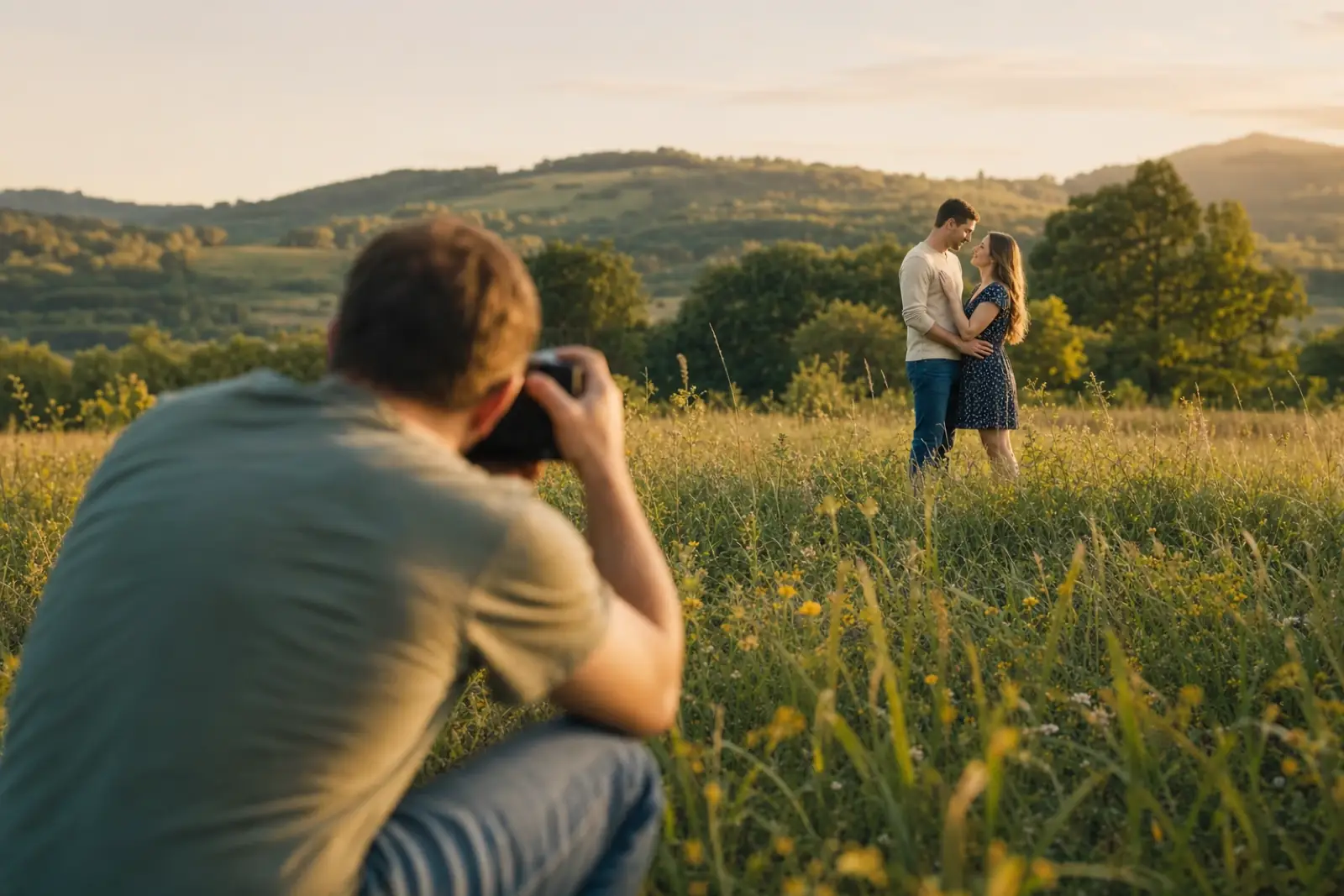
An engagement shoot is mostly practice. You find out how the two of you work in front of a camera, and your photographer finds out who you are — both of which pay off on the wedding day, when the couple portraits get a narrow slot and no second attempt. Location, clothes and season follow from that, along with the question of what the pictures are actually for.
The pictures from a session like this keep working long after the session is over: on the save-the-date, on your wedding website, framed on a wall at your parents' house. That is the visible part, and the reason most couples think about booking one at all.
The invisible part is worth more. A couple who have already spent an hour being photographed need no run-up on the day itself, and the photographer is not guessing at what works. This piece covers both halves: what the session does for you, and how to set it up so that it delivers.
What the session actually does
Being photographed is a skill, and almost nobody has it. On the wedding day you get a narrow window between the ceremony and the meal, with guests waiting and a strong sense that these are the pictures that will last. That is the worst imaginable moment to work out for the first time what to do with your hands.
An engagement shoot takes that job out of the day, with no audience and no clock. After the first few minutes almost every couple does the same thing: the shoulders drop, the laughing turns real, and the camera stops being an object you react to. That warm-up is the most expensive part of the couple portraits on the day — couples who have been through it once start the second session where they finished the first.
The other half is talked about less: the photographer learns you. Who leads and who waits. Who tenses up at the word relax and who needs a task in order to look natural. Which side each of you stands on when nobody puts you there. Whether glasses catch reflections, how big the height difference is, what genuinely makes you laugh and what only looks polite. None of that is in an enquiry email, and together it decides whether somebody on the day is photographing you or photographing a couple.
There is a third effect, unromantic and hard to replace: you find out what working with this person feels like while changing your mind is still an option. If the tone is wrong, that is one uncomfortable evening months before the wedding rather than one uncomfortable day in the middle of it.
On the day itself everything has to work first time. A shoot is where you get to learn it slowly.
How a session runs
The session starts before the session. The conversation beforehand covers two things: where the pictures happen and what you need them for. The second sounds incidental and is not — a picture that will later carry two names and a date needs a quiet area inside the frame, and that either happens while shooting or not at all.
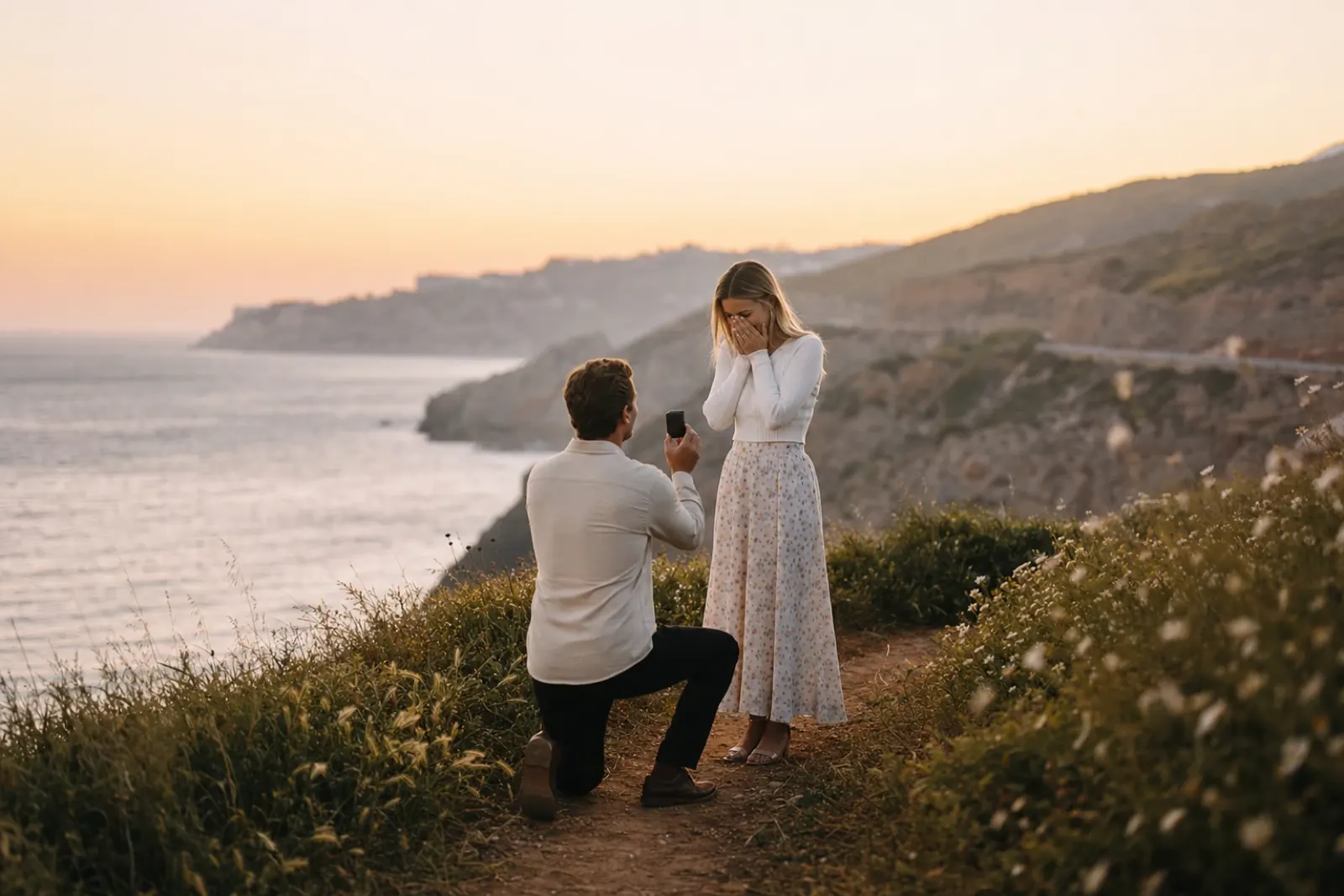
On location, about an hour is normal, often with one short change of setting. The beginning is the same for everyone, which is to say awkward. Experienced photographers expect that and start with the easiest thing: walking, talking, standing still. Very little is posed. What you get instead are instructions that trigger an action rather than a position — walk down the path and talk about anything at all, stop and look at each other, tell each other what the proposal looked like from your side. What gets photographed is the reaction, not the instruction.
Then comes the longer part. Selection and editing sit with the photographer, and you receive an edit rather than everything. More images is not a better result, only more sorting for you.
Three points are worth settling before you book, because they are surprisingly rarely in the quote by themselves:
- Number and resolution. How many edited images you receive, and whether they arrive at full resolution. The moment anything gets printed, that is the line that matters.
- What you may do with them. Print them, pass them to family, put them on your own site. In the UK and the US alike the photographer normally keeps the copyright and grants you a licence, so what that licence covers is the part to read — being allowed to print a picture is not the same as owning it, and it belongs in the agreement rather than in a phone call afterwards.
- The weather date. Who decides, by when, and where the replacement date sits. Without that agreement, steady rain leaves you choosing between a soaked session and a lost fee.
One question shortens the whole conversation: what do you need from us to make this work? The answers come back more concrete than you expect, and they save a round of follow-up emails.
Cost varies by market far more than by photographer, so it is worth reading local figures rather than any single number. In the United States a standalone engagement session commonly falls somewhere between $300 and $1,500, with hourly rates of roughly $150 to $500. In the United Kingdom a separate shoot sits nearer £200, and added to a wedding package it typically adds £250 to £450. Before comparing any of that, check what you have already booked: a good many full-day packages include a session, and an included shoot is a completely different decision from a separate one.
The location matters more than the backdrop
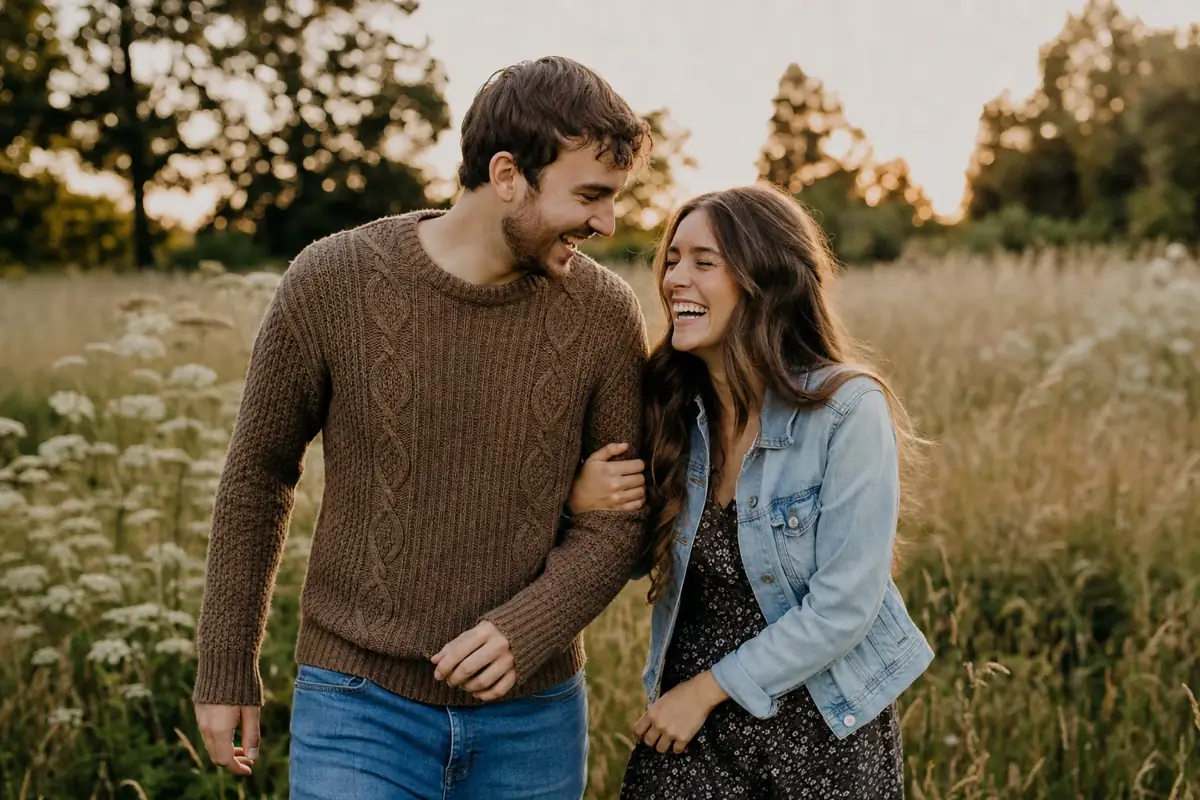
Two criteria carry the choice, and beauty is neither of them. First, you have to be able to forget yourselves there; a couple who feel watched look exactly like that in every frame. Second, the place should mean something to you. The yard where you met, the neighbourhood you live in, the walk you take every Sunday — places like that supply the conversation a shoot runs on.
How busy it is decides more reliably than how it looks. A famous lake on a Sunday afternoon belongs to everyone else for those hours; the same lake on a weekday evening belongs to you. Where you have the choice, take the unremarkable place at a quiet hour over the spectacular one at a busy one.
Some places need permission, and the rules differ sharply by country. In the UK, the Royal Parks issue a specific wedding and lifestyle photography permit that covers engagement and pre-wedding shoots: one hour, a maximum of ten people, selected areas only, at least ten days' notice, and proof of the photographer's public liability insurance, for which they ask £5 million of cover. The National Trust handles requests property by property — you contact the place in advance, agree access and pay whatever that property charges. In the United States, the National Park Service takes the opposite approach for small sessions: still photography with eight people or fewer, in areas open to the public, using hand-carried equipment and asking for no exclusive use of a spot, needs no permit at all, though park entrance fees still apply and going beyond any of those limits puts you back into permit territory. Municipal parks, botanic gardens and private estates in both countries set their own terms, and most of them do charge.
Agree who asks. Many photographers know the rules where they work, but nobody automatically feels responsible for the question, and it is far easier to ask in the first week than in the last one.
On the season, one rule of thumb runs against instinct: high summer is the hardest time of year. Hard light, heat, crowded places. Spring and autumn are easier; winter is beautiful and short. In every season the usable window sits in the same place, the last hour before sunset, so build the appointment around that hour rather than around your diary. In Britain that hour has finished by around four o'clock in late December and does not begin until after eight in late June — a bigger practical difference than most couples expect, and one that quietly decides which evenings of the week are available at all.
One practical point usually only surfaces on location: the place has to be reachable in what you are wearing. Fifteen minutes along a wet field path changes how you arrive — and the first pictures are, inevitably, taken at the beginning.
Related articles
Clothes: coordinate rather than match
Clothes decide more about the pictures than any pose does, and there is a technical reason behind it: colour bounces. A bright red or neon top lays its own tone onto skin and face — including your partner's, the moment you stand close together. Black does the opposite and swallows texture, which in soft evening light quickly reads as hard.
What works is coordination without matching. Two pieces from the same colour family, different in tone and material, make a calm picture. A full matching outfit makes a costume. Slogans, large logos and strong patterns fail for a plain reason: at card size nothing survives of them but a pattern, and in two years they date the picture more precisely than any date could.
Wear things you have worn before. A new shirt sits differently the first time, new shoes change the way you walk, and both show. A second outfit is only worth it if there is somewhere on site to change — otherwise the change costs exactly the time in which you had just loosened up.
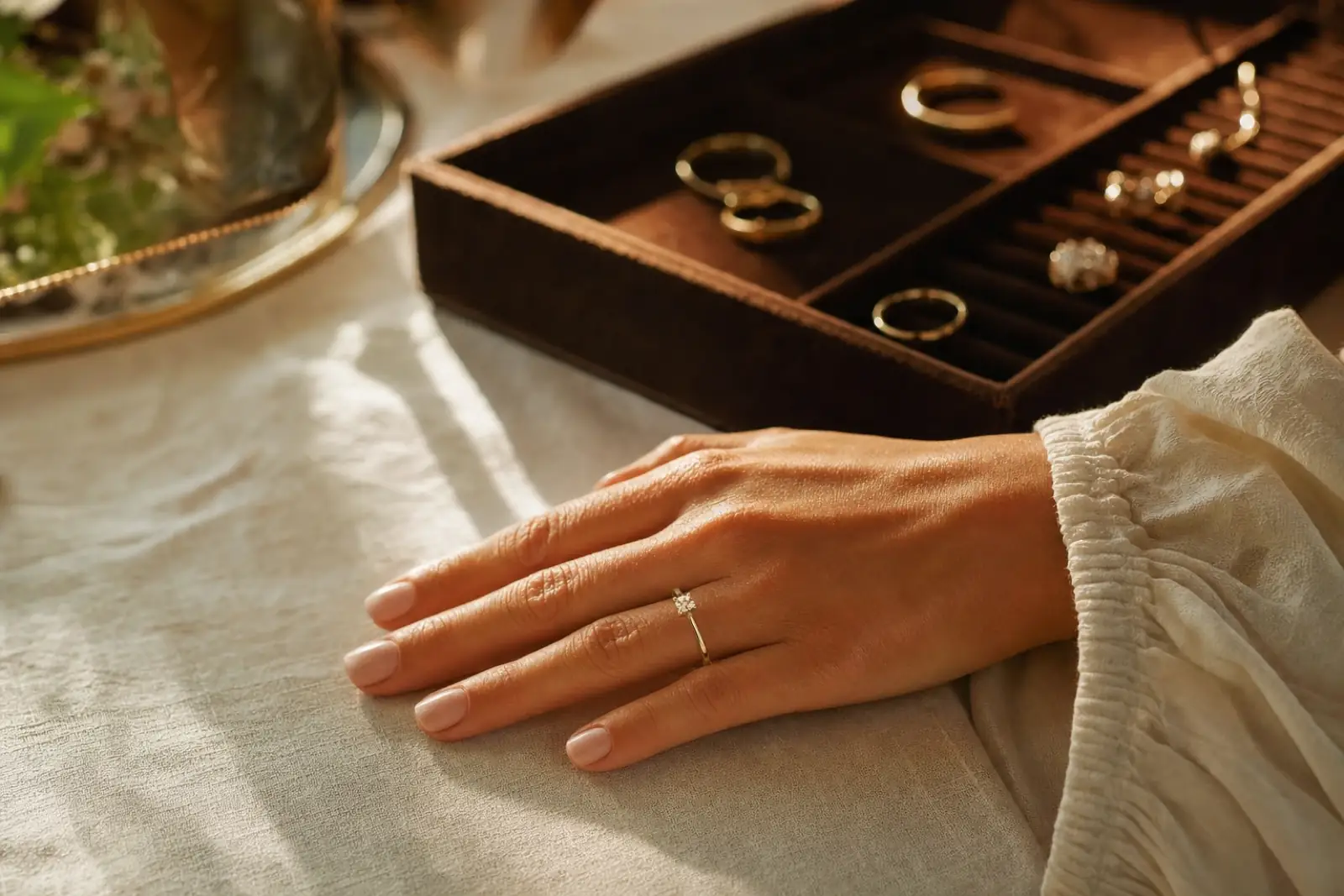
Two details get overlooked with great regularity. If the ring is going to be in the picture, then hands are in the picture, with everything that involves. And anyone who wears glasses should raise it beforehand: reflections can be avoided while shooting, and afterwards only with effort.
The wedding outfit does not belong at this session. Not because of the old superstition, but because it pre-empts the pictures you are getting anyway a few months later. A shoot in the dress produces no photographs of its own, only a preliminary version of the wedding photographs — which is precisely the thing the session was supposed to be preparing for.
What you actually need the pictures for
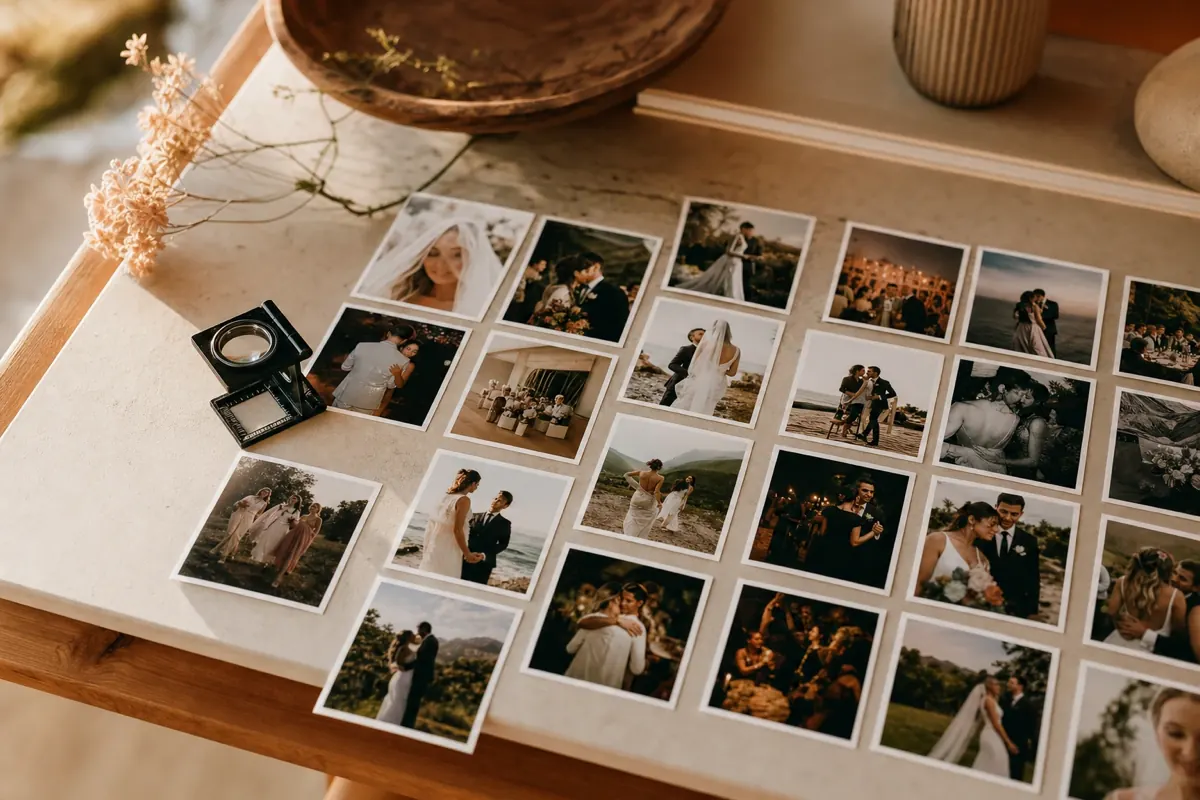
Once the session is over the images have three fixed destinations, and each asks something different of the frame.
- The save-the-date. It carries little information and a lot of open space, so a single picture holds the whole card. It is also the print that ends up on other people's fridges.
- The invitation. It gets read, not looked at. A picture sits better on the back or inside than beside the details that have to be correct.
- The wedding website. It needs the widest frame of the three, because a page header runs across while a card motif stands upright. Say so beforehand and both come out of the same session.
That produces an order most couples arrive at too late. The date is not set by mood but backwards from the first print run: save-the-dates go out, before that setting and printing, before that your selection, before that the photographer's editing time, before that the shoot itself. The usual advice on both sides of the Atlantic is to send save-the-dates six to eight months ahead, and closer to a year for a destination wedding. Walk that chain backwards once and you land regularly on an earlier date than you thought — and on a season you would not have chosen.
Say as well which formats you need. A picture with a quiet area at the top left is a different frame from the same subject filling the frame, and that area is created in the composition, not afterwards. Keep the finished images in the same place as a wedding website of your own and they are to hand when the cards are being set.
The side effect is the one almost nobody plans for and the one you see for longest: a single set of images gives everything that follows the same handwriting. Save-the-date, website, invitation and later the thank-you cards look like they belong together, without anyone having needed a design concept.
An engagement shoot pays for itself twice: in pictures you need anyway, and in the warm-up that then does not have to happen on the wedding day. Work backwards from the date the first cards go out — that one appointment fixes season, location and clothes along with it. And before you book anything separately, check the package you already have; a session is often in it.
All things wedding
Plan your wedding
Bring your tasks, costs and guests together for the day.
Invitations and wording
Find the right words for your wedding invitation.
As a wedding guest
Write a personal message and choose a thoughtful gift.
Wedding anniversaries
Explore anniversary names, traditions and celebration ideas.
Planning your dream wedding?
Create your own wedding website in minutes – with RSVP function, photo gallery, and more.