Table of contents
An evening works when it alternates: one fixed moment, then an open hour. A dependable shape is drinks from 5pm, dinner at 6.30pm, speeches in the gaps between courses, cake around 9pm, first dance straight after, late snack around midnight. Keep it to five fixed moments.
The most common mistake with a reception running order is not having too little in it but too much. Six fixed moments across four hours takes away the one thing guests actually came for, which is time with each other. An evening without gaps does not feel full to a guest. It feels relentless, because somebody keeps picking up a microphone.
A good running order follows a rhythm rather than a list. Every fixed moment is followed by an open block in which nothing happens except eating, drinking, dancing and talking. Those open blocks are not the gaps between the programme. They are the evening, and the programme is only what separates them from each other.
1. Rhythm beats a list
Picture the evening as a series of waves. Each fixed moment gathers attention into one place, and afterwards it breaks apart into groups again. Both halves are necessary. An evening made only of gathering exhausts people. An evening made only of drifting feels shapeless, and guests leave earlier without being able to say why.
In practice that means at least forty minutes between any two fixed moments. After dinner the gap can grow, because dancing has started and looks after itself. Put the cake twenty minutes after the last speech and you are asking a room to gather twice in a row. The second gathering gets noticeably less attention than the first, even though it is usually the better moment of the two.
The second principle is the direction of energy. The evening rises: welcome, then food, then the emotional moments, then music. Couples who move the first dance before dinner because they want it over with end up dancing in front of guests who are standing up and hungry. Serve the late-night snack at 10pm because the kitchen wants to close and you have hungry guests at midnight with nothing to offer them.
A third point concerns the guests who will not stay to the end. At almost every wedding a group leaves between 10pm and 11pm: older relatives, families with small children, anyone facing a long drive. Anything that matters to you should therefore have happened before 10pm. A cake cutting at 11.30pm is missed by roughly a third of the people you invited, and usually by the third that travelled furthest to be there.
Keep the number of fixed moments small as well. Five is a lot; six is too many. Everything beyond that competes with what you actually wanted, which is people staying, talking and dancing.
The open hours are not the gaps between the programme. They are the evening.
2. A realistic shape from 5pm to 2am
The outline below assumes an afternoon ceremony, around a hundred guests and a three-course meal. It is a template to measure your own timings against rather than a rule. The right-hand column gives the reason each moment sits where it does, which is the part worth keeping when you change the times.
| Time | What happens | Why it sits there |
|---|---|---|
| 5.00pm | drinks reception, congratulations | Allow 90 minutes, or 120 above 80 guests |
| 6.30pm | guests seated, starter served | Later than 7.15pm and the drinks reception drags |
| 7.00 to 8.45pm | meal with speeches in the gaps | Three courses need two to two and a half hours |
| 9.00pm | cake cutting | Before the photographer finishes, usually around 10pm |
| 9.30pm | first dance, floor opens | Straight after the cake, while everybody is up |
| 10.00pm to midnight | open block: dancing, bar, talking | No programme at all, and that is deliberate |
| midnight | late-night food | Catches the dip, keeps guests an hour longer |
| from 1.00am | second dance stretch, wind-down | Typically 20 to 40 per cent of guests remain |
Move the whole shape later if the ceremony starts later. Do not move parts of it. Pushing only dinner back drives the dancing into the hours when the first guests are already leaving, and the evening never fully starts.
3. Transitions matter more than the moments themselves
Almost every reception that loses its energy loses it between two moments rather than during one. The classic scene: the cake is cut, the photographer packs up, the music has not started and a hundred people are standing in a room. Two minutes of silence there costs more atmosphere than an average speech ever could.
A transition needs three things: somebody to announce it, a track that starts immediately, and somewhere for guests to move to. When the first dance follows the cake directly, the transition solves itself, because everybody is already standing. Leave half an hour between them and you need something to fill it: coffee, the terrace doors opening, the bar reopening.
The most reliable technique is to couple the difficult moments together. Cake and first dance belong together. Speeches and course changes belong together. The late-night snack couples to a track that is already pulling people towards the middle of the room. Anything coupled needs an announcement rather than a transition of its own.
Where a gap is unavoidable, give it a reason to exist rather than pretending it is not there. Fifteen minutes with the doors open, coffee poured and the lights slightly up reads as a deliberate pause. The same fifteen minutes with the lights unchanged and no music reads as something having gone wrong, even when nothing has.
Related articles
4. Whoever holds the plan holds the evening
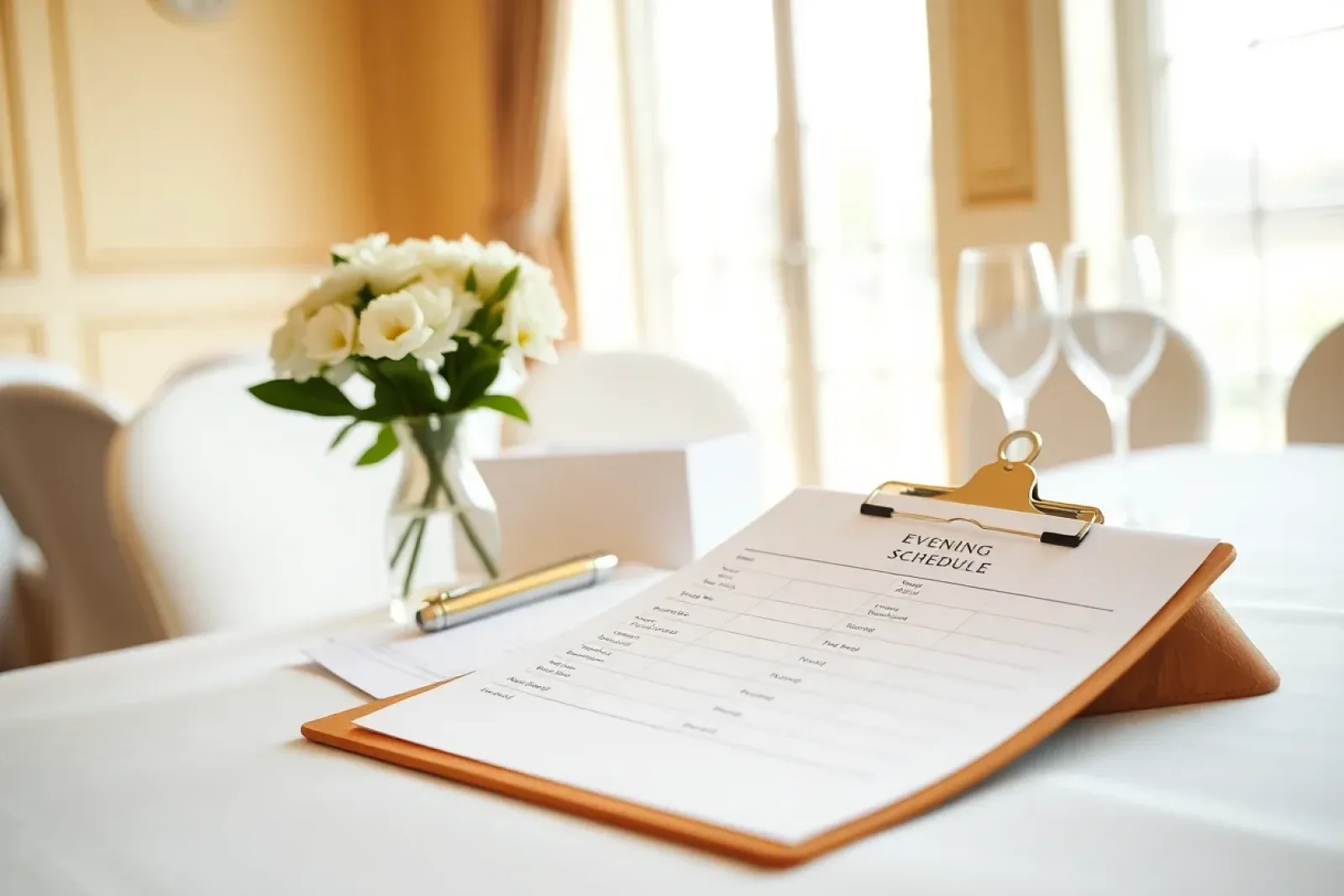
A running order covering the whole wedding day that exists only in the couple's heads works until the first conversation at the table. After that the chef needs a decision about the main course and cannot find anybody to give it. Put the plan on one sheet and give it to no more than five people: the venue or caterer, the band or DJ, the photographer, whoever is announcing, and one trusted friend.
The couple deliberately does not belong on that list. Anybody running the schedule at their own wedding spends the evening looking for people instead of being at it. Hand the role to somebody who knows the plan, recognises the suppliers and has the authority to make a call when something slips, because something always does.
Three columns are enough: time, what happens, who triggers it. The photographer only needs their three moments, the kitchen its two, the band the cue for the first dance. Print it twice, because one copy always goes missing. For the guest-facing version, the simplest place is where guests already look: putting the outline of the day on your wedding website as a schedule guests can check themselves cuts down the questions on the day noticeably.
5. What to leave out on purpose
There is a short list of items couples add because they seem to belong at a wedding and which reliably break the rhythm. A second round of speeches after the dancing has started is one. Anything that asks seated guests to get up while they are eating is another. So is a long slideshow that takes the lights down for twenty minutes in the middle of the evening.
Test every planned item with the same three questions. How many minutes does it cost, how many people stand still while it happens, and what happens immediately afterwards? If the answer to the last one is not obvious, the item does not belong in the evening. It belongs in the afternoon, at the rehearsal dinner or at the next morning's brunch.
The exception is anything with a genuine reason behind it. A song from the nieces, a fireworks display, a choir that has travelled to be there: those are worth stopping the evening for. Two of them is generous. Three is a programme. The rule of thumb is unromantic but dependable: anything over ten minutes has to be better than whatever would be happening without it.
One more category deserves a mention, because it looks harmless. Surprises arranged by guests without telling anybody often arrive at exactly the wrong minute, usually while the kitchen is plating. Ask people to tell one person in advance, not to abandon the surprise. You keep the surprise for yourselves and the kitchen keeps its schedule.
A reception that works has few fixed moments, clean transitions between them and long open blocks in between. The 5pm to 2am shape is only the frame; the quality lives in the hours where nothing is planned. The next sensible step is fixing the time of the cake cutting, because once you know when the photographer finishes, the cake, the first dance and the late-night food fall into place around it.
Planning your dream wedding?
Create your own wedding website in minutes – with RSVP function, photo gallery, and more.