Table of contents
A plan B is a second location, not an intention. It has to exist before you book, seat every guest and be ready in under thirty minutes. Decide in advance who makes the call and when: in practice the decision belongs to the morning of the wedding, and at the latest three hours before the ceremony.
The sentence 'we will just move inside' is not a plan. It gets said on a sunny day, and on the wet one it turns out the inside room seats sixty of your ninety guests, the chairs are all outdoors, and nobody has decided who decides.
A workable plan B answers three questions: where exactly, who calls it, and how long the switch takes. Once those three answers are written down and every supplier has them, rain is weather rather than an incident.
1. Your plan B is a room, not a thought
Inspect the alternative during the site visit, not over the phone. Stand in the room that would be used and count the chairs. Three things have to be true: it seats every guest, a question answered by the room's seated capacity rather than its floor area; it is reachable without anyone walking through rain; and it is genuinely free on your date — not storing the outdoor chairs, not doubling as a changing room, not hosting a second event.
Ask explicitly who performs the switch. At some venues turning the room around is part of the service; at others it falls to you or to whoever is dressing the space. If it belongs to nobody, on the wet day it belongs to you, on the one day you have the least time to give it.
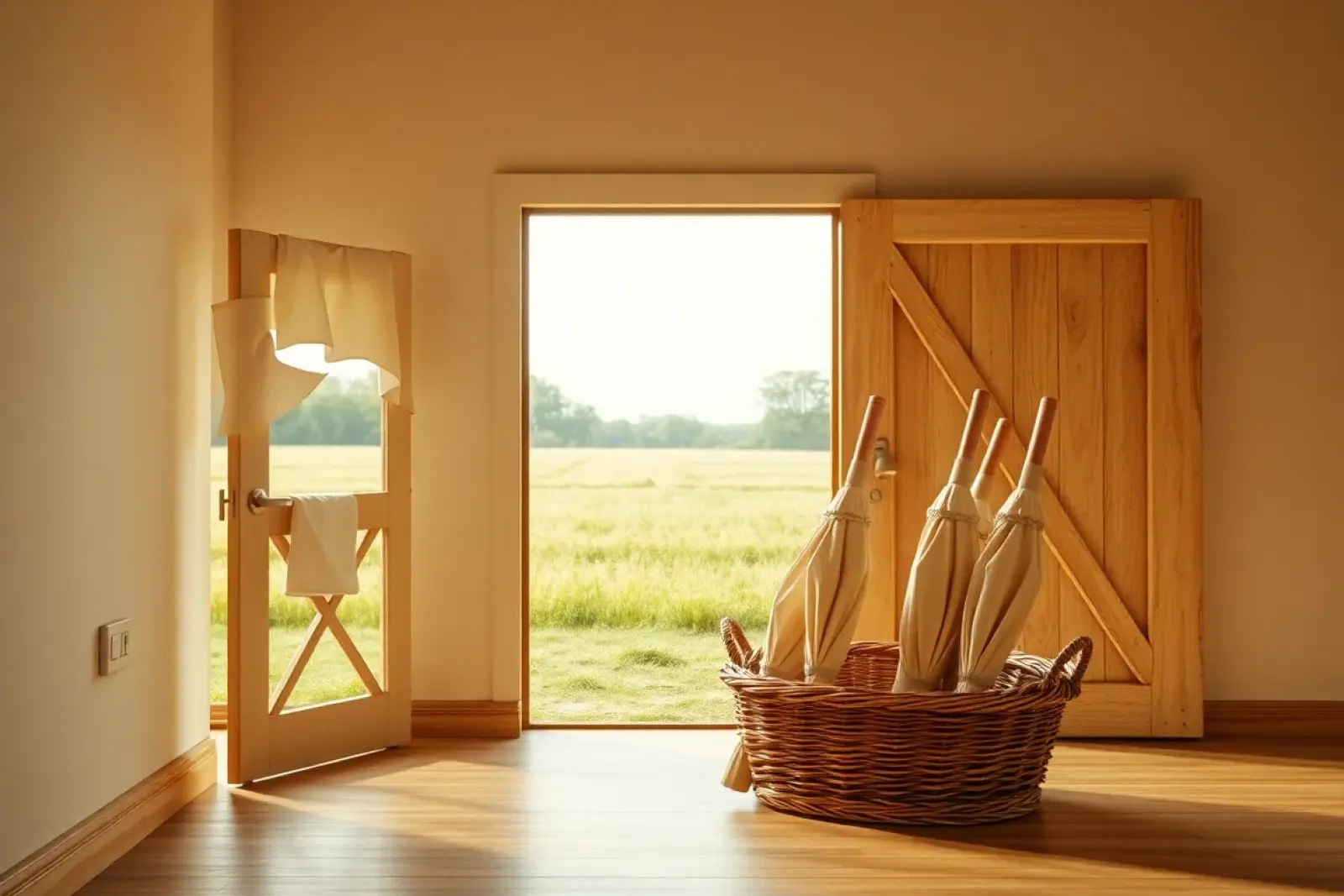
The blind spot is almost always the walk. Between the parking lot, the ceremony and the reception there is nearly always a stretch outdoors. Find out whether umbrellas exist, how many, and who hands them out. Twenty umbrellas at a wedding for eighty people is equipment, not decoration.
A second question belongs to the same inspection: how long does the switch actually take? Do not ask whether the room can be turned around, ask how many minutes and how many people it needs. A hall requiring eighty chairs to be moved takes four people half an hour. If the seating lives indoors and only goes outside when the weather is good, then plan B is the default state and plan A the exception — a far calmer starting position, and the reason many experienced venues work exactly that way.
A plan B invented on the morning is not a plan B. It has to exist while the sun is still out.
2. Who decides, and when
The second half of a plan B is the decision path. Every switch has a last comfortable moment. The table lists the usual calls, their deadline and who should make each one — deliberately not always the couple.
| Decision | Latest moment | Who calls it |
|---|---|---|
| Put up a tent or not | 1 to 2 days before | You, together with the rental company, driven by their build time. |
| Ceremony inside or outside | 3 hours before the start | Your coordinator or the venue, following a rule you agreed in advance. |
| Move the drinks reception | 1 hour before | Venue or caterer, because they are the ones setting tables and glassware. |
| Delay the couple portraits | rolling, through the day | The photographer. They read the light better than any weather app. |
| Move the evening indoors | 2 hours before | Venue with the band or DJ, because of power and stage position. |
| Fire pit, sparklers, outdoor send-off | late, on the night | Your coordinator, in agreement with the venue. |
Agree a simple threshold in advance so the call does not have to be debated, for example: above 60 per cent chance of rain in the ceremony hour, we set up inside. A stated rule takes an enormous amount of pressure out of the morning.
3. Three kinds of plan B
In practice there are only three, and what separates them is how early you have to commit:
- The indoor room. Simplest and cheapest, because it is already there. The trade-off is that it looks different from what you pictured, and the styling has to be thought through twice.
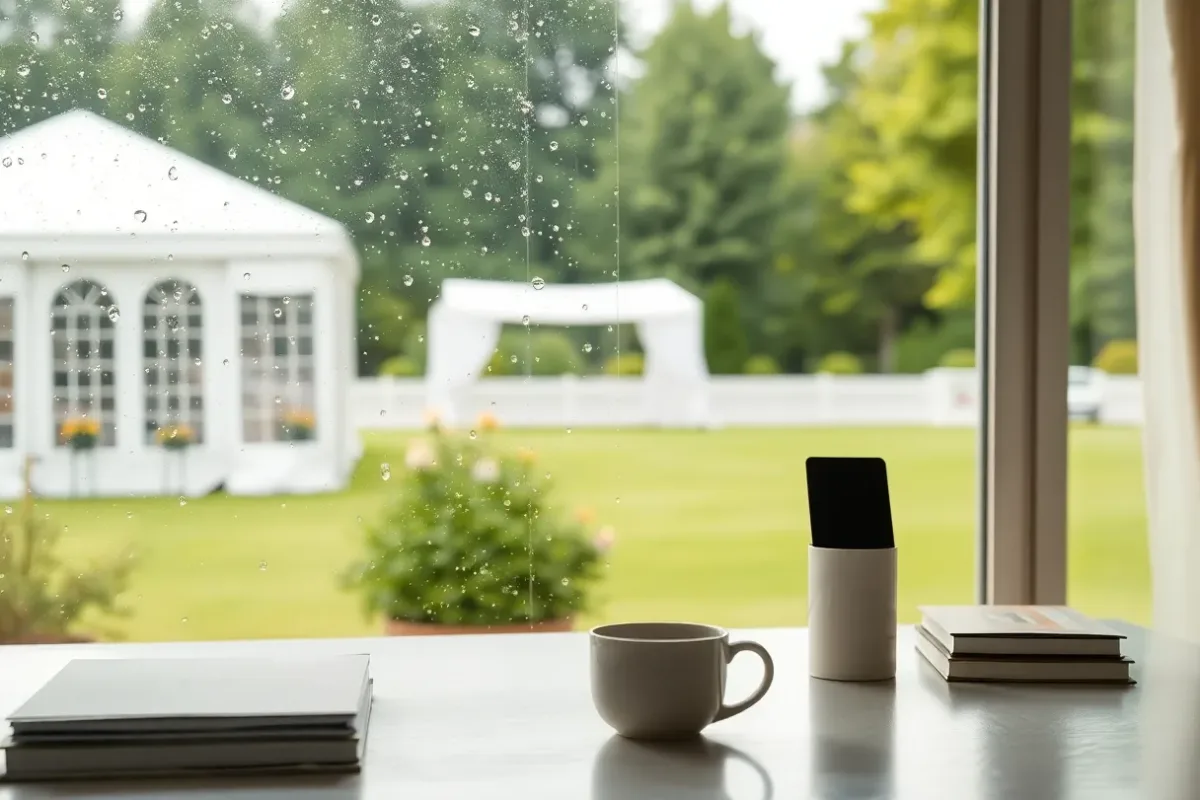
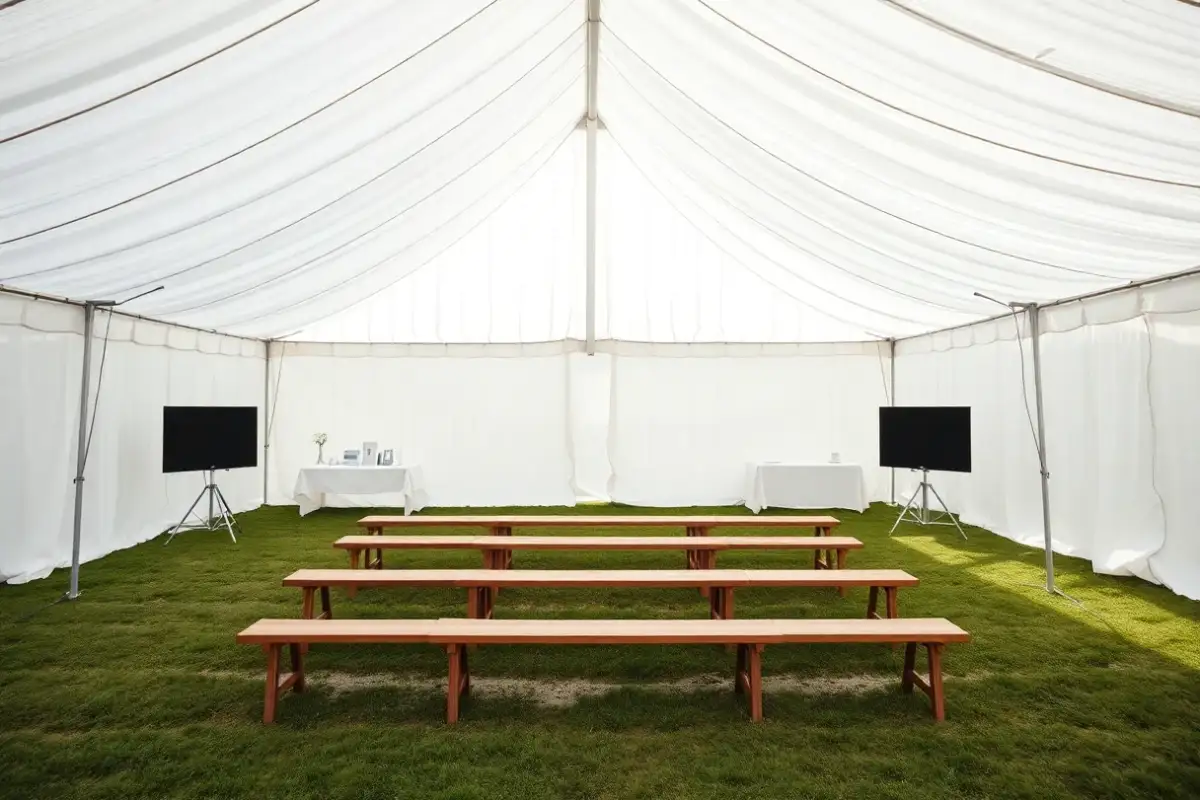
- The tent. Keeps the feel of an outdoor wedding, but has to be ordered and built a day or two ahead — at a point when the forecast is still uncertain. If you have a tent, you have already used your plan B.
- Moving things within the day. Instead of the place you change the hour: portraits into a dry window, drinks pushed back forty minutes. It costs nothing, but it needs slack in the schedule and one person to communicate the change.
These combine well. Many couples end up with a tent option for drinks, the hall for the ceremony and a movable photography window. What matters is writing the combination down, or every supplier will be working from a different version on the day.
Related articles
4. What rain changes beyond the location
Moving indoors is the obvious consequence. The less obvious ones are what actually disrupt the day. Wet ground does not carry heels or heavy tables; on a lawn, tent legs and chairs sink. Extension cables outdoors need protected routing once it is wet, and outdoor music is often the first thing to go — not because of the rain but because of the equipment.
The schedule shifts too. A location change realistically costs twenty to forty minutes, because people move more slowly than furniture. Without that slack, you lose the time somewhere else, usually at dinner or in the portraits.
Then there is telling people. If the meeting point changes, eighty guests need to know and half of them are already on the road. Messaging a handful of well-connected guests works well; and if travel details already live on a wedding website, changing the meeting point there takes a minute.
Think about set-up times as well. If everything has been styled outdoors and rain arrives in the morning, all of it has to be collected and redistributed indoors — the same work as the original set-up, done under pressure. Planning sensibly for weather risk means styling indoors fully from the start and only carrying things out if the forecast holds. Flowers then travel outward in good weather rather than inward in bad. Reversing that one sequence removes most of the effort from a wet day and costs nothing but the decision to make it in advance.
5. Reading the forecast properly
Forecasts get over-read under planning stress. Anything beyond seven days is useful for a decision like ordering a tent and useless for the shape of the day. The information you can actually act on arrives the evening before and on the morning itself, and what matters there is not the daily figure but the hour your ceremony sits in.
Look at three numbers: chance of rain in that window, expected rainfall, and wind speed. Wind is the underrated one. It decides the tent, the candles, hairstyles, anything paper on the tables, and whether a floral arch stands safely.
Then one last unromantic rule: once the call is made, it is not revisited. Turning a room around twice costs far more than any amount of rain.
One point is missing from nearly every plan B: the photographs. In rain, a photographer needs two or three covered spots within a few minutes of the venue — an arcade, an archway, a doorway, a large window. That takes ten minutes to settle at the site visit and it saves the pictures, without anyone having to go hunting for shelter on the day. Raise the question at the viewing even when the sun is out.
And think about clothes. Wet grass ruins pale shoes within a few steps, and a dress with a train takes every puddle with it. Two pairs of shoes to change into, a towel in the car, and a line in the invitation saying that the walk to the ceremony is outdoors all cost nothing, and between them they head off the commonest small disaster of a rainy day.
Call your venue and ask three questions: which room is the plan B, how many guests does it seat, and who turns it around. With those three answers in writing your plan B is essentially finished, and everything else is fine-tuning the evening before.
Planning your dream wedding?
Create your own wedding website in minutes – with RSVP function, photo gallery, and more.