Table of contents
In Britain, Ireland, the US and much of the English-speaking world, both the engagement and wedding rings are worn on the fourth finger of the left hand. In Germany, Poland, Russia, Norway and parts of Spain the right hand is used instead. Neither is more correct; the custom is regional.
This is a question people ask quietly, usually two weeks before a wedding, and the answers online are unusually confident for something that varies by country, religion and family.
What follows sets out where the left-hand custom comes from, where the right hand is standard, how the two rings are worn together, and the practical questions that come up afterwards: resizing, wearing rings at work, and what happens when one of them no longer fits.
1. The left-hand custom and the vein that is not there
The usual explanation is the vena amoris, a vein said to run directly from the fourth finger of the left hand to the heart. The story is Roman in origin and appears in early modern European writing, and it is repeated at almost every wedding.
Anatomically it is not correct. There is no vein unique to that finger, and the venous system of the hand is much the same on both sides. As an explanation it is charming and false, which puts it in the same category as most wedding folklore.
The more likely reasons are practical. The left hand is the non-dominant hand for most people, so a ring worn there is less exposed to damage. And the fourth finger is the least independently used of the five, which makes a band on it less obtrusive.
The custom of using that finger specifically is very old in Europe and predates the vein story, which appears to have been attached afterwards as an explanation. That order of events, practice first and meaning second, is worth remembering whenever a wedding custom comes with a tidy origin.
There is no international rule here. There is a map, and your family sits somewhere on it.
2. Where each hand is used
The division is broadly geographic and partly religious, and the exceptions are numerous.
| Country or region | Wedding ring hand |
|---|---|
| UK, Ireland, US, Canada, Australia, New Zealand | Left |
| France, Italy, Sweden | Left |
| Germany, Austria, Poland, Russia, Ukraine | Right |
| Norway, Denmark in part, Greece, Bulgaria | Right |
| Spain | Right in most regions, left in Catalonia |
| India | Right traditionally, left increasingly common |
| Turkey, Brazil, Chile | Right |
Two patterns run underneath this. Orthodox Christian tradition generally favours the right hand, and in several countries the right hand carries an older association with fidelity and honour. In parts of central Europe the engagement ring is worn on the left and then moves to the right at the wedding, which is a neat solution to the stacking problem below.
If the two of you come from different traditions, both wearing rings on different hands is entirely normal and nobody will notice but you.
3. Wearing an engagement ring and a wedding ring together
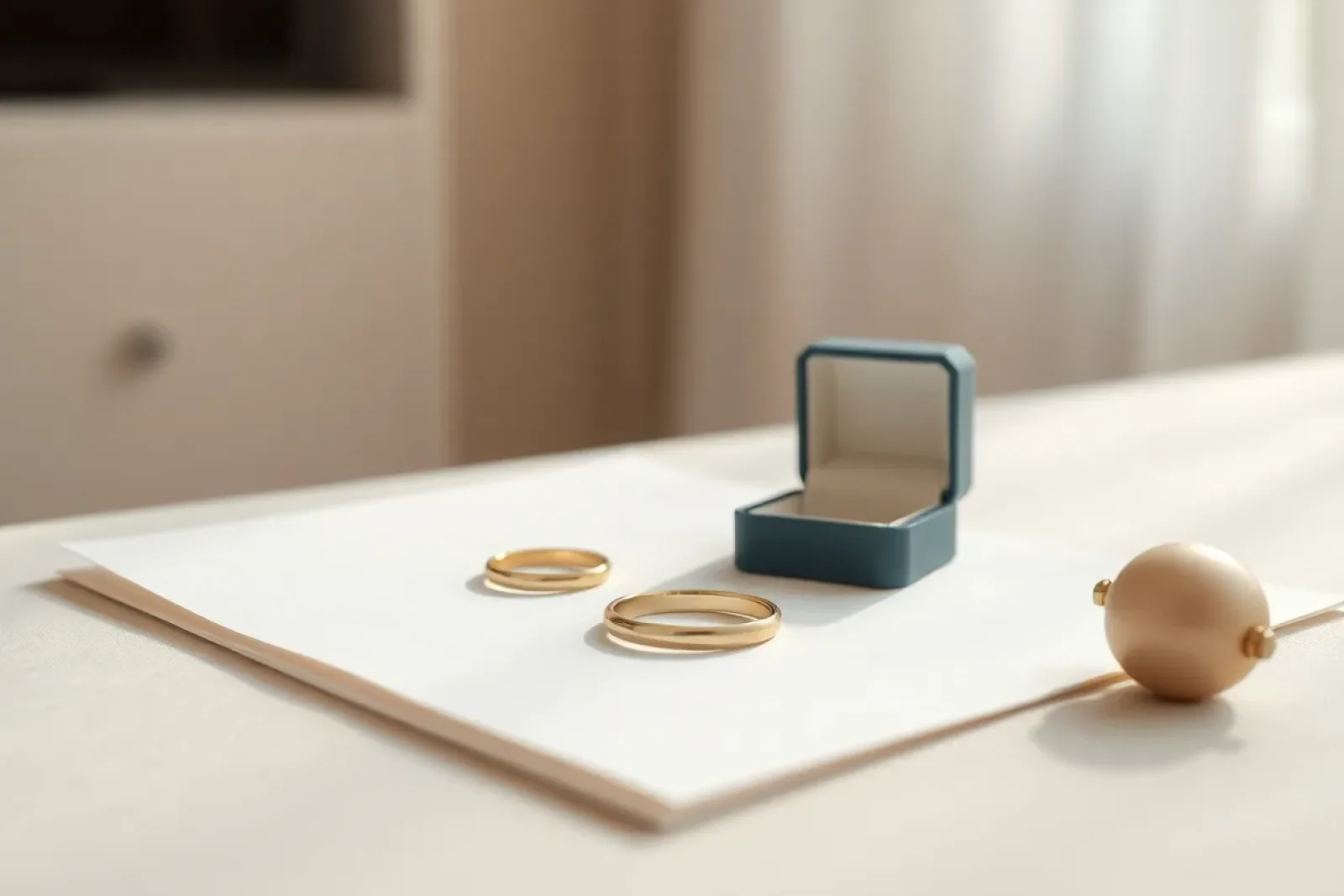
Where both are worn on the same finger, the convention in Britain and the US is that the wedding band sits closest to the hand, with the engagement ring above it.
The usual explanation is that the wedding ring should be nearer the heart. The practical version is that the band is normally plainer and sits flatter, so it is more comfortable underneath. Either way the order is a convention, not a rule.
- Before the ceremony: many brides move the engagement ring to the right hand for the day, so the band can be placed on a bare finger.
- During: the band goes on the left fourth finger.
- Afterwards: the engagement ring goes back on top of it.
- Later: some people add an eternity ring, which usually sits above both.
The alternative is to wear them on different hands permanently, which suits anyone whose engagement ring is high-set or whose work makes a stack impractical. Some couples have the two soldered together into a bridal set, which solves spinning and uneven wear but makes future resizing harder and is not easily reversed.
For men, the pattern is simpler: one band, same finger, same hand. Adding a signet or family ring to the other hand is common and carries no particular convention.
Related articles
4. Fit, resizing and wearing it at work
The practical questions arrive within the first year, and they are the ones nobody thinks about while choosing the ring. The amounts below are US dollars; the questions themselves arise wherever you marry.
Fit changes. Fingers swell in heat and after salt, and shrink in cold. A ring that fits perfectly in August may spin in January. Size in the middle of the day at normal temperature, not first thing in the morning and not after exercise.
Resizing has limits. Plain gold and platinum bands resize easily, at roughly 50 to 150 dollars. Rings with stones set all the way round, engraved bands and tungsten or ceramic rings often cannot be resized at all, which is worth knowing before buying rather than after.
Some jobs rule rings out. Healthcare, catering, engineering, anything with machinery, and any work involving gloves or degloving risk. A silicone band is the standard answer and costs a few dollars. Wearing the real ring on a chain is the other.
Metals wear against each other. A soft gold band worn against a platinum engagement ring will lose material faster. If you are buying both at once, matching the metals extends the life of the softer one.
None of this changes which hand. It does change how often the ring is actually on it, which for many people is the more honest question.
Insurance is the other overlooked piece. Most household policies cover jewellery only up to a low single-item limit, often one or two thousand dollars, and a ring above that has to be named on the policy. Do it in the first month, along with keeping the receipt and a photograph, because the claim nobody can evidence is the one made two years later.
5. The questions that come up afterwards
Four situations produce the same enquiry, and none of them has an etiquette answer so much as a common practice.
- A second marriage. The new band goes on the same finger. Rings from a previous marriage are usually moved to the right hand, kept for a child, remade into something else, or simply put away.
- Widowhood. There is no rule and no timetable. Many people move the ring to the right hand at some point, and many never do. Either is normal.
- Engagement rings for men. Increasingly common and worn on the same finger as the eventual band, usually on the left in the UK and US.
- Same-sex couples. The same conventions apply, and plenty of couples simply agree between themselves rather than inheriting the arrangement.
One last practical note for the day itself. Whoever is holding the rings should have them in a pocket that closes, not in a hand. Ring boxes come open, and the floor of a church is an unforgiving surface. If the rings are being carried by a child, the usual solution is a cushion with the real rings safely in an adults pocket.
The exchange itself, including which hand and in what order, is worth settling with your officiant at the rehearsal rather than at the altar. It is also the sort of detail worth noting alongside the ceremony running order on your wedding website, where anyone with a job on the day can find it.
Left hand, fourth finger, if you are in Britain, Ireland or North America; right hand across much of central and eastern Europe. Beyond that it is family and preference. The decision worth making early is not which hand but whether the ring you are buying can be resized, because that answer is fixed at the point of purchase.
Planning your dream wedding?
Create your own wedding website in minutes – with RSVP function, photo gallery, and more.