The search for the dress gets easier once four things are fixed: the wedding date, where you are celebrating, a ceiling for the outfit as a whole, and who is coming to the appointments with you. After that you decide in this order: first how you buy, then the appointments, then the dress. Start at the other end and you fall in love with dresses you can no longer get in time.
This article describes no silhouettes and no styles. There are more than enough pictures of those, and they do not help with the one question the search actually hangs on: how you get from an unlimited number of possibilities to a decision you will not regret and that hangs in the wardrobe on time. So this is about order, dates and stopping rules.
How you get to a dress differs from country to country and even from city to city. Where a bridal boutique with special-order gowns is the default in one place, elsewhere people buy off the rack, book a sample sale or have a dressmaker work from scratch. So check at every point which routes actually exist where you are, rather than adopting a sequence wholesale. The process below works the same for every route; only the names of the stations change.
1. What should be settled before you try on the first dress
Four pieces of information decide which dresses are candidates at all. Bring them and you save yourself appointments that lead nowhere.
| What you should know | Why it belongs before the appointment | What happens without it |
|---|---|---|
| The wedding date | It determines which lead times you can still afford | You commit to a dress that arrives after the wedding |
| Where and what kind of celebration | Ground, season and level of formality rule out cuts and fabrics | A train on a lawn, heavy fabric in high summer |
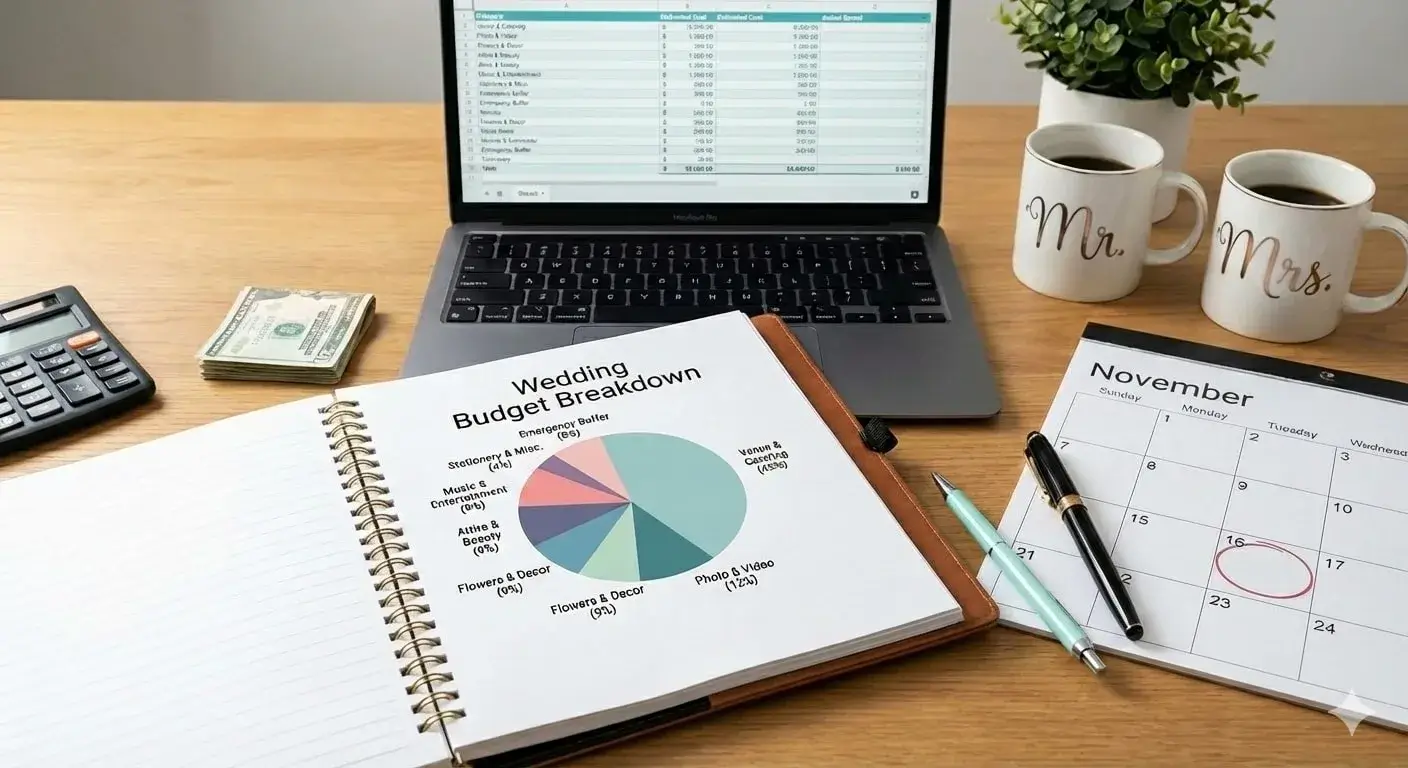
| A ceiling for the outfit as a whole | Alterations, underpinnings, shoes and jewellery come on top of the dress price | The budget is spent on the dress before the rest is bought |
| Who is coming along | Every extra opinion lengthens the decision | You decide by majority instead of by your own judgement |
The ceiling is where most couples work sloppily. Set it not on the dress but on everything that ends up being worn together. As a rough orientation: alterations, underpinnings and shoes together often come to somewhere between a tenth and a third of the price of the dress. That range is experience rather than statistics, but it is more reliable than assuming the purchase pays for everything. What a wedding costs in total, and what share the outfit usually takes, is worked through in our article on the average cost of a wedding.
On company: two people are good, four are too many. The reason is not taste but small-sample statistics. The more opinions are in the room, the more likely it is that every dress attracts a dissenting voice, and what survives at the end is the dress nobody objected to. That is rarely the same as the dress you wanted.
The most expensive dress is not the one with the highest price. It is the one whose delivery date no longer fits in your calendar.
2. Six routes to a dress, and what each costs in time and risk
How you buy is the real decision, because it fixes lead time, price bracket and your right to change your mind all at once. The price statements are deliberately relative, because they differ from market to market.
| Route | Lead time until you can wear it | Alterations | Price picture | Where the risk sits |
|---|---|---|---|---|
| Special order at a bridal boutique | roughly four to seven months of production plus alterations | almost always needed, usually done in house | the reference everything else is measured against | The delivery date belongs to the maker, not to the shop |
| Sample gown or trunk-show piece | walk out with it the same day | needed, sometimes substantial | clearly below the new price of the same model | There is exactly one size, and wear is priced in |
| Off the rack | immediately to a few weeks | usually hem and waist | a wide range, often well under a special order | Fit is luck, and advice is often not part of the deal |
| Made to measure or bespoke at an atelier | roughly four to six months with several fittings | built into the process | usually at the top end, because you pay for hours rather than a production run | You are buying a drawing, not a dress you have tried on |
| Pre-owned or resale | immediately | needed, and nobody stands behind the result | often well below the original new price | No returns, condition only as far as you check it yourself |
| Rental | reserve months ahead, collect shortly before | permitted only within limits | a fraction of the purchase price, but you own nothing afterwards | Damage and stains are charged to you |
Two routes are regularly misjudged, though not always in the same direction. The sample gown is the fastest way to a dress that would otherwise take months, and the only route where you take home the exact dress you tried on. Made to measure, meanwhile, is not automatically the most expensive option: it becomes that once you order elaborate fabrics and handwork. A plain dress in a good cloth that fits exactly often lands in the same bracket as a special order plus alterations. Rental is the one that varies most by market — mainstream in some places, a niche you will struggle to find in others — so check what exists near you before you rule it in or out.
In all six cases, settle the same three points before money moves: what exactly the price includes, until when you can walk away at no cost, and what happens if the agreed date is missed. The answers differ sharply, and they rarely arrive on the table by themselves.
3. How many appointments you need and how to space them
The search does not fail on too few fittings but on too many. After the twelfth dress the first ones blur, and the decision does not get better, only later.
- Two or three shops are enough. A fourth almost never produces a different outcome, but it does cost another Saturday.
- Two appointments a day at the most. Trying on is physically tiring, and the second afternoon slot reliably gets an unfair verdict.
- Five to eight dresses per appointment. More does not fit into ninety minutes, and more is not what you will remember either.
- The first appointment is a sorting appointment. That is where you find out which shapes work on you. Buy there only if you are genuinely sure.
- Do not book too early. Start eighteen months out and you try on collections that will no longer exist by the wedding.
Book by phone and give the wedding date, the price bracket and the number of people coming with you. Some shops work by appointment only, others cap the number of guests, and many carry sample gowns in only one or two sizes. Settling that in advance is not a formality: it decides whether you can get into the dresses you came to see at all. How to prepare a single appointment so that it earns its ninety minutes has its own article on preparing for the fitting.
Leave at least one night between appointments. What still looks convincing on the evening after a fitting often looks different in the photo the next morning, and that gap is the cheapest test you have.
Related articles
4. How to decide when every dress is beautiful
At the end there are usually two or three dresses in contention, and they all look good. From here more trying on does not help. What helps is a list of criteria you write down beforehand and tick off afterwards.
- It stays put without hands. Raise your arms, turn, walk a few steps. Anything that has to be tugged will be tugged all day.
- You can sit, eat and dance in it. Sit down in the shop, even if it feels odd. A dress that only works standing up costs you the party.
- It suits the place and the season. Ground, temperature and distances are part of the dress, not accessories to it.
- The total cost is known. Get alterations, underpinnings and accessories estimated in writing before you say yes.
- The delivery date sits safely before your own. With at least six weeks for alterations and a reserve on top for delays.
- It survives twenty-four hours. Look at the photos again the next day. What still holds then will still hold in ten years.
Just as important is a stopping rule you set in advance: if three appointments have produced nothing, it is usually not the selection that is wrong but a constraint that is too tight. Most often that is the budget, sometimes it is an idea about a shape that does not work on you. Change one constraint deliberately instead of booking a fourth appointment.
If you want to carry the estimated alteration costs into your overall budget without keeping a second spreadsheet, our article on how much to budget for a wedding dress sets out the items that belong in that line, so you can see straight away what raising it costs somewhere else.

5. What a yes sets in motion
Saying yes in the shop is not a purchase in the everyday sense. It is the start of a schedule. Six things happen afterwards, and all six belong in your calendar.
- Measurements and the size that gets ordered. What is ordered is the next size up, which is then taken in. Ordering larger is standard practice and not a mistake.
- The deposit. A part payment on ordering is usual. Get the balance and its due date in writing.
- A delivery date in writing. Not the month, a date, and with it the answer to what happens if it is missed.
- Alteration appointments. Expect two or three of them across several weeks. The last one ideally sits about two weeks before the wedding.
- Shoes and underpinnings before the first alteration. Without them nobody can set the hem, and a second hem costs twice.
- Collection and storage. Settle where the dress hangs until the wedding and who brings it to wherever you are getting ready.
Before you sign, ask a question that is rarely asked: under what conditions can you withdraw from the contract, and what does it cost. The answer depends on the country and on how you are buying. In most markets a purchase made in a shop carries no automatic right to cancel — the cancellation rights people know from online shopping generally attach to distance and off-premises sales, and for a garment made to your measurements even those tend to be limited. So ask what applies where you are buying rather than importing an assumption from e-commerce, and get the answer in writing.
Once the delivery date is fixed, it belongs in the same calendar as hair and make-up: if you are being styled, you need the dress not only in time for the wedding but for the trial. Which decisions come up there is set out in our article on wedding hair and make-up. And if you want the overview of every outfit question — suit, accessories and how the two of you coordinate — our article on outfit and styling has it.
Finding a dress is not a problem of taste but of order. Settle date, place, ceiling and company first, then choose how you buy, and from then on you only try on dresses you can actually get. Everything after that is a list of six criteria and the willingness to take them seriously when two dresses are equally beautiful.
The next sensible step is a look at the calendar: count back from the wedding date to see how much time is left for production and alterations. That number decides which of the six routes are still open to you.
All things wedding
Plan your wedding
Bring your tasks, costs and guests together for the day.
Invitations and wording
Find the right words for your wedding invitation.
As a wedding guest
Write a personal message and choose a thoughtful gift.
Wedding anniversaries
Explore anniversary names, traditions and celebration ideas.
Planning your dream wedding?
Create your own wedding website in minutes – with RSVP function, photo gallery, and more.