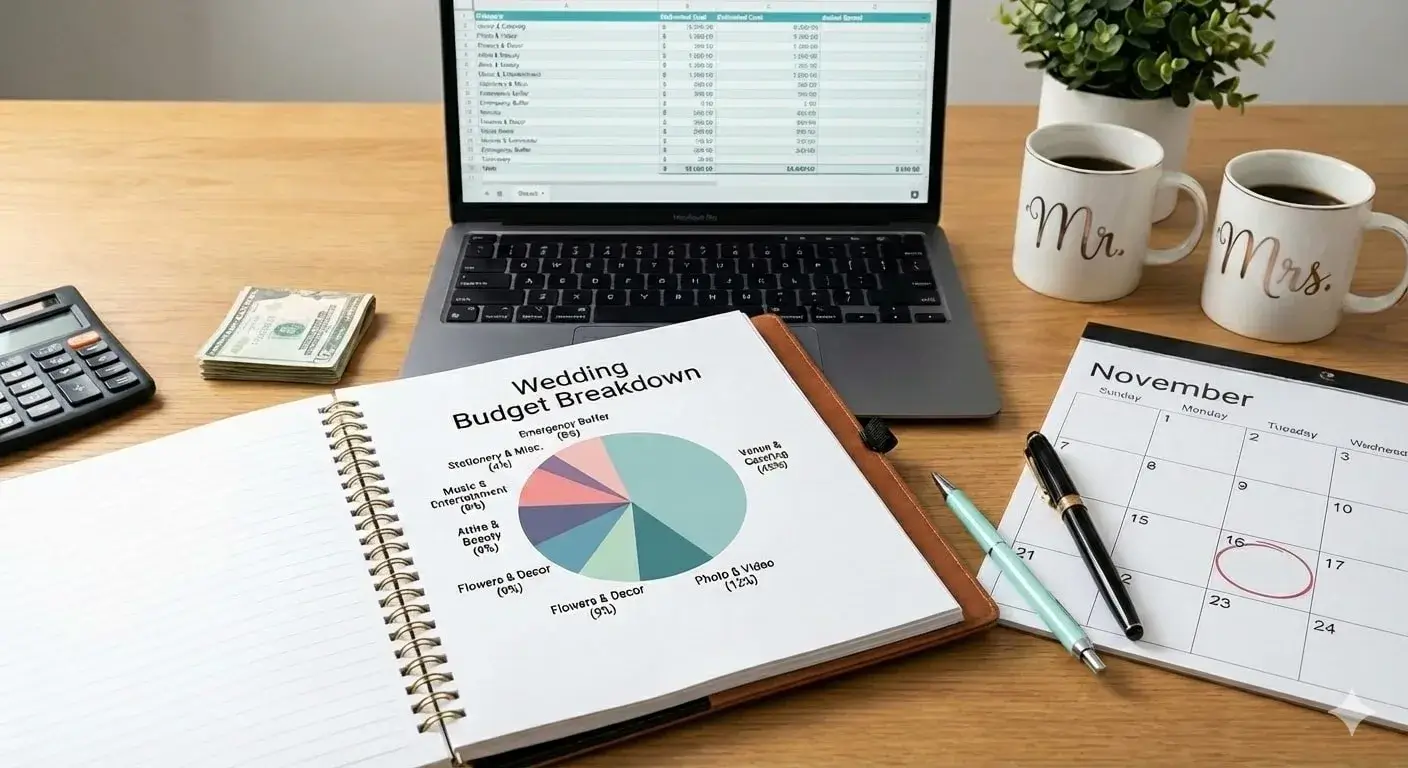
Budget per household, not per guest. Six items go into the sum: the invitation, the reply card, the details card, envelopes, postage and design. Postage is the only fixed figure, and these are US rates: 82 cents for a USPS Forever stamp, plus a 49-cent non-machinable surcharge the moment the envelope is square, and a second stamp on every reply card.
Stationery quotes are hard to compare because every printer bundles differently: one price includes envelopes, another does not, a third quotes a unit price that only applies from two hundred pieces upwards.
That is why "what does stationery cost" cannot be answered without doing your own arithmetic. What can be answered is the shape of the sum, which items move it most, and where the fixed figures sit.
This article builds the calculation, names the four decisions that drive the price, works an example through, and identifies where cutting actually saves money rather than just looking frugal.
1. The six line items
Every stationery budget is made of the same components. If a quote does not mention one, it is not missing — it is simply not included.
- Main invitation: the print itself, driven by size, paper and method.
- Reply card: smaller, but a separate print run, and often with its own envelope.
- Details card: directions, accommodation, running order. One sheet, but it adds weight.
- Envelopes: for the mailing and, where used, the return; coloured or lined envelopes cost noticeably more.
- Postage: outbound and, with a stamped reply card, inbound.
- Design: a template from a shop, a customised template, or original artwork by a designer.
The last two are the most often forgotten and the most variable. An originally designed suite costs a multiple of a customised template — which can be entirely justified, but it should be a deliberate decision rather than a discovery at the invoice stage.
Add about ten per cent reserve on everything printed. Reorders almost always repeat the full set-up cost and rarely match the original colour exactly.
There is a seventh line item that appears in no quote and costs anyway: your time. Reviewing artwork, proofing, stuffing, addressing, stamping and posting sixty invitations is a good day's work for two people. That is not an argument against paper, but it belongs in the sum when you are deciding whether an assembly service is worth its fee.
The unit price of the card is rarely the biggest line. The enclosures, the weight and the postage are.
2. What actually drives the price
Four decisions move the total more than everything else combined.
| Decision | Effect on price | Effect on the result |
|---|---|---|
| Printing method | The biggest lever: digital is the baseline; letterpress and foil sit at a multiple of it. | Clearly felt in the hand, barely visible in a photograph. |
| Number of enclosures | Each enclosure is a separate print run and extra weight. | More information, but past three sheets the envelope gets confusing. |
| Size and shape | Sets your postage band; a square envelope attracts the non-machinable surcharge, and every extra ounce steps the rate up again. | Heavy paper feels considered; an unusual shape stands out. |
| Quantity | Unit price falls sharply with the run, because set-up is paid once. | None — except that ordering too few is expensive. |
The shape row is the one that surprises people. A square envelope is non-machinable and carries a 49-cent surcharge on top of the ordinary rate, which takes a one-ounce invitation from 82 cents to $1.31. Rigid pieces, wax seals, ribbons and clasps trigger the same surcharge, because all of them stop the envelope running through the sorting machine.
Weight steps in the same blunt way. Postage is charged by the whole ounce, so a suite weighing an ounce and a fraction pays the full additional-ounce rate — the last three grams of a design cost as much as the first twenty-eight.
At eighty households the surcharge alone is $39, and that difference is entirely down to the shape and thickness of the envelope — not to anything printed on the card.
3. Working the sum
Count households, not guests: a couple receives one invitation, so does a family. A hundred guests usually means fifty to sixty mailings.
Take sixty households. Each mailing contains a main card, a reply card, one details card, an outer envelope and a small return envelope, and carries postage out and back. Even before a single sheet is printed, the postage alone is sixty stamps outbound and sixty inbound — around $98 at US Forever-stamp rates.
Push the envelope into a higher band and that number moves sharply. The square-envelope surcharge alone adds 49 cents per mailing, or $29 across sixty, and it lands twice over if the reply envelope is square as well. A suite that tips past one ounce adds the additional-ounce rate on top of that, on every single mailing.
Printing costs themselves vary so much by supplier, quantity and method that any number quoted here would mislead. The sum becomes reliable only when you put two or three quotes side by side for the same quantity, the same size and the same number of enclosures. Anything else compares different things.
Watch the quantity breaks while you are at it. Price lists typically step at 50, 100 and 200, and the step down is often larger than the cost of ten extra cards. If you need 92 mailings, look at the price for 100 — the spare cards are cheaper than a reorder.
Related articles
4. Where cutting actually helps
Combine the enclosures. Directions, accommodation, dress code and gift wording fit on one sheet. That saves a print run and often a postage band.
Take replies online. Dropping the reply card and its stamped return envelope removes the entire inbound postage block — at sixty households, the single largest lever available. Print ten cards for the guests who would rather answer on paper instead of sixty.
Keep the shape rectangular. If a square is a preference rather than a design principle, switching to a standard rectangle removes the surcharge entirely. It is the cheapest saving available because it changes almost nothing about the result.
Lighter paper for enclosures. 120 gsm rather than 250 for a sheet that only carries information. The main card stays substantial and the mailing gets lighter.
Stuff and address them yourselves. Assembly services charge meaningfully at small quantities, and the work is one manageable evening for two people.
Fewer pieces overall. Printing only the invitation and the thank-you card, and using boards and signs on the day, halves the whole budget. A hand-lettered board at the entrance replaces the table plan and the signage at once.
Where you should not cut: the reserve, the proofing round, and the stamp on the return envelope. All three cost little and prevent the one outcome that is genuinely expensive.
5. Making quotes comparable
Ask every supplier for the same five specifications and the prices become comparable: quantity, size in millimetres, paper weight in grams per square metre, number of enclosures, and whether envelopes are included.
Then clarify three things that are rarely in the price: how many rounds of amendments are included, what an extra round costs, and how long your chosen paper will remain available. That last one decides whether you can get menu and place cards on the same stock months later.
Order a printed sample before you commit, if the supplier offers one. Paper cannot be judged on a screen, and a sample in the hand answers the weight question in two seconds.
Set stationery's share of the overall wedding budget before you start rather than after. A realistic figure makes the choices easier, because it puts method, size and enclosures on a common footing. Without one, the total grows line by line without any single decision having been wrong.
And weigh a fully assembled sample envelope before you finalise the size. It is the only way to know which postage band you are in — and it is the number the whole calculation turns on.
Six line items, counted per household, postage as the one fixed figure, and three like-for-like quotes: that produces a number you can rely on. The next step is the kitchen scale — assemble one sample envelope completely and weigh it before you settle on a size.
All things wedding
Plan your wedding
Bring your tasks, costs and guests together for the day.
Invitations and wording
Find the right words for your wedding invitation.
As a wedding guest
Write a personal message and choose a thoughtful gift.
Wedding anniversaries
Explore anniversary names, traditions and celebration ideas.
Planning your dream wedding?
Create your own wedding website in minutes – with RSVP function, photo gallery, and more.