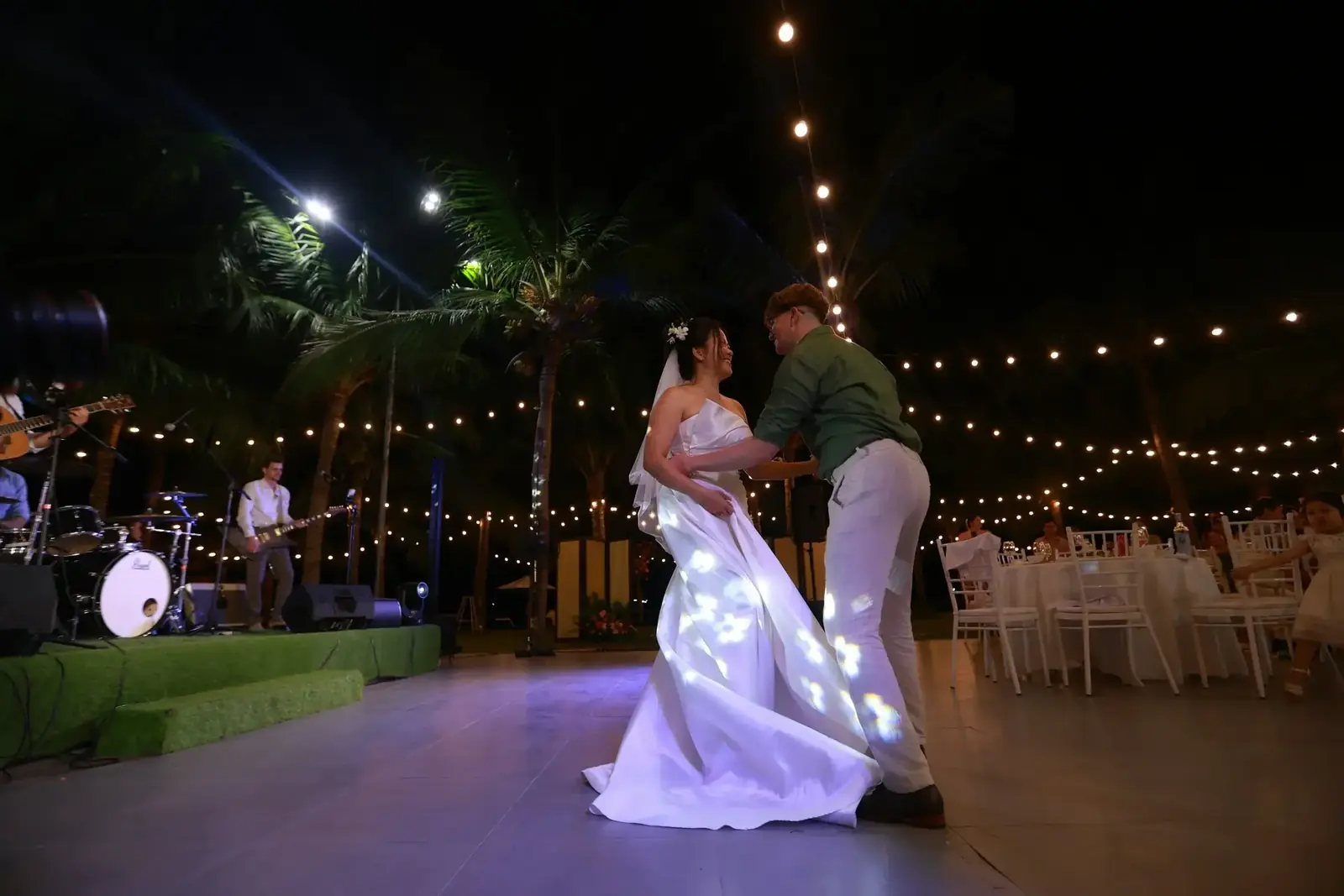
A toast is the raising of a glass at the end of a short speech. Stand, say who you are, speak for two or three minutes, then name the people being toasted and ask everyone to raise their glasses. Guests stand for the toast, raise, sip and sit. Nobody toasts themselves.
Toasts are the part of a wedding where guests are most likely to feel exposed, both the person holding the microphone and the room, because almost nobody is told what they are supposed to do.
This article covers the mechanics rather than the writing: who traditionally proposes which toast, the order they come in, what a guest does while a toast is being made, and the awkward cases. That includes being asked to say a few words with no warning, and toasting when you do not drink.
1. Who proposes what, and in what order
The British and American orders differ slightly, and both are conventions rather than requirements.
| Speaker | Traditionally toasts | Position |
|---|---|---|
| Father of the bride, or a parent | The couple | First, after the meal |
| The groom, or one of the couple | The bridesmaids, and thanks the hosts | Second |
| Best man | The couple, again | Third |
| Maid of honour | The couple | Common in the US, growing in the UK |
| Anyone else invited to speak | Whoever they choose | Wherever the couple place them |
Two things about this list. It is heavily gendered by inheritance and almost nobody follows it exactly any more; both partners speaking, a mother speaking and a friend speaking instead of a best man are all now unremarkable.
And the total matters more than the order. Three speeches of five minutes is a good stretch of a wedding. Six speeches of ten is sixty minutes of sitting still after a large meal, and the room will not survive it. If more people want to speak than the day can hold, the rehearsal dinner or the welcome drinks is the traditional overflow.
A toast is not a speech with a drink at the end. It is a sentence, and the speech is what earns it.
2. The mechanics of the toast itself
The toast is the last twenty seconds, and it has a fixed shape. Everything before it is the speech.
- Stand and get attention. Do not tap glass with silverware on a table of a hundred and fifty; ask the band or the toastmaster to announce you.
- Say who you are. Half the room does not know. One sentence: I am Tom, I have known Anna since we were eleven.
- Speak. Two to five minutes. Shorter is nearly always better.
- Signal the turn. A plain phrase works best: so please join me, or would you all stand.
- Name the toast. To the bride and groom. To Anna and Tom. To absent friends.
- Raise, pause, drink. Then sit down. Sitting down promptly is a skill.
Two practical points. Make sure everyone has something in their glass before you start, which means telling whoever is pouring; a toast where a third of the room is holding an empty glass falls flat. And hold the glass at chest height rather than above your head, which is the difference between a toast and a cheer.
If there is a microphone, use it even if you think you do not need it. Rooms with high ceilings and soft furnishings absorb an unamplified voice within about four metres.
3. What guests do
Nobody explains this, so people copy whoever moves first. The conventions are simple.
- Stand if asked, stay seated if not. Follow the person proposing the toast. If half the room stands and half does not, stand.
- Raise your glass, do not drain it. A sip is the whole gesture.
- Do not toast yourself. If you are one of the people being toasted, sit, smile and do not raise your glass or drink. This is the rule most often broken and the easiest to remember.
- Do not clink around a large table. It works with four people and turns into a five-minute intermission with twelve.
- Put your phone down. A room of raised phones is what the photographs will show.
Timing matters more than any of that. Guests should be seated and quiet before the first speaker starts, which is the job of whoever is running the room rather than the speaker. A speech begun over the noise of forty conversations never recovers.
One more, for the person being toasted: a short thank you afterwards, from your seat or standing, is gracious and does not need to be a speech. Two sentences is plenty.
Related articles
4. Toasting without alcohol
The tradition attaches to the glass, not to what is in it, and the idea that toasting with water or an empty glass brings bad luck is folklore with nothing behind it.
For guests, any drink works. Nobody at a wedding is auditing glasses, and the gesture is identical.
For hosts, a little planning removes the issue entirely:
- Make sure a non-alcoholic option is poured at the same moment as the sparkling wine, not fetched afterwards from a bar.
- Use the same glassware. A person holding a different glass is visibly marked out.
- Count on more than you expect. Drivers, pregnancy, medication, religious observance and simple preference add up, and a fifth of the room is not unusual.
This matters more than it looks. The toast is the one moment where every guest is asked to do the same thing at the same time, and it is the moment where anyone without a drink feels it most.
The same logic applies to speeches that are built around drinking as a running joke. They land differently in a room that includes people in recovery, and a wedding always does.
5. The awkward cases
Four situations come up often enough to have a standard answer.
You are asked with no warning. Stand up, keep it to sixty seconds, and use the simplest structure there is: how you know them, one specific thing about them together, and the toast. Do not attempt a joke you have not tested.
Someone significant has died. A toast to absent friends is the conventional form, usually placed early and kept to one or two sentences. Check with the couple first, because some would rather it were mentioned quietly and some would rather it were not mentioned at all.
The speaker overruns badly. This is the couple's problem to prevent, not the room's to fix. A stated limit given in advance, and a band told to start playing at a certain time, do the work without anybody being embarrassed.
A speech goes wrong. Someone says something that lands badly. The correct response from everybody else is to let it pass, keep the energy up and move to the next item. Reacting extends it; the room forgets faster than the speaker does.
If you are hosting, the single most useful thing you can do is tell every speaker the length, the running order and the time they are on, well in advance. That information usually sits with the rest of the day's schedule on your wedding website, which is also where a nervous speaker will go looking for it at half past eleven the night before.
Keep the speech short, make the toast a single named sentence, check the glasses are full before you start, and remember that nobody drinks to themselves. If you are hosting, decide the order and the time limits early and tell the speakers, because a room will forgive a poor speech far more easily than a long one.
All things wedding
Plan your wedding
Bring your tasks, costs and guests together for the day.
Invitations and wording
Find the right words for your wedding invitation.
As a wedding guest
Write a personal message and choose a thoughtful gift.
Wedding anniversaries
Explore anniversary names, traditions and celebration ideas.
Planning your dream wedding?
Create your own wedding website in minutes – with RSVP function, photo gallery, and more.